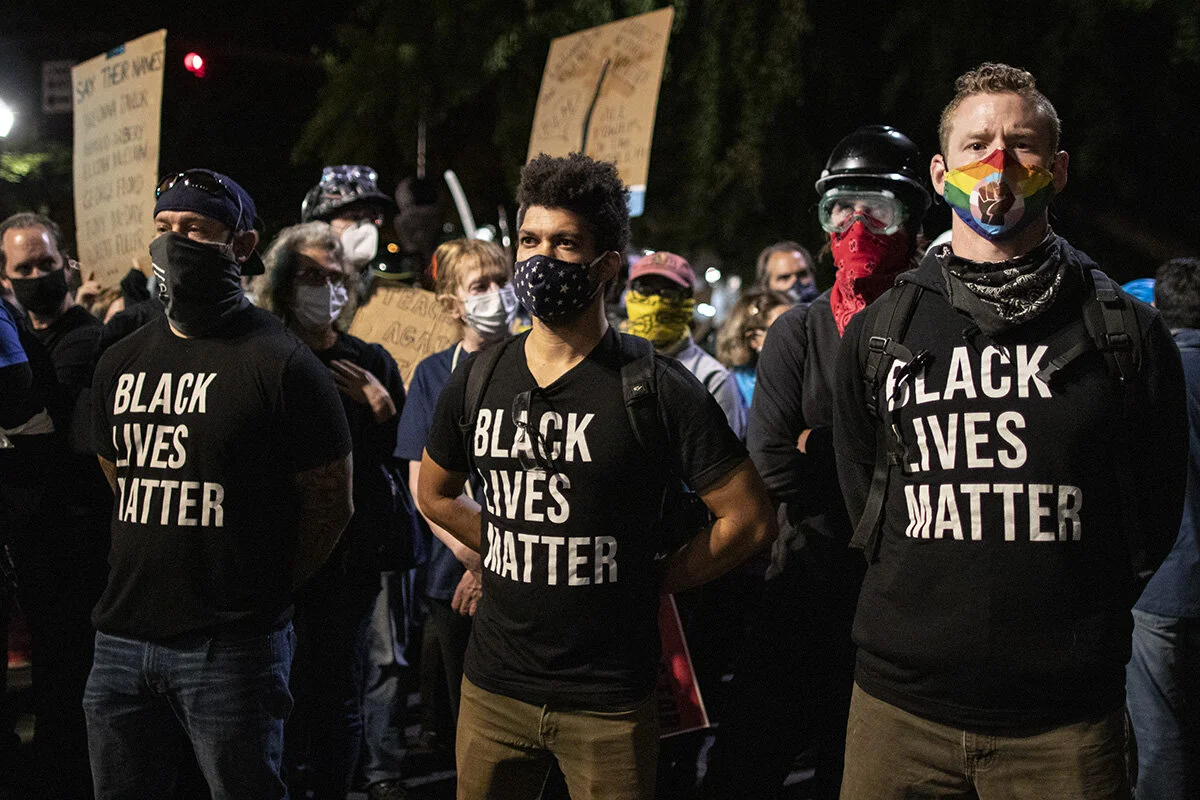
Protesters line up in front of the fence surrounding the federal courthouse. More than 3000 people showed up Friday, July 24, for the 58th consecutive night of protests at the federal courthouse and Multnomah County Justice Center in Portland, Oregon.
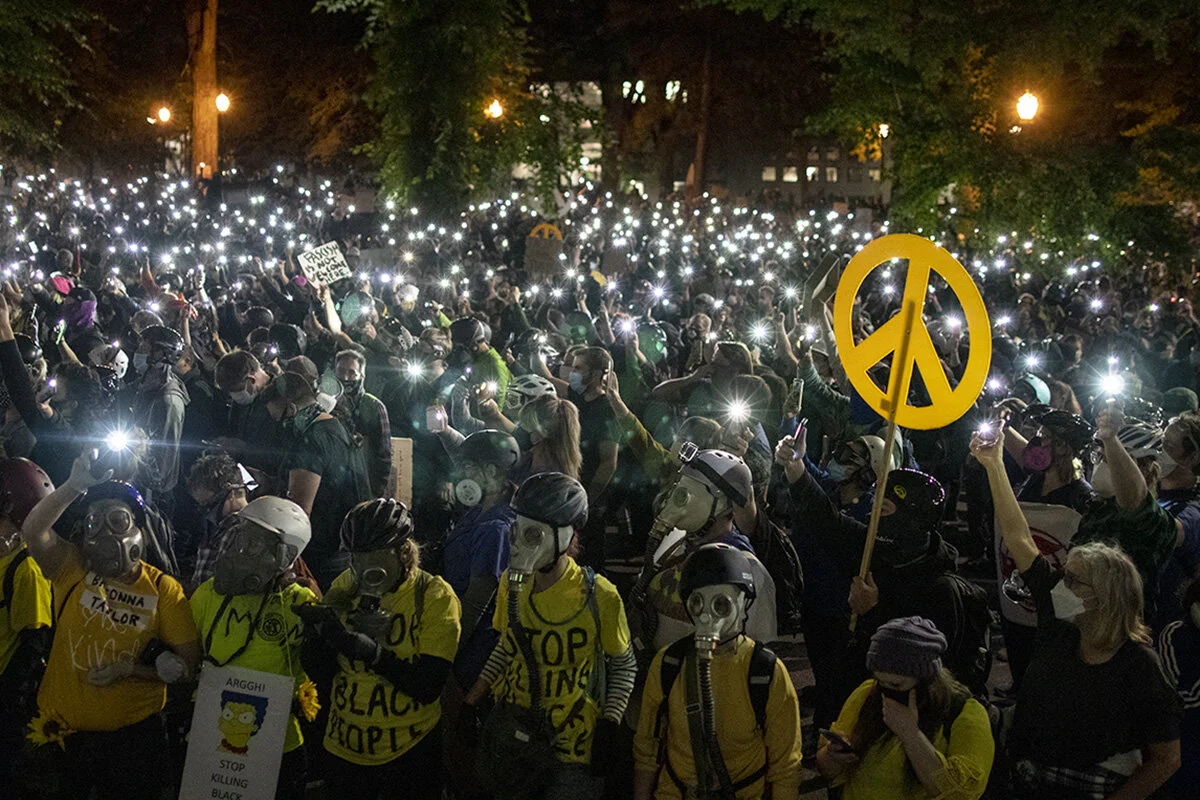
Protesters hold up their smartphone flashlights in front of the Multnomah County Justice Center. The night started with speeches and chants led by local activist leaders from Portland, but the protest intensified after federal police officers fired tear gas and other crowd control munitions at protesters who were trying to knock down a fence surrounding the courthouse.
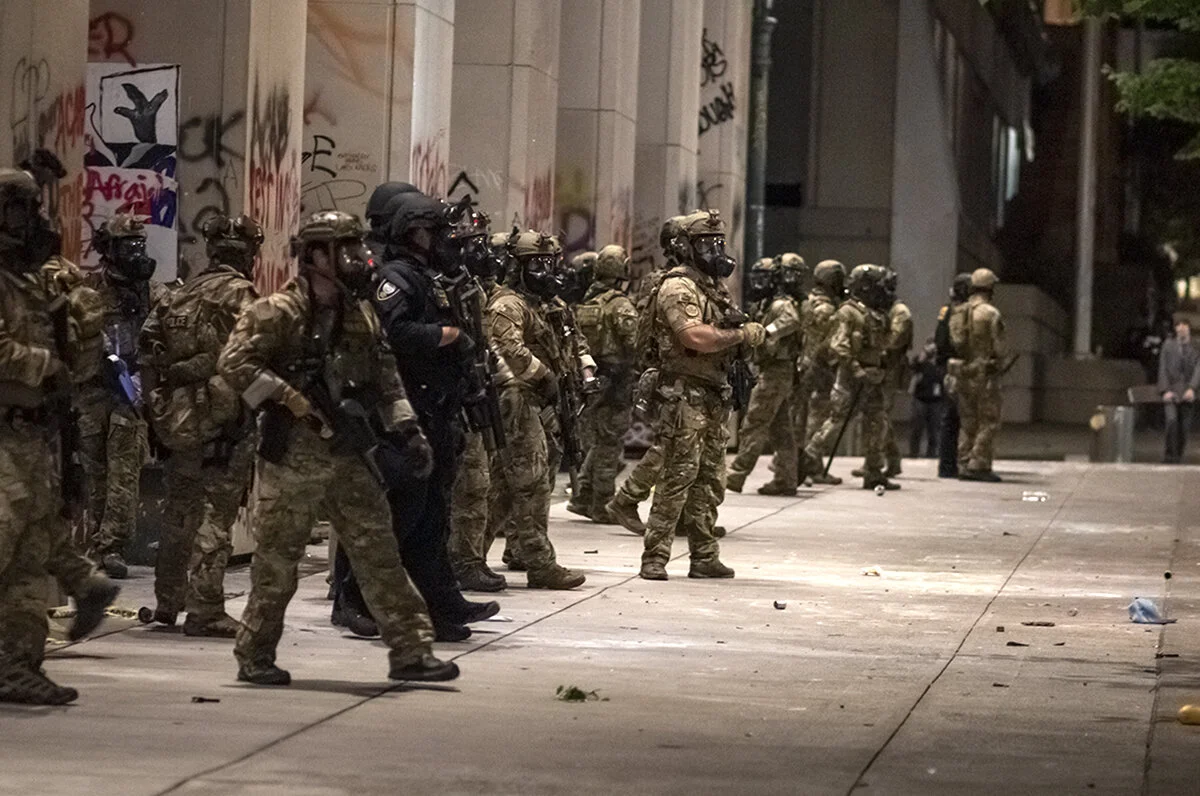
Police line up in front of protesters. Police fired pepper balls and roughly 20 cans of tear gas at protesters over the span of three hours on July 11, 2020, at the Multnomah County Justice Center in Portland, Oregon.
Protesters shout at police officers in front of the Multnomah County Justice Center. Police fired pepper balls and roughly 20 cans of tears gas at protesters over the span of three hours on July 11, 2020, at the Multnomah County Justice Center in Portland, Oregon.
A firework thrown by a protester explodes inside the fence line surrounding the federal courthouse. More than 3000 people showed up July 24, 2020, for the 58th consecutive night of protests at the federal courthouse and Multnomah County Justice Center in Portland, Oregon.
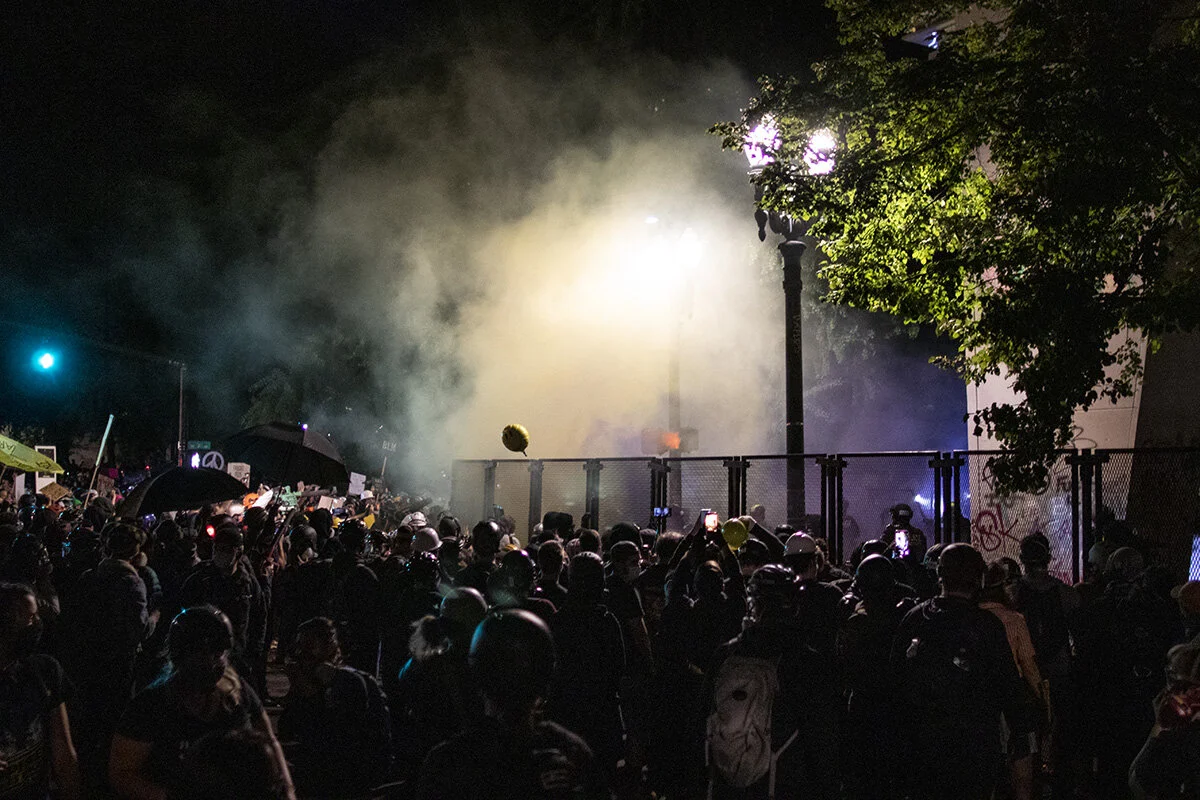
A cloud of tear gas drifts through the air in front of the courthouse. Police fired pepper balls and roughly 20 cans of tears gas at protesters over the span of three hours on July 11, 2020, at the Multnomah County Justice Center in Portland, Oregon.
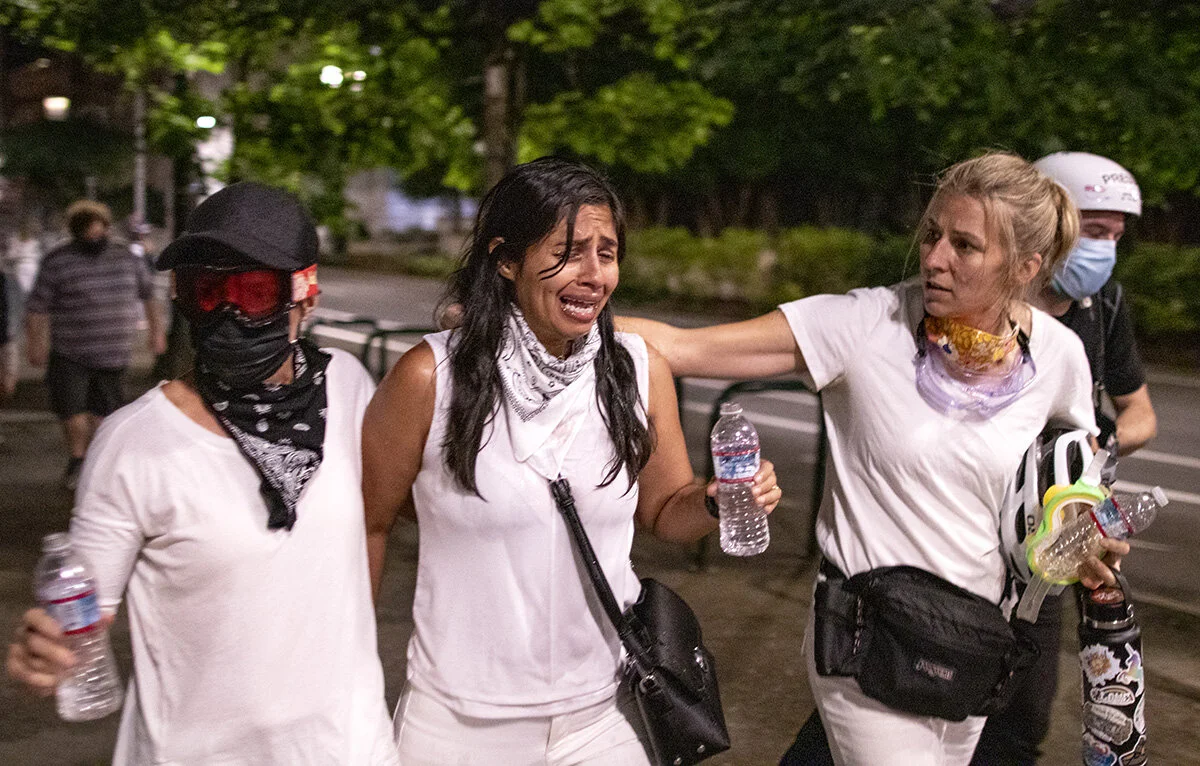
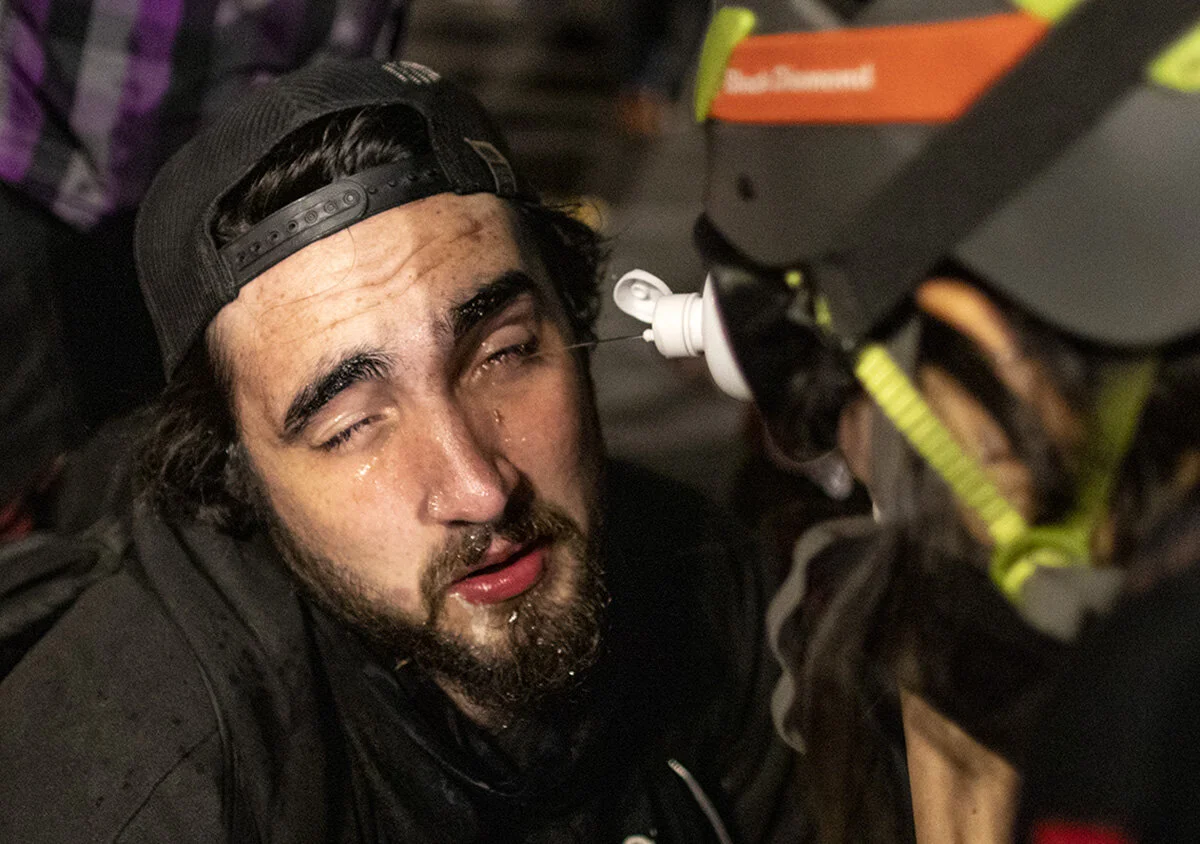
Juli Maus, left, and Erin Kelley, right, help another protester center, name withheld, who was exposed to tear gas fired by federal police officers. Roughly 500 people gathered on July 18, 2020, for the 52nd consecutive night of protests at the Multnomah County Justice Center in Portland, Oregon.
A volunteer medic helps wash tear gas out of Hunter Brooks's eyes. More than 3000 people showed up on July 24, 2020, for the 58th consecutive night of protests at the federal courthouse and Multnomah County Justice Center in Portland, Oregon.
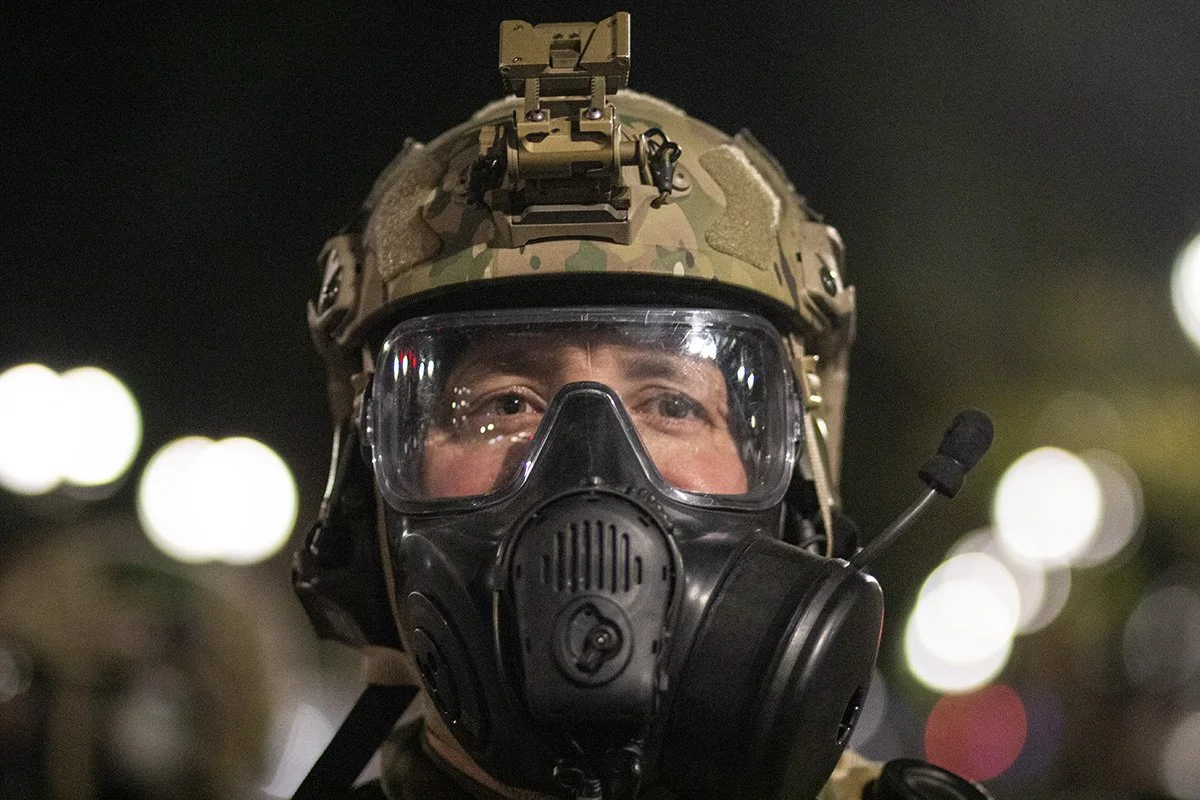
A federal police officer holds an assault rifle in front of protesters who were forced to run from tear gas and crowd control munitions. Approximately 3000 people gathered outside the Multnomah County Justice Center and the U.S. District Courthouse in downtown Portland, Oregon, for a demonstration against police brutality.
A federal police officer stands near Chapman Square in Portland, Oregon, after police fired tear gas at protesters.
A cloud of tear gas drifts toward protesters. Approximately 3000 protesters gathered outside the Multnomah County Justice Center and the U.S. District Courthouse in downtown Portland, Oregon, on July 25, 2020, for a demonstration against police brutality and racism.
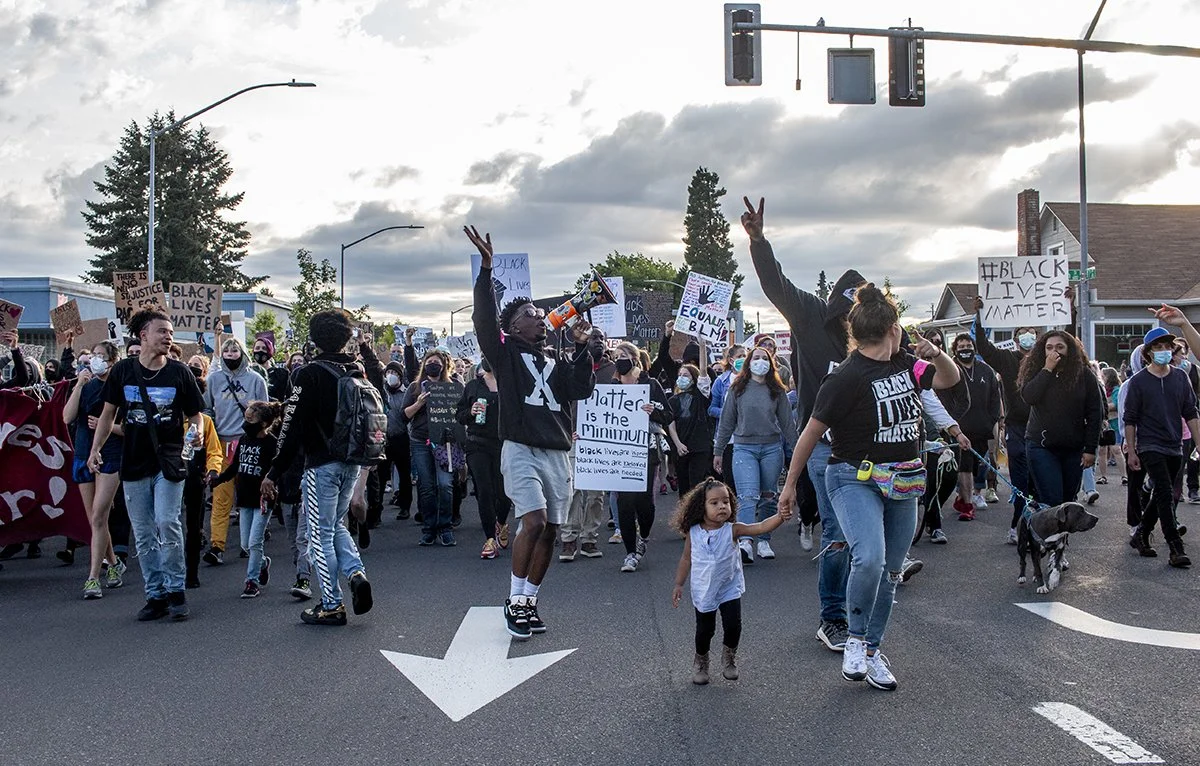
Protesters march down West Seventh Avenue in Eugene, Oregon, during a protest against police brutality. Hundreds of protesters marched from Monroe Park through the Whiteaker area of Eugene on June 11, 2020.
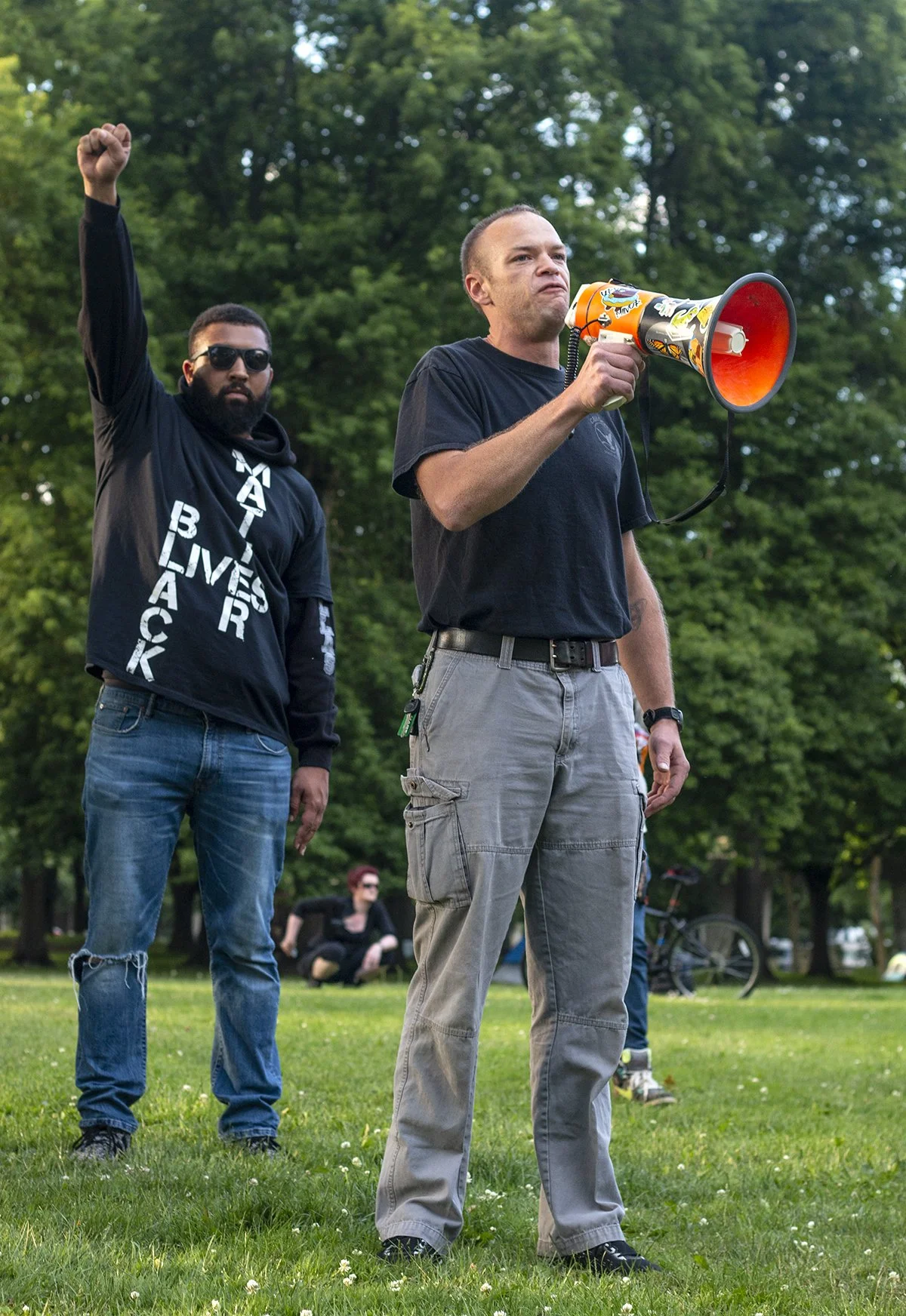
CAHOOTS Medic and Crisis Worker Manning Walker speaks into a megaphone. Hundreds of protesters marched from Monroe Park through the Whiteaker area of Eugene, Oregon, on Thursday, June 11.
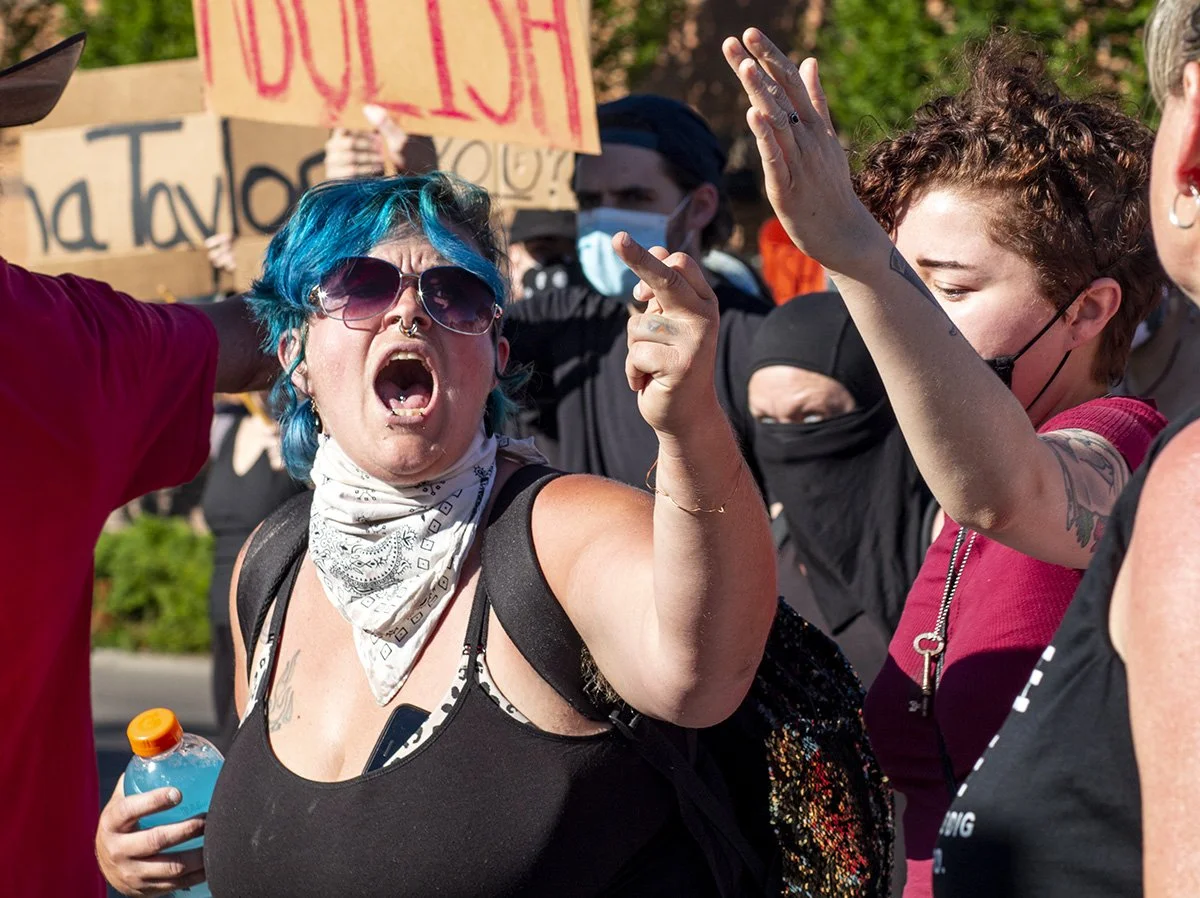
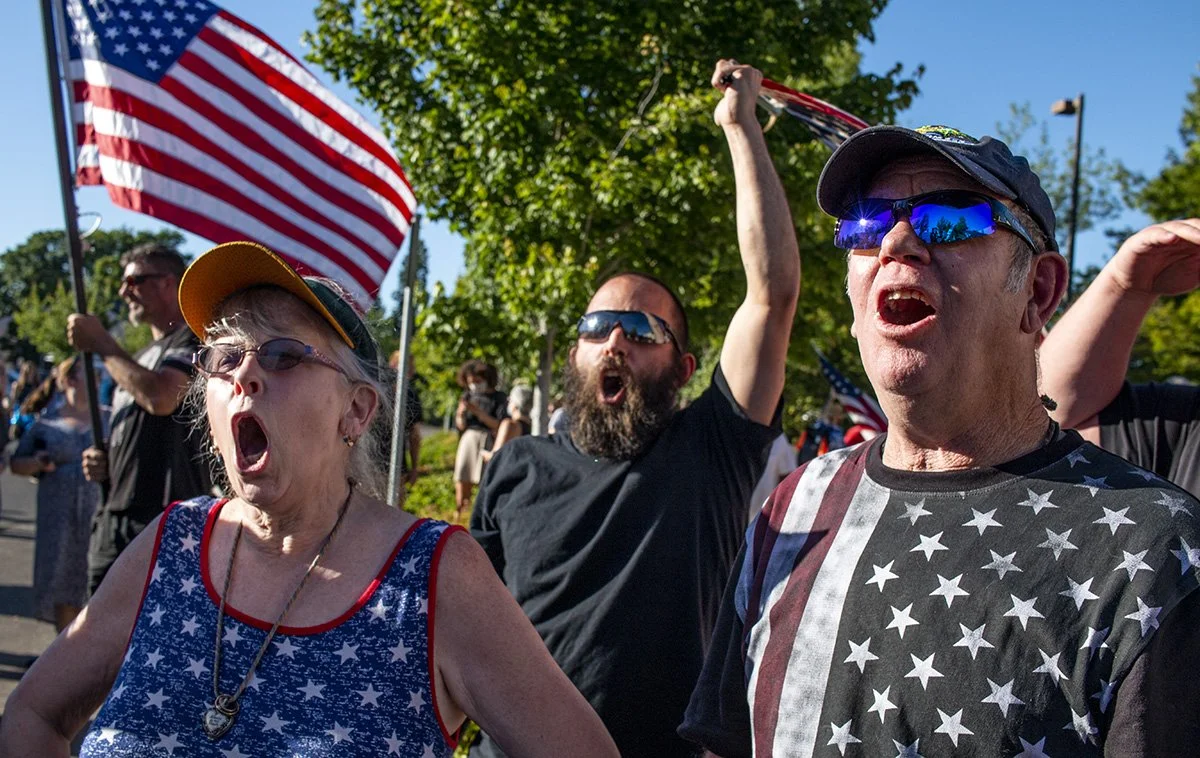
A man shouts and waves an American flag while recording with his phone recording. A pro-police rally was held in Springfield, Oregon, on June 22, 2020, and met by counter-protesters.
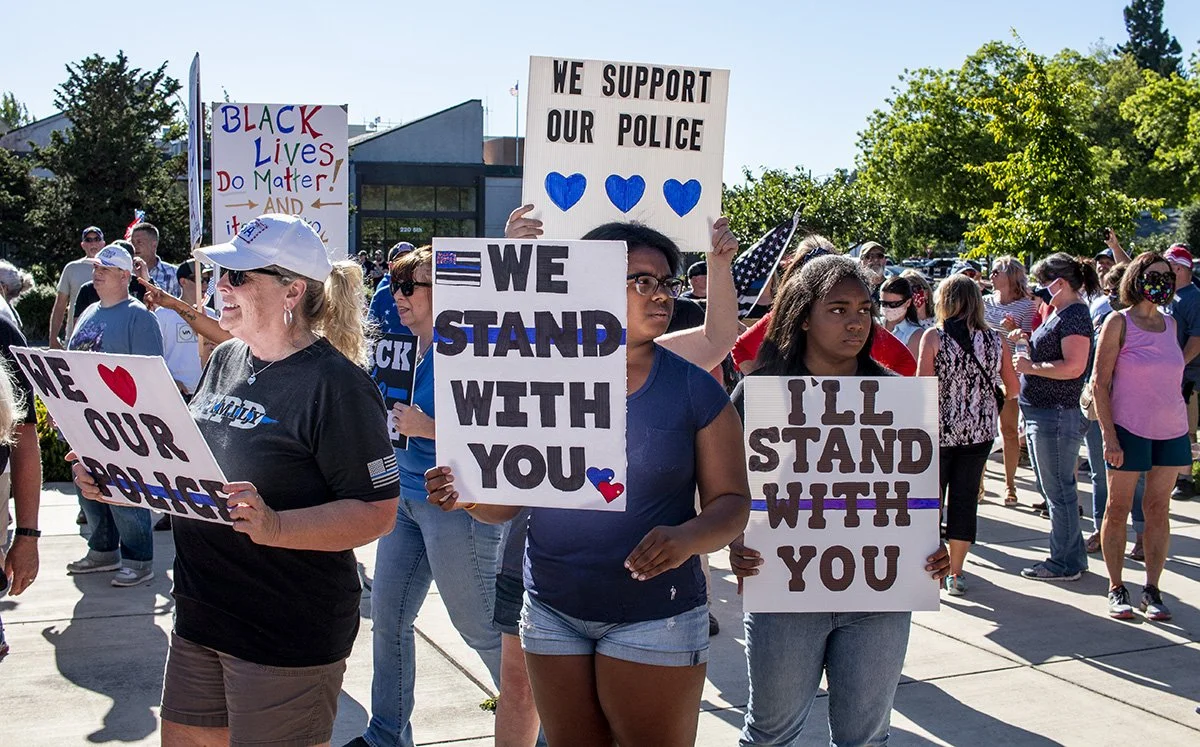
Pro-police demonstrators hold signs in front of the Springfield Public Library. A pro-police rally was held in Springfield, Oregon, on June 22, 2020, and met by counter-protesters.
A counter-protester yells and waves a middle finger at a pro-police rally attendee.
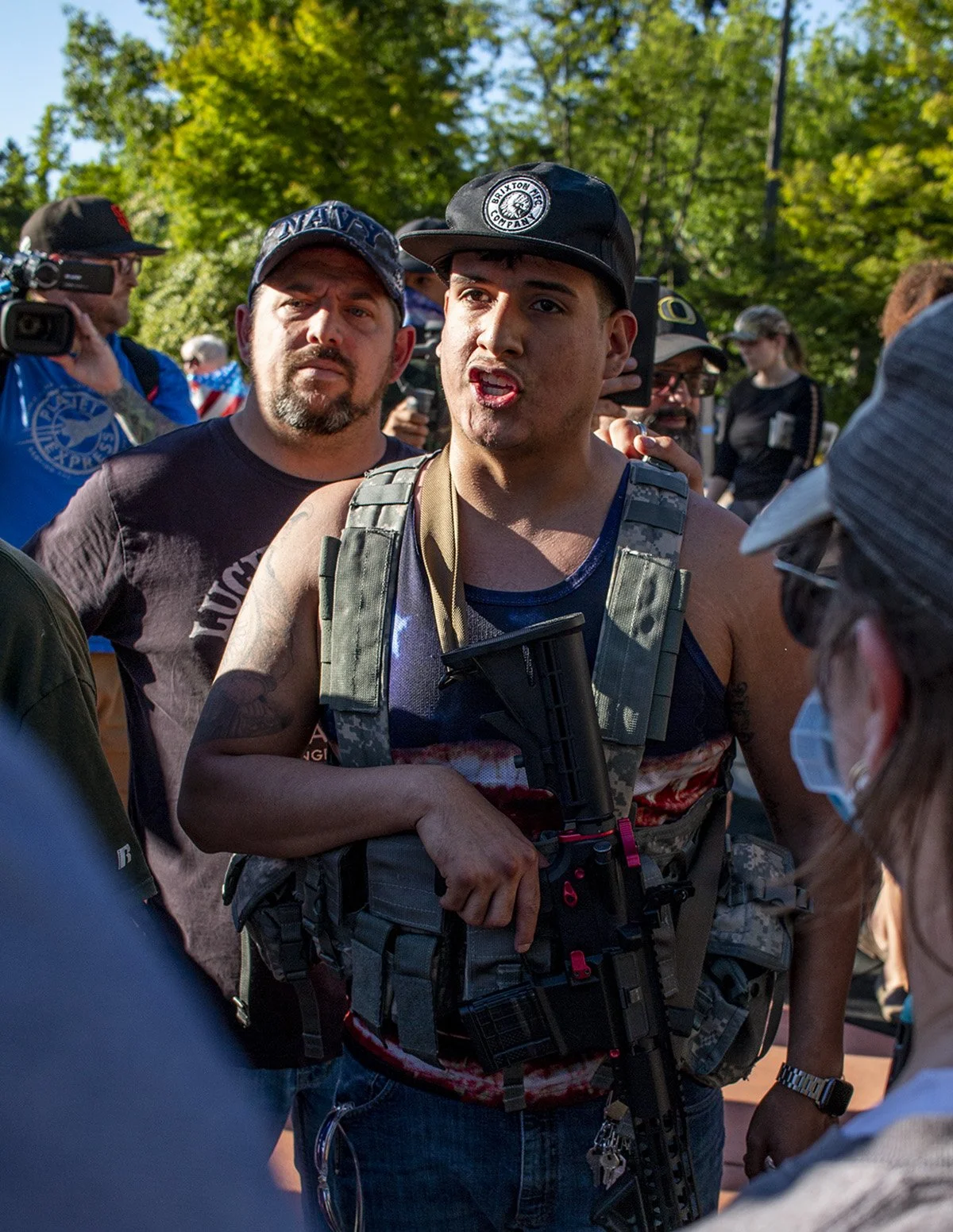
A pro-police rally attendee holds an assault rifle while he shouts at a counter-protester.
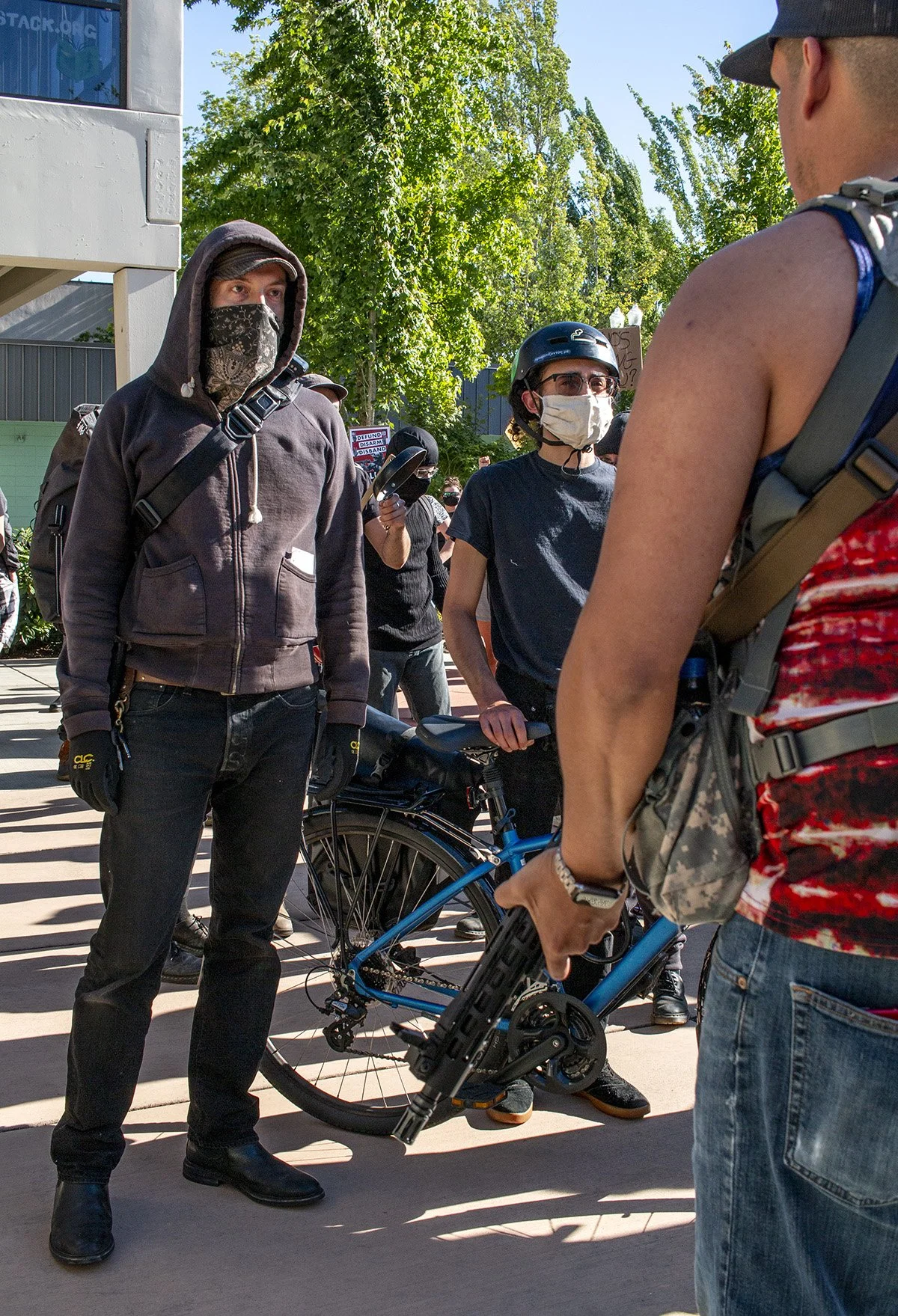
A counter-protester stares at a pro-police rally attendee holding an assault rifle.
Pro-police rally attendees shout "all lives matter" in response to counter-protesters shouting "Black lives matter."
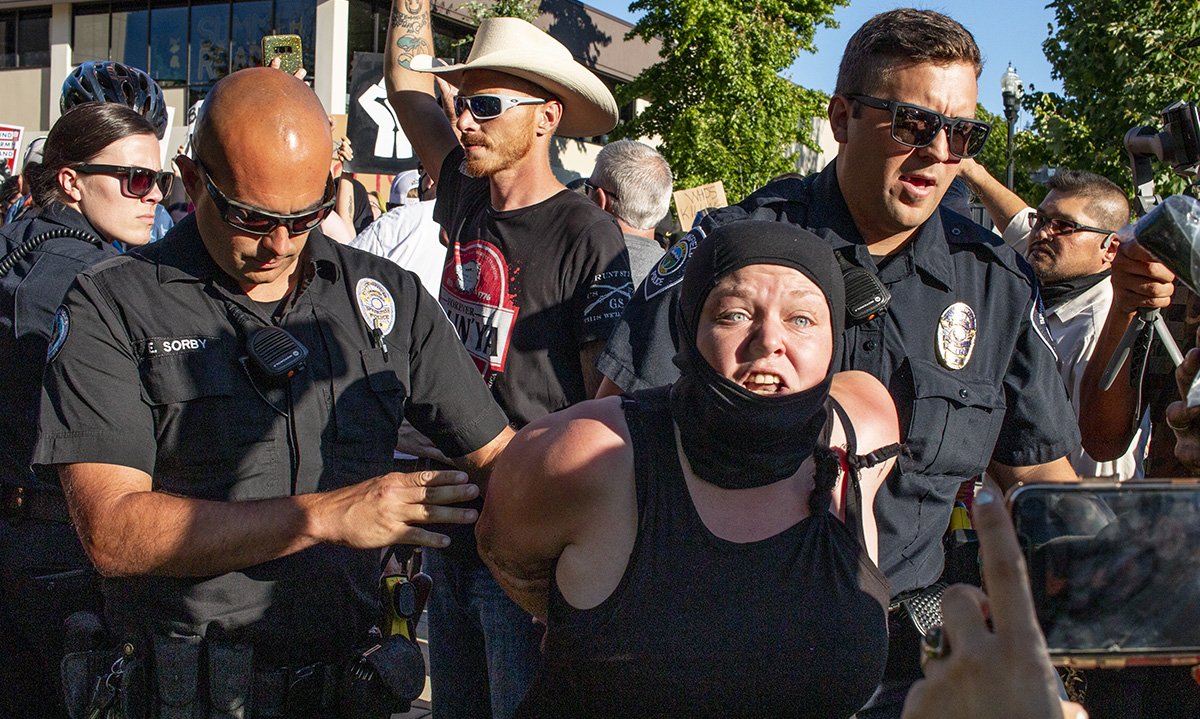
Springfield police officers detain a counter-protester during a pro-police rally on June 22, 2020, in Springfield, Oregon.
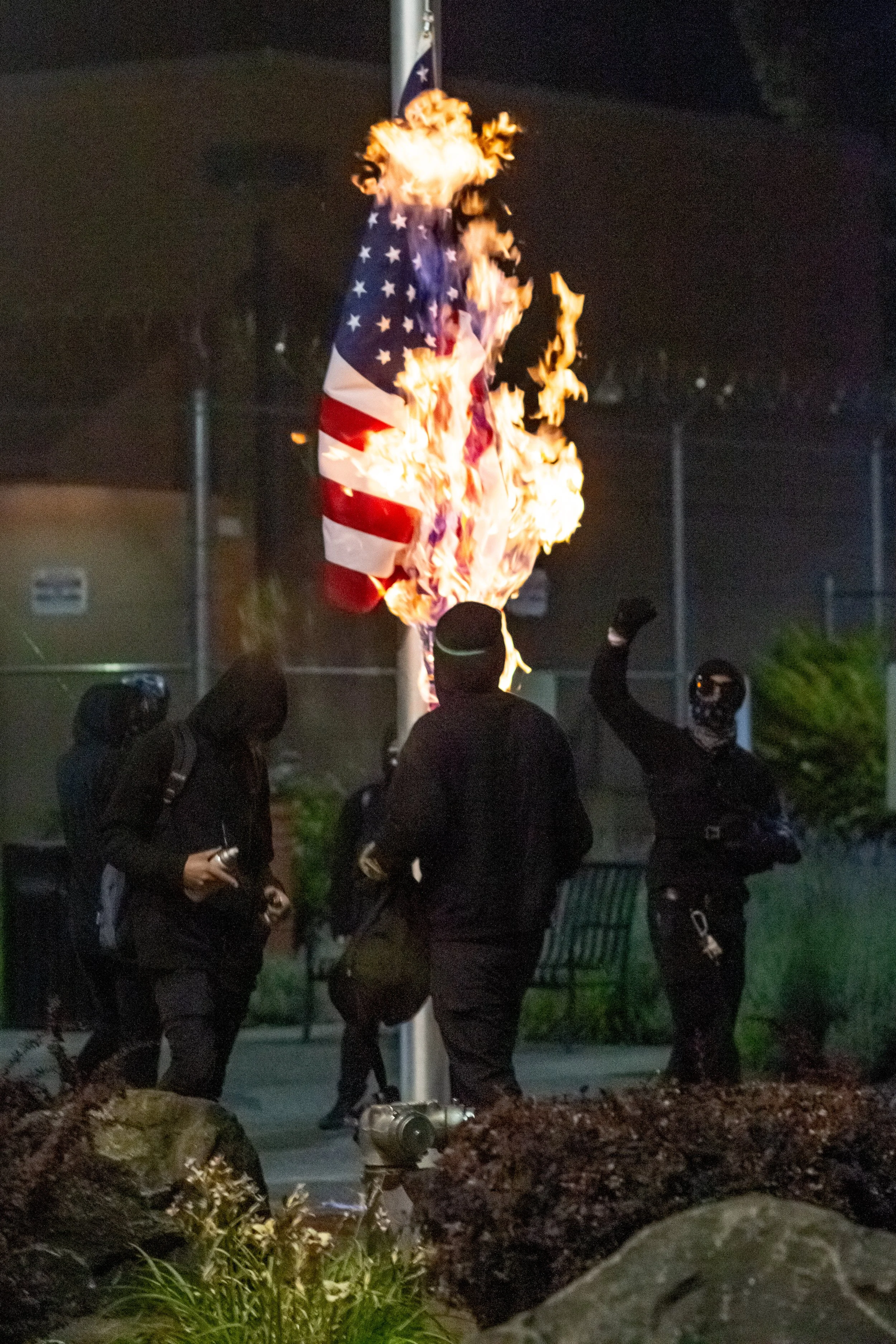
Protesters burn the American flag in front of the Lane County jail in Eugene, Oregon, on July 1, 2020.
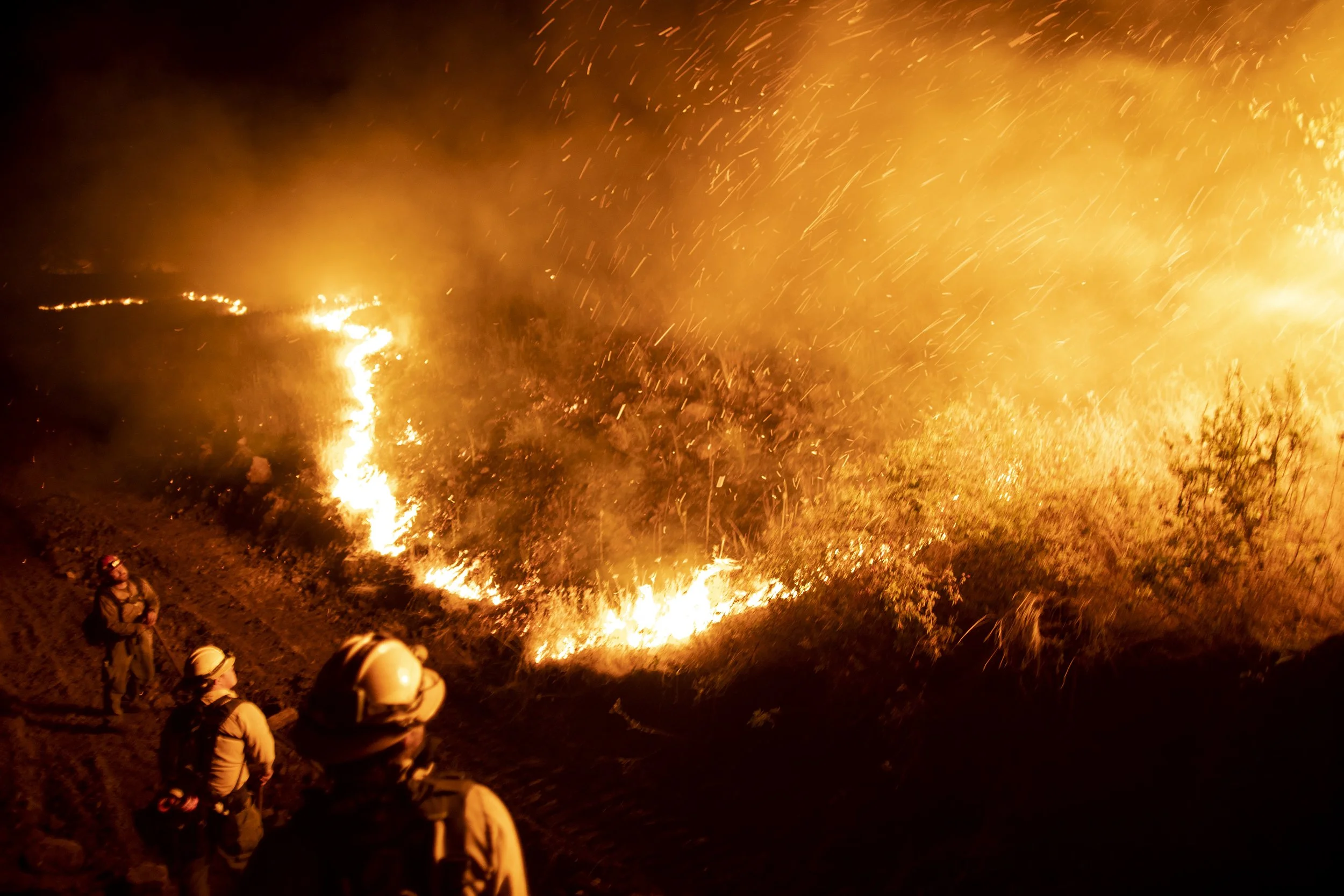
Wildland firefighters monitoring a fire as it approaches a containment line cut by a bulldozer at the Double Creek fire in eastern Oregon.
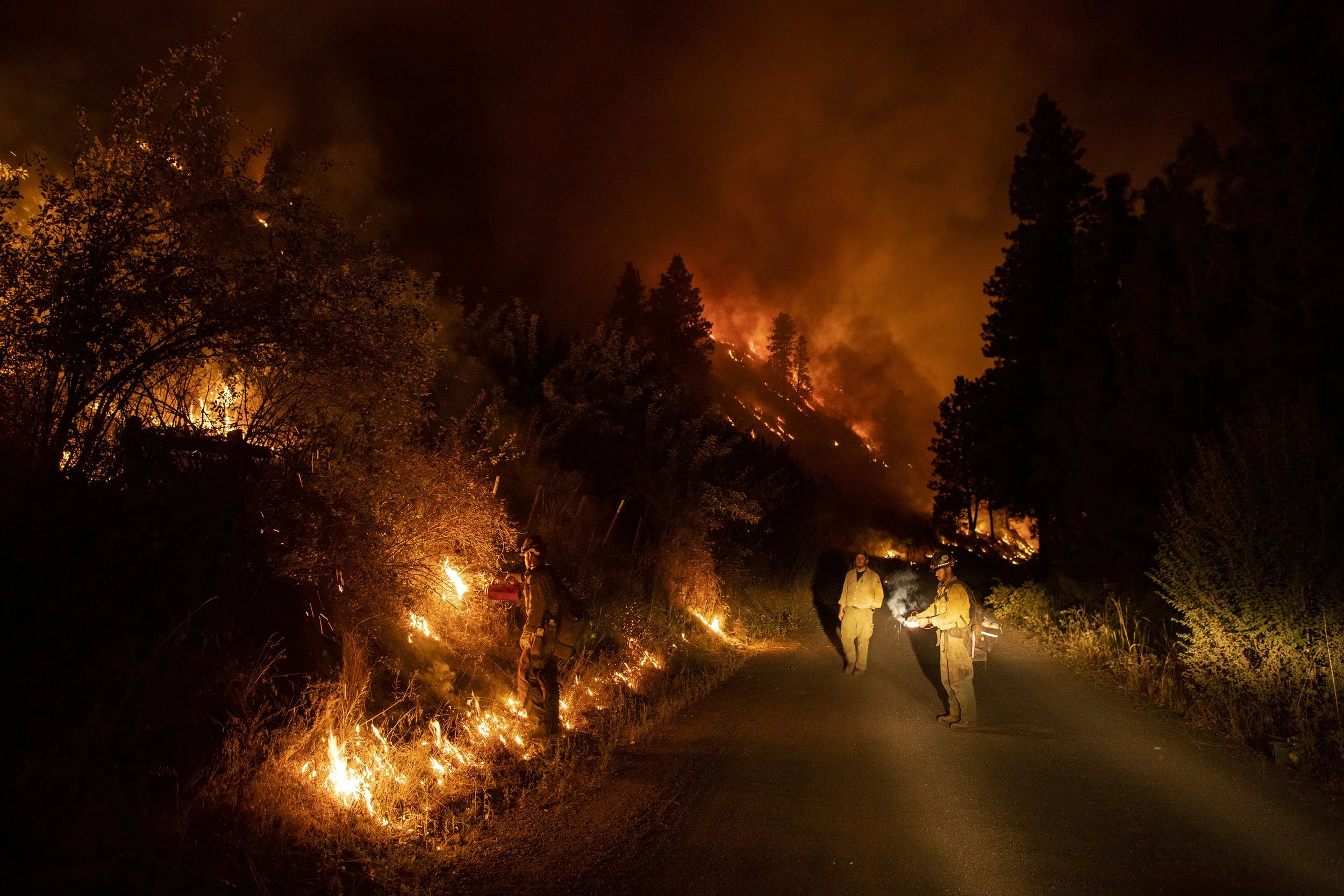
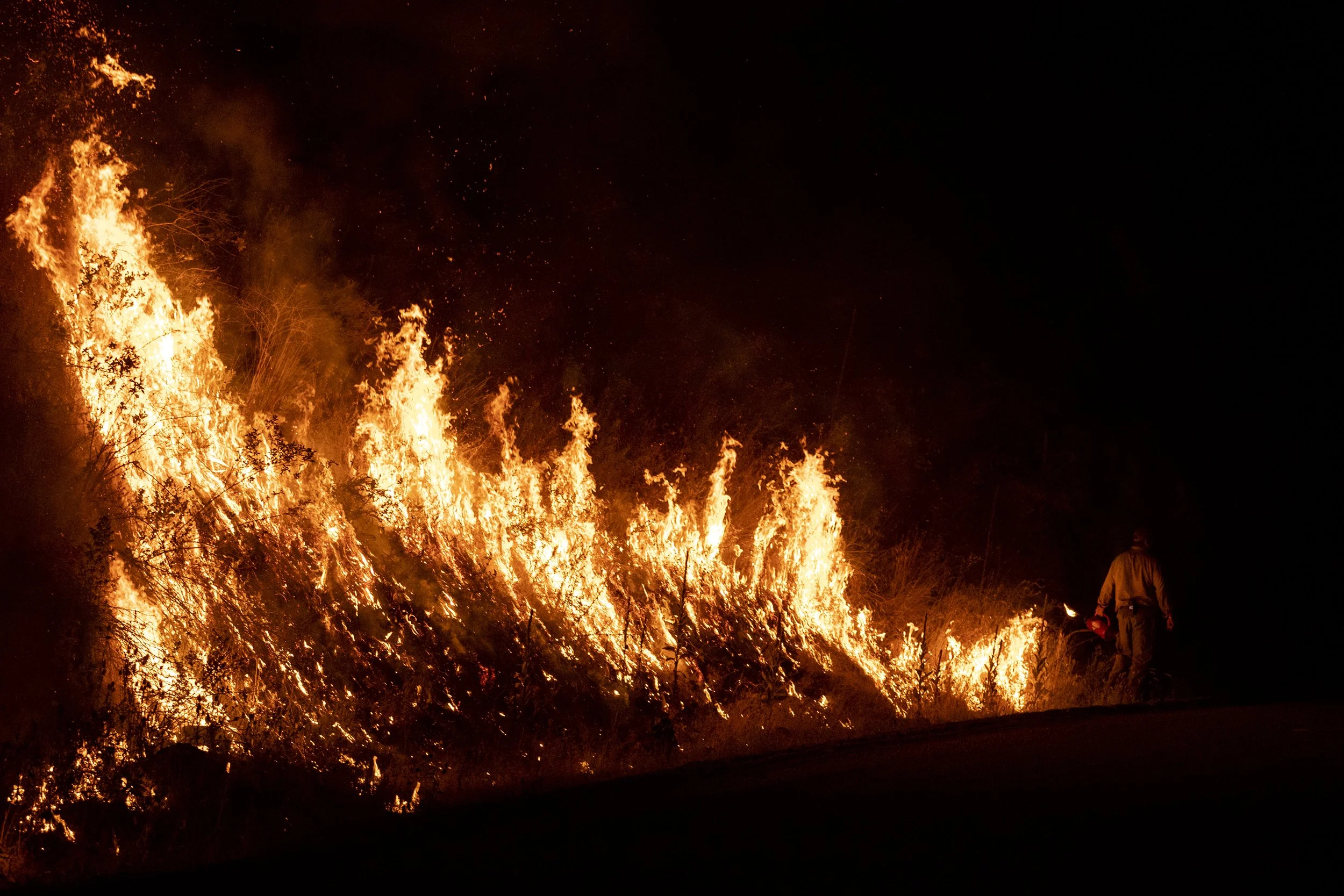
Members of a hotshot crew, an elite firefighting unit, conduct a backburn at the Double Creek fire. In a backburn, wildland firefighters intentionally burn vegetation ahead of the main body of a wildfire to create a buffer zone of burnt fuel that can slow or stop a fire’s spread.
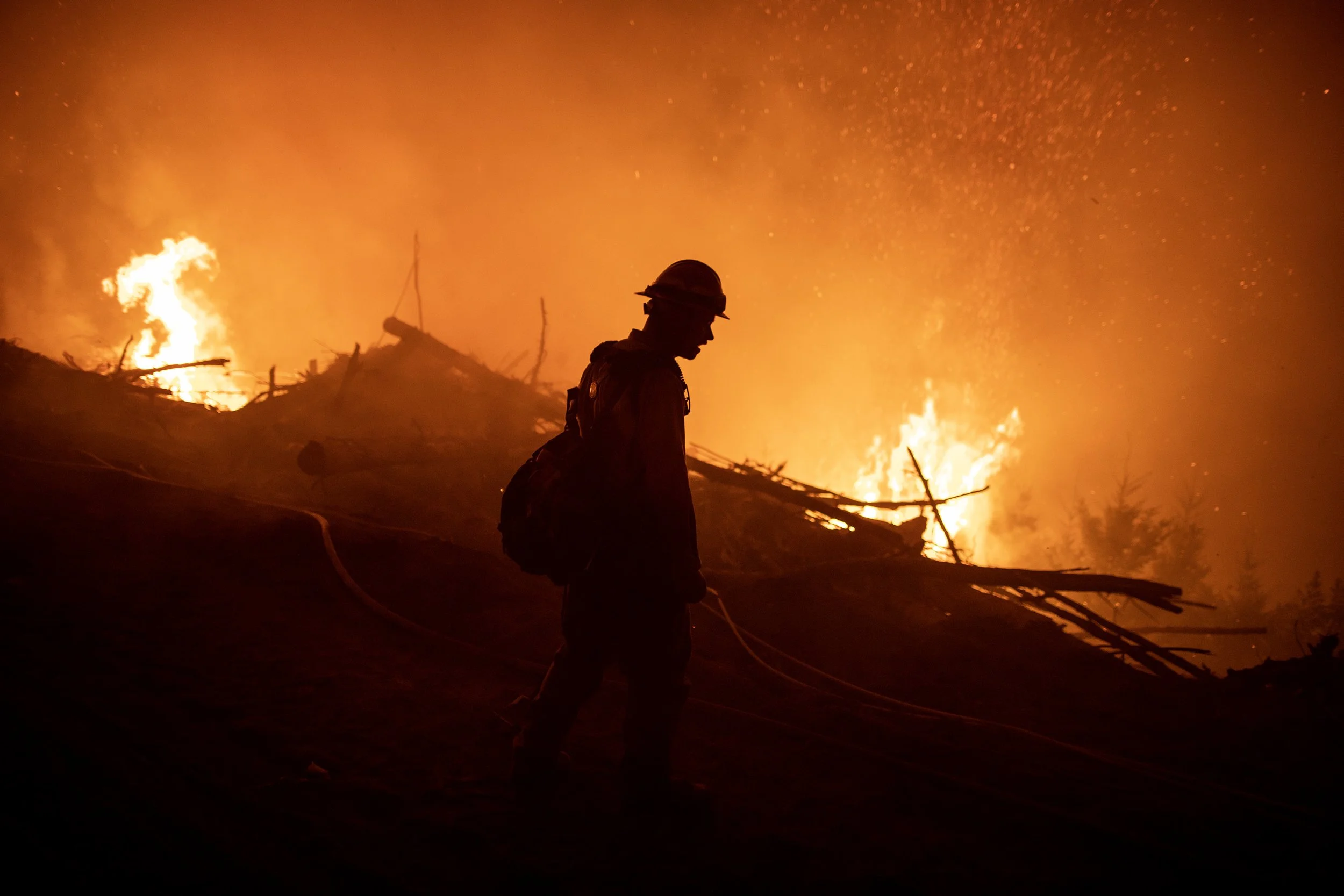
A wildland firefighter working night shift at the Lookout fire in western Oregon walks along a containment line.
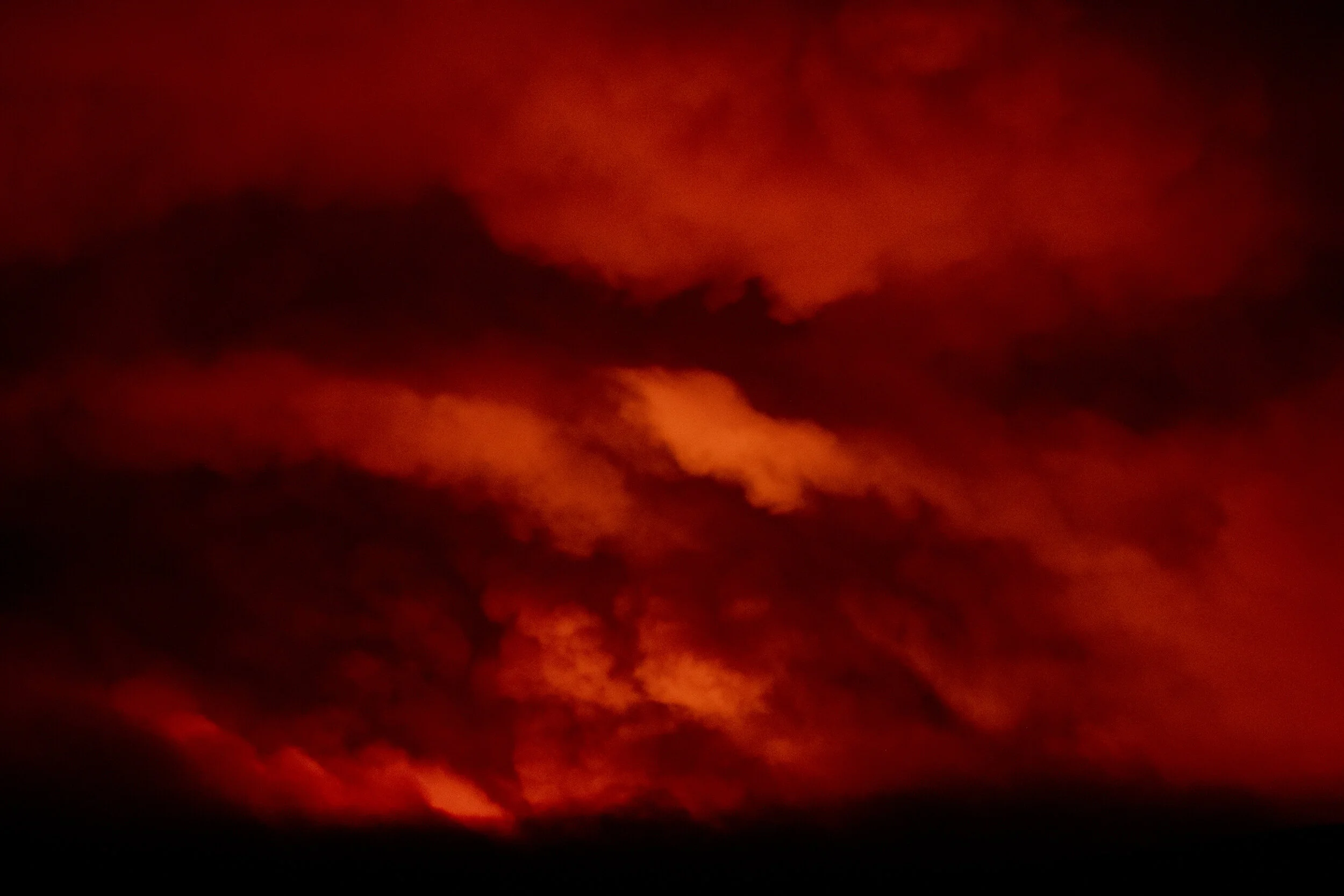
Fire from the Bootleg fire in southern Oregon illuminating smoke at night.
Fire igniting the crown of a tree, causing it to torch up during night shift at the Shoe Fly fire near Mitchell, Oregon.
A handcrew digs containment line during night shift at the Shoe Fly fire near Mitchell, Oregon.
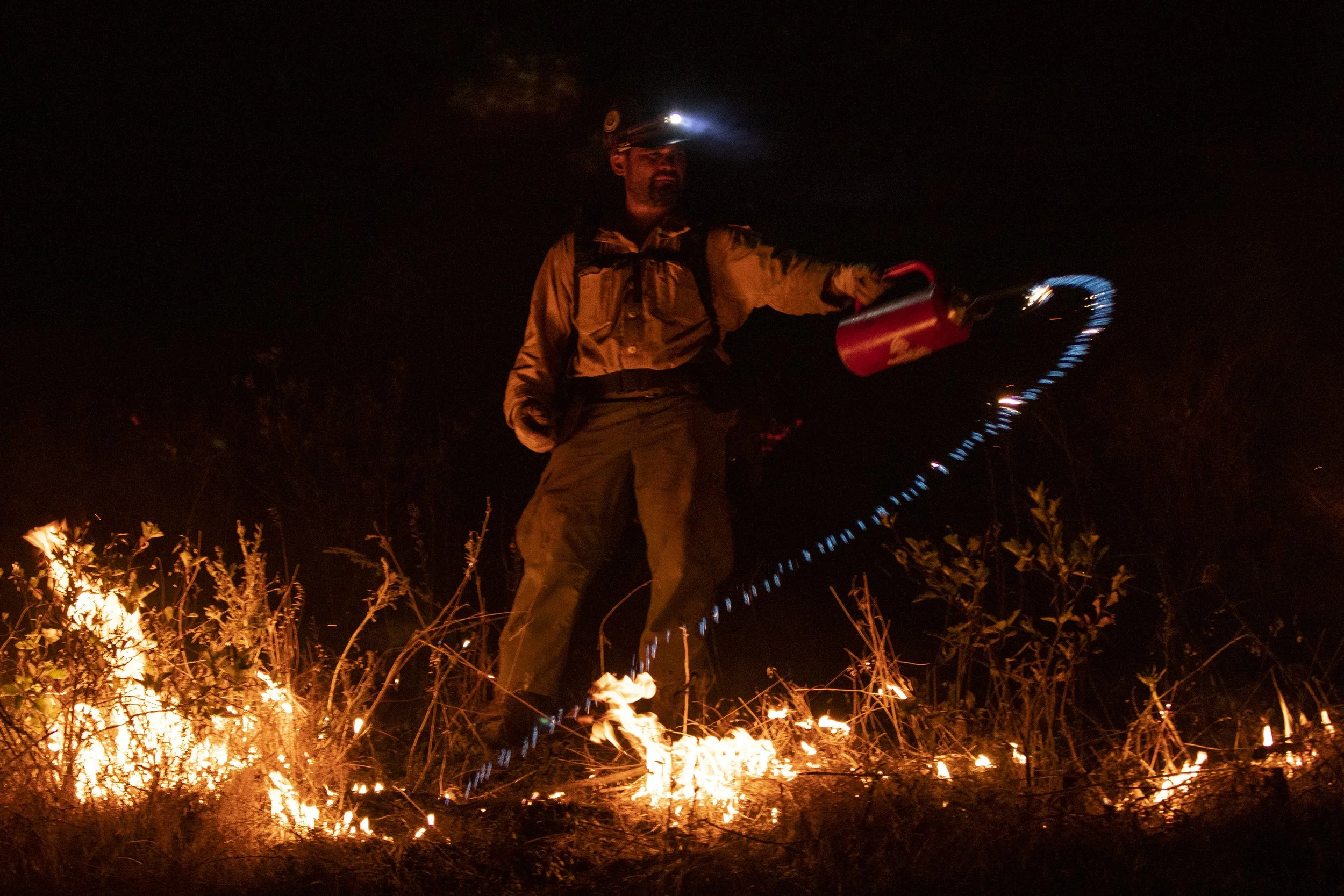
A wildland firefighter uses a drip torch to light vegetation on fire during a backburn operation. Drip torches contain a mixture of gasoline and diesel and serve as an essential tool for wildland firefighters.
A wildland firefighter uses a drip torch to burn a hillside during a backburn operation.
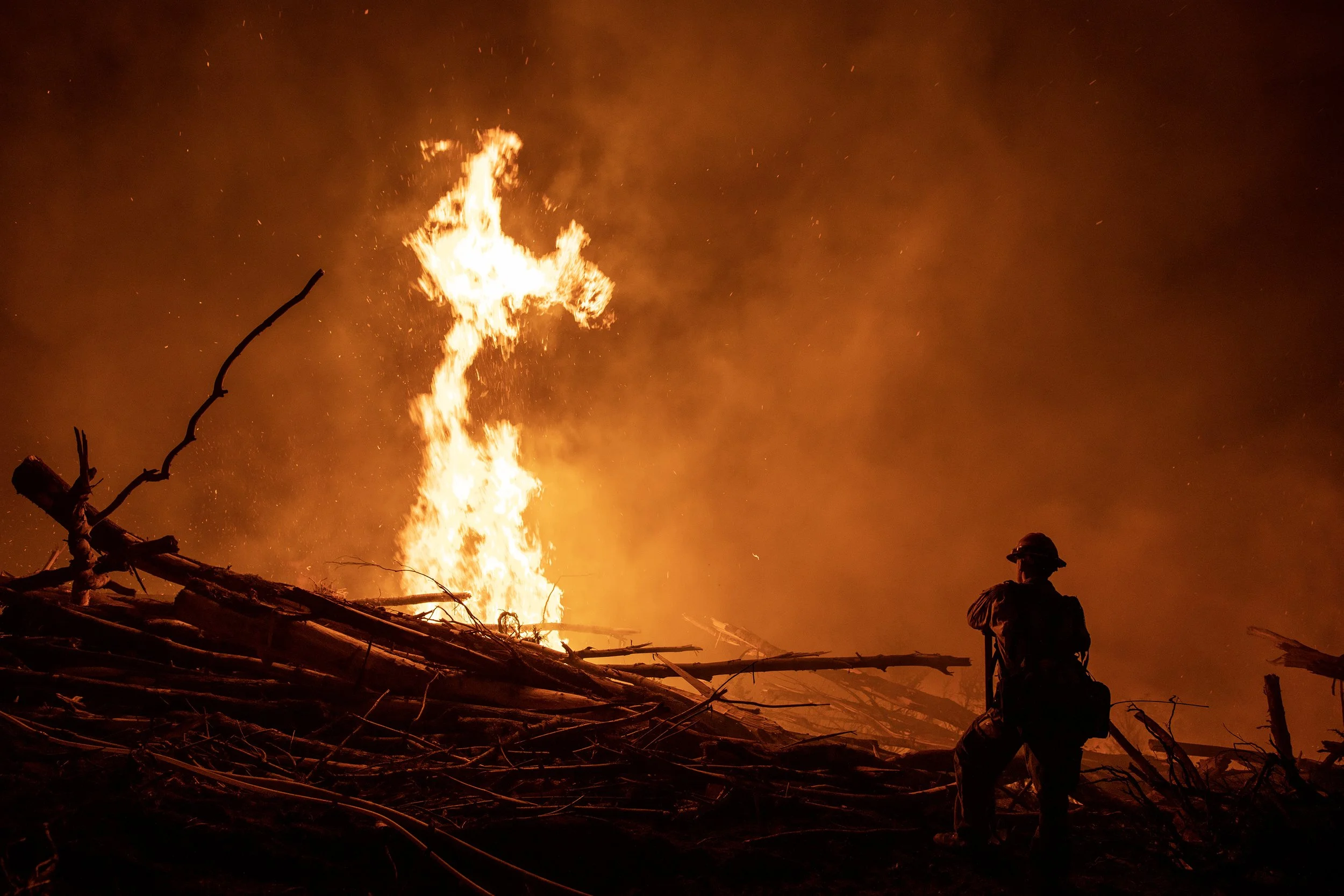
A wildland firefighter watches as flames shoot into the air during night shift. Firefighters assigned to a major fire typically work 16-hour shifts, but can work longer or shorter depending on fire suppression efforts.
Wildland firefighters attend briefing at the Bly fire camp in southern Oregon before starting their shift suppressing the Bootleg fire.
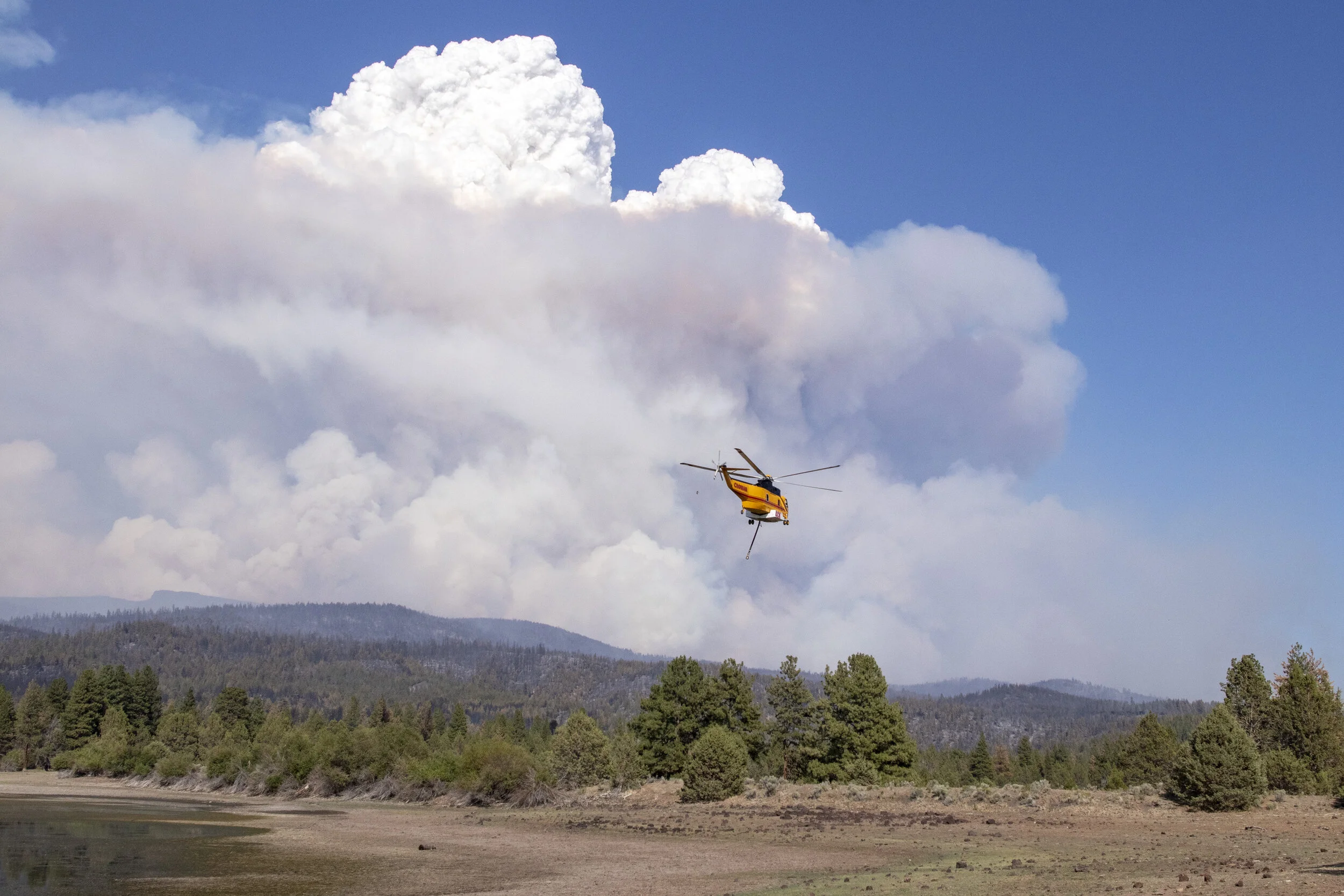
A helicopter transports a load of water to be dropped on the Bootleg fire.
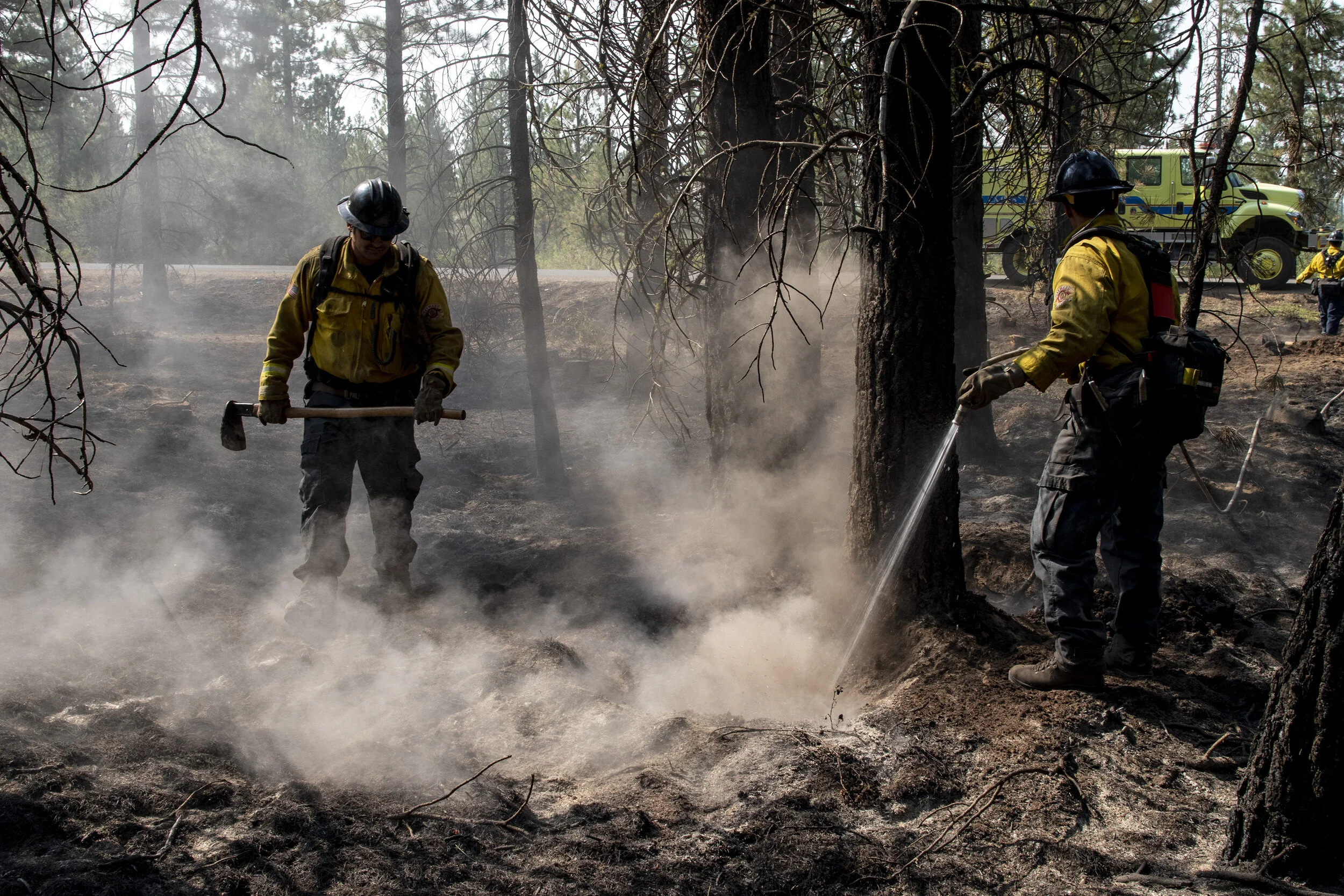
Wildland firefighters mop up hot spots along the perimeter of the Bootleg fire. Mopping up in firefighting is the process of cooling down burnt material left behind by a fire. To ensure the fire is completely out in an area and nothing rekindles, firefighters cool any material that is too hot to touch with a bare hand.
Wildland firefighters watch as a juniper tree torches up inside a control line at the Courtrock fire near Monument, Oregon.
Wildland firefighters rush to extinguish a spot fire at the Courtrock fire near Monument, Oregon.
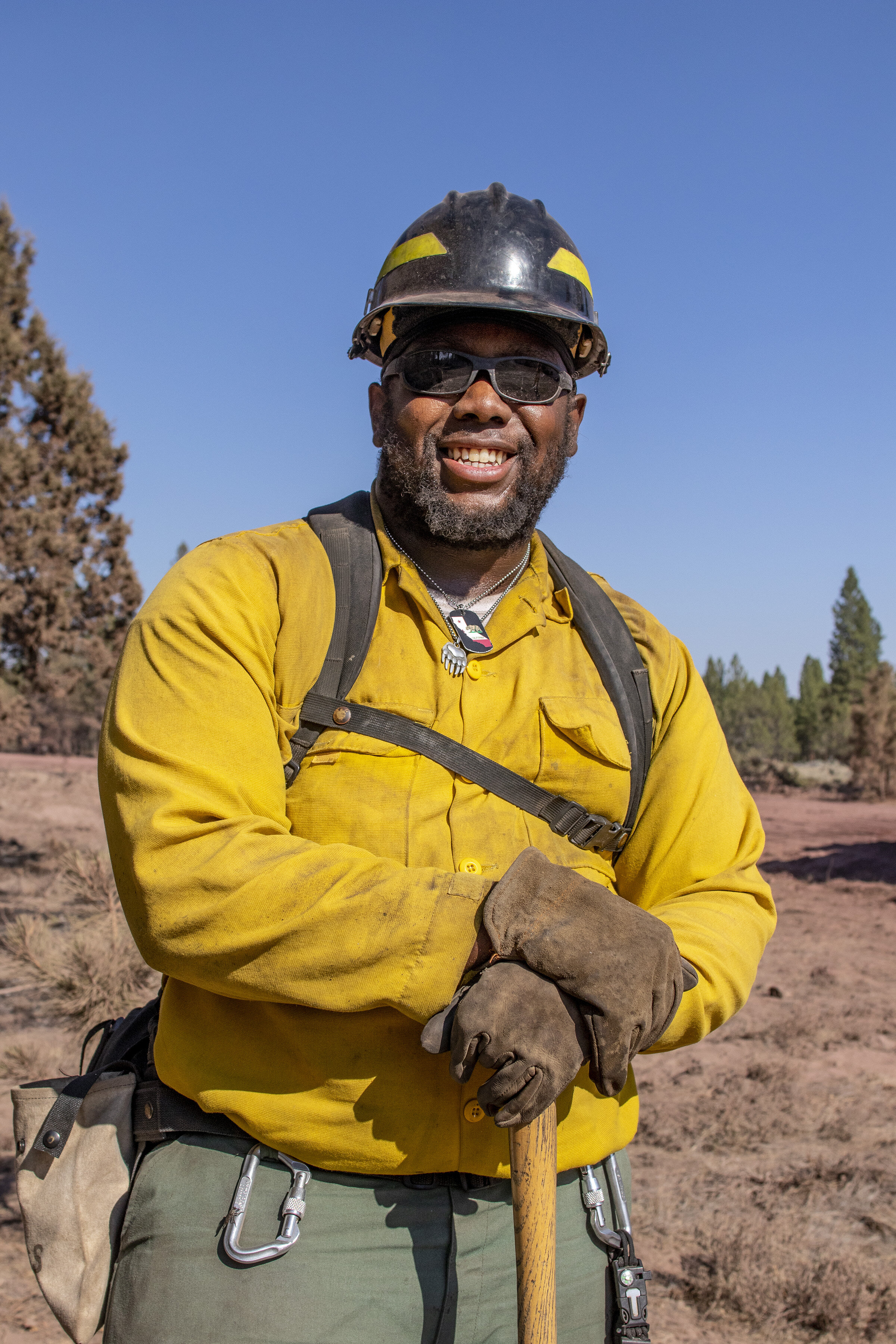
Wildland firefighter Gamari Griffin poses for a photo during mop up operations at the Bootleg Fire in southern Oregon.
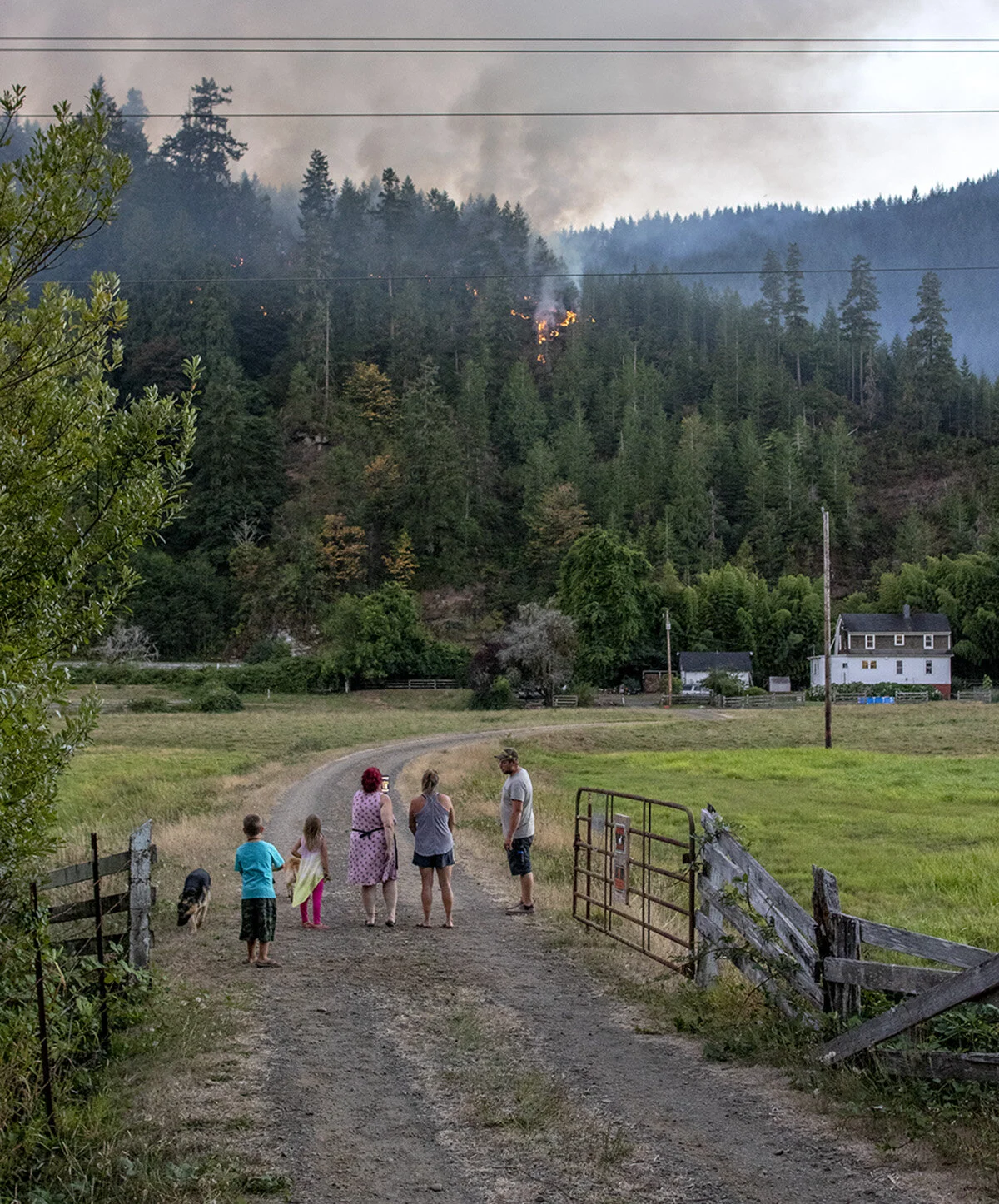
The Hendricks-Davis family watches as a fire burns across the Siuslaw river behind their farm. The fire burning behind the Hendricks-Davis family farm was lit intentionally by firefighters for a controlled burn of an area that was at risk of catching to the Sweet Creek Mile Post 2 wildfire.
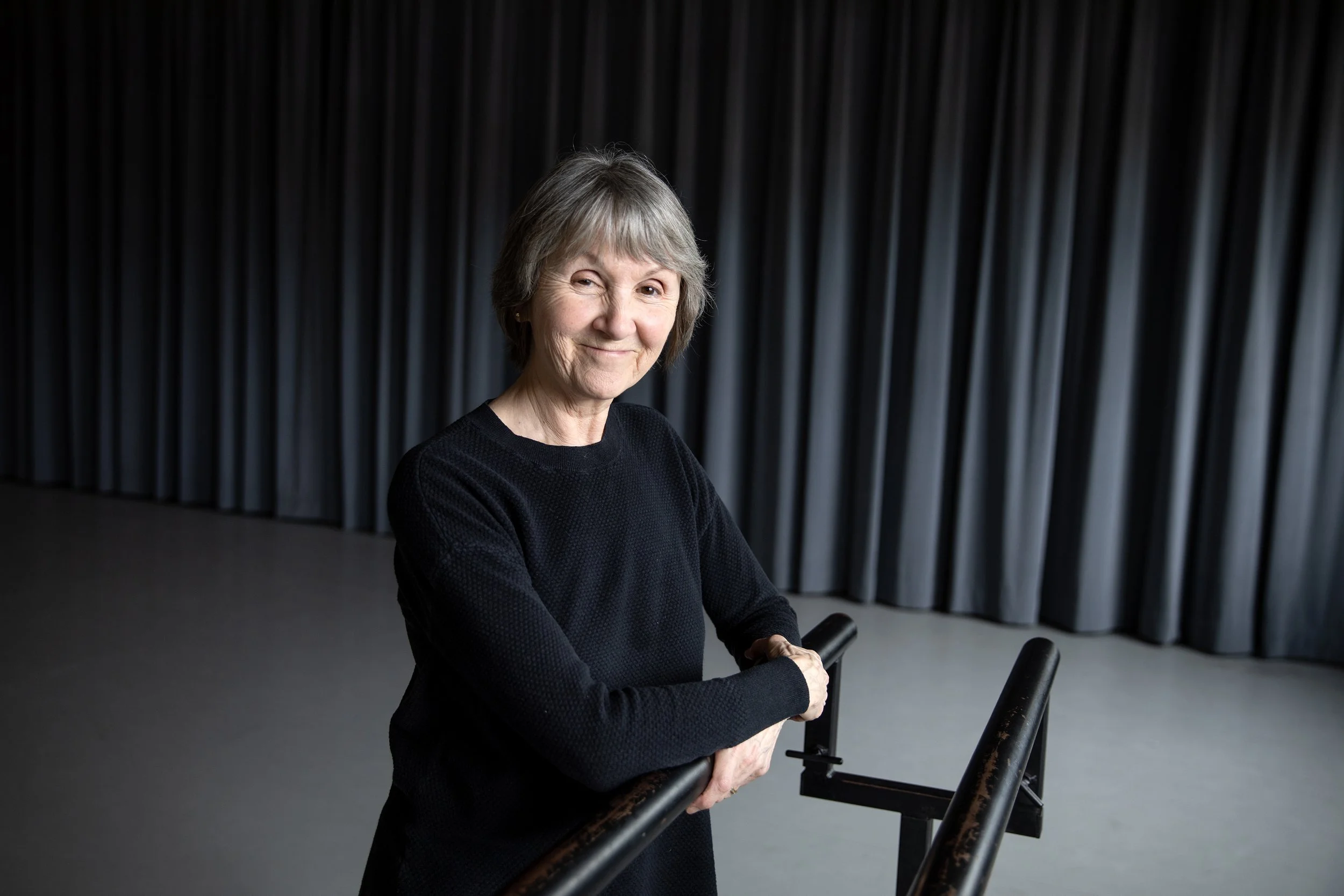
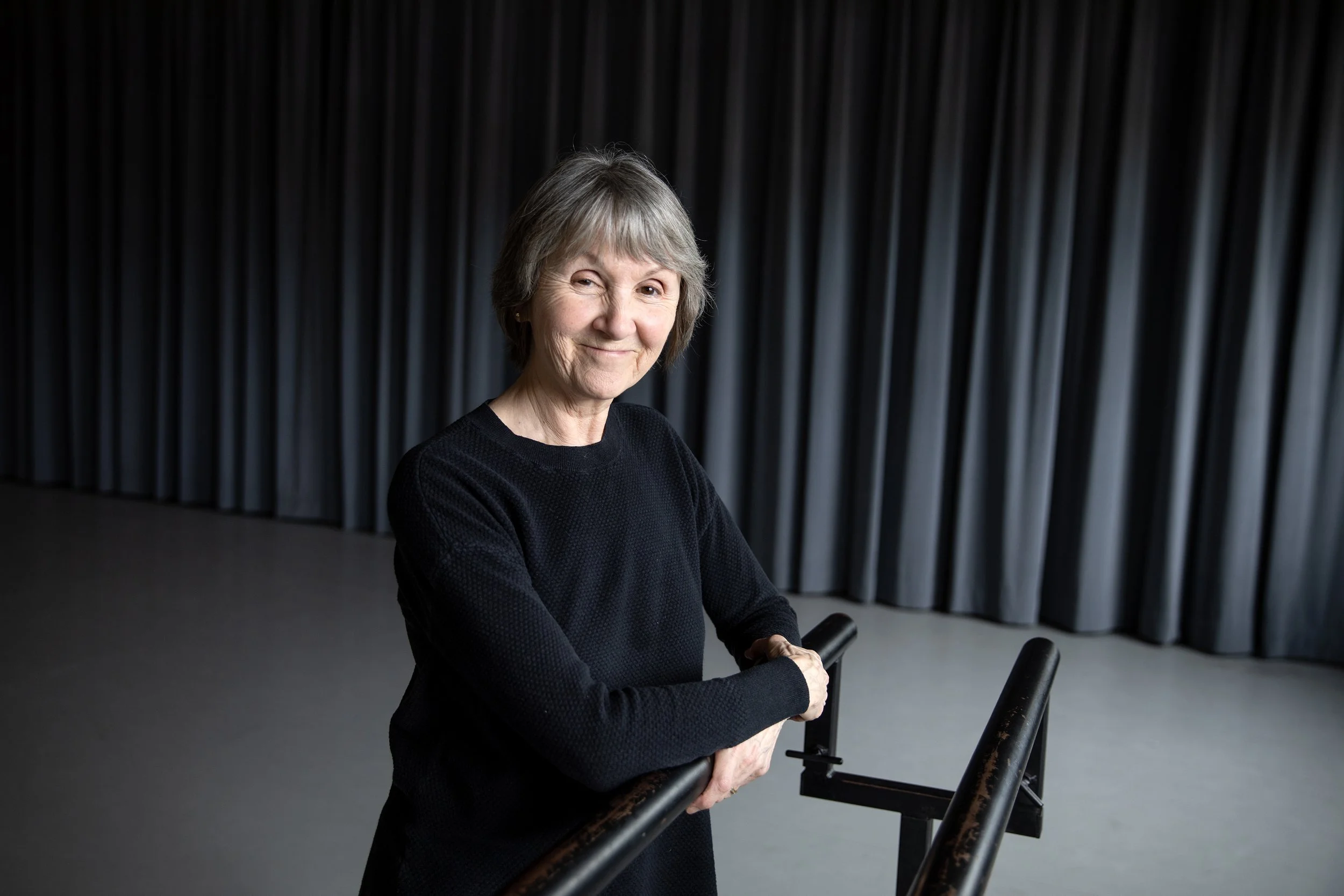
Eugene Ballet Artistic Director Toni Pimble poses for a portrait in a dance studio at the Midtown Arts Center in Eugene, Oregon. Pimble co-founded the Eugene Ballet Company in 1978 and announced her retirement after more than 40 years with the Eugene Ballet.
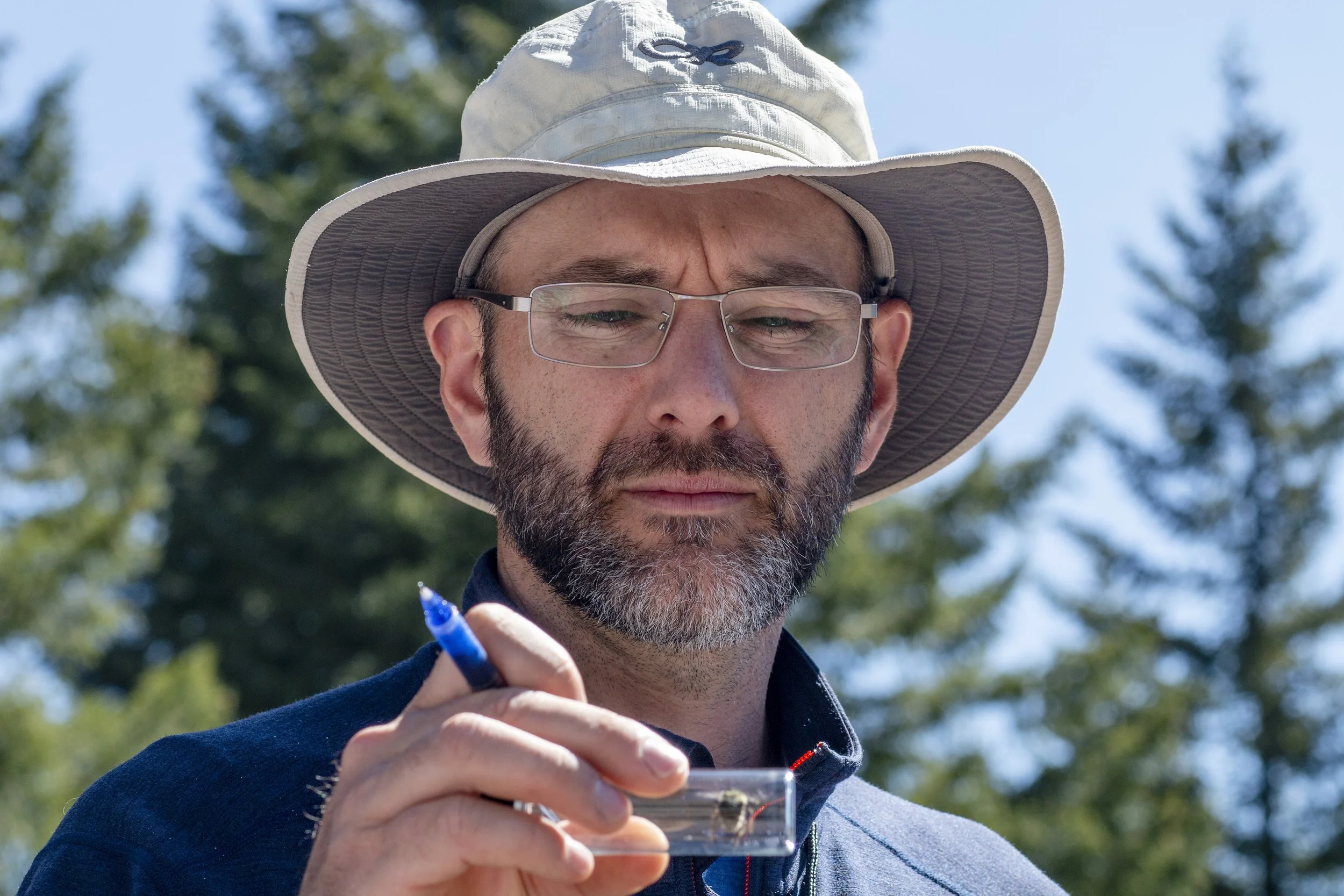
Oregon State researcher Lincoln Best examines a captured wild bee. Best co-heads the Oregon Bee Project, which works to document the different bee species in the state.
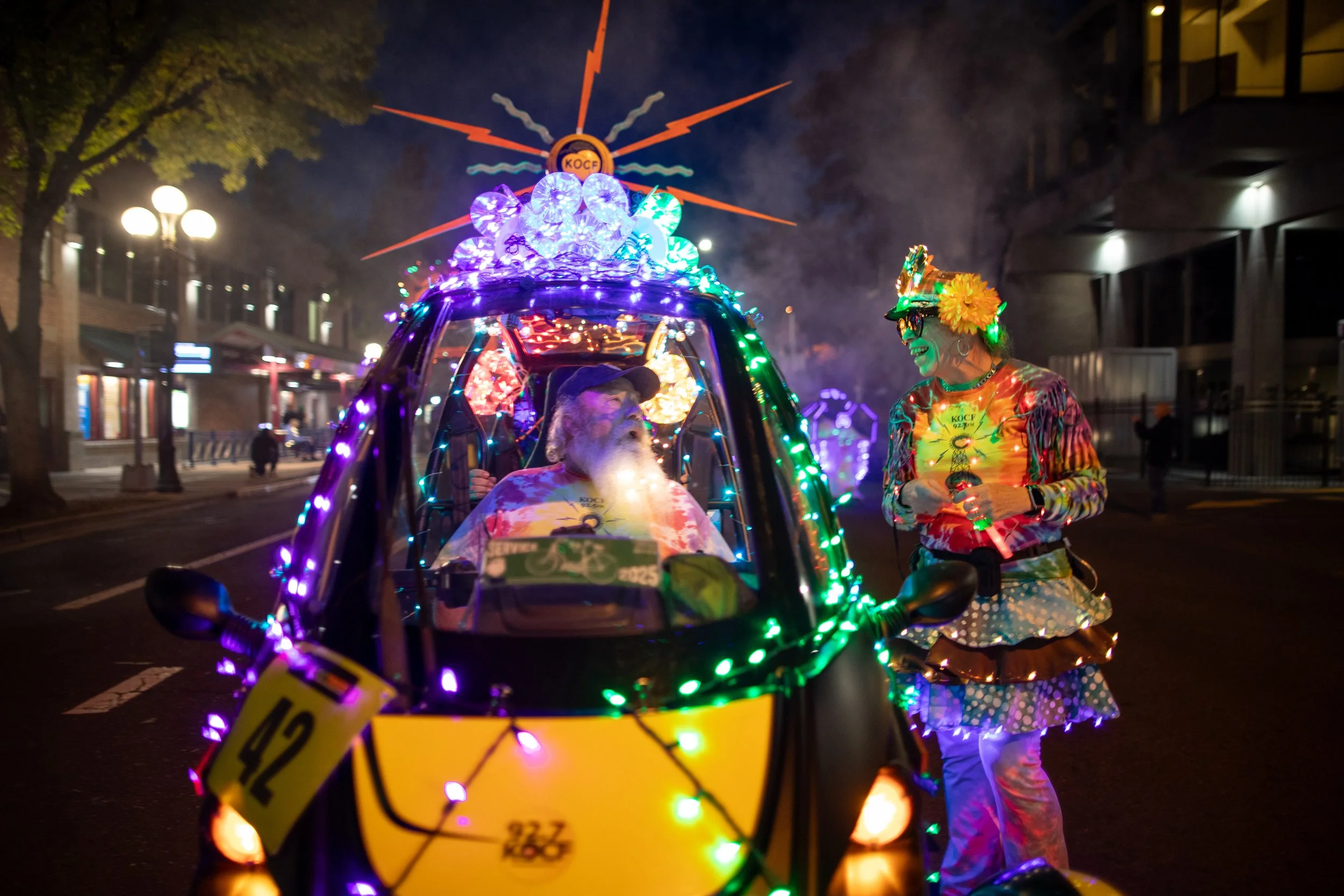
Participants in the Eugene BRiGHT Parade stop and chat during a pause in the parade as it moves through downtown Eugene Saturday night, Sept. 27, 2025.
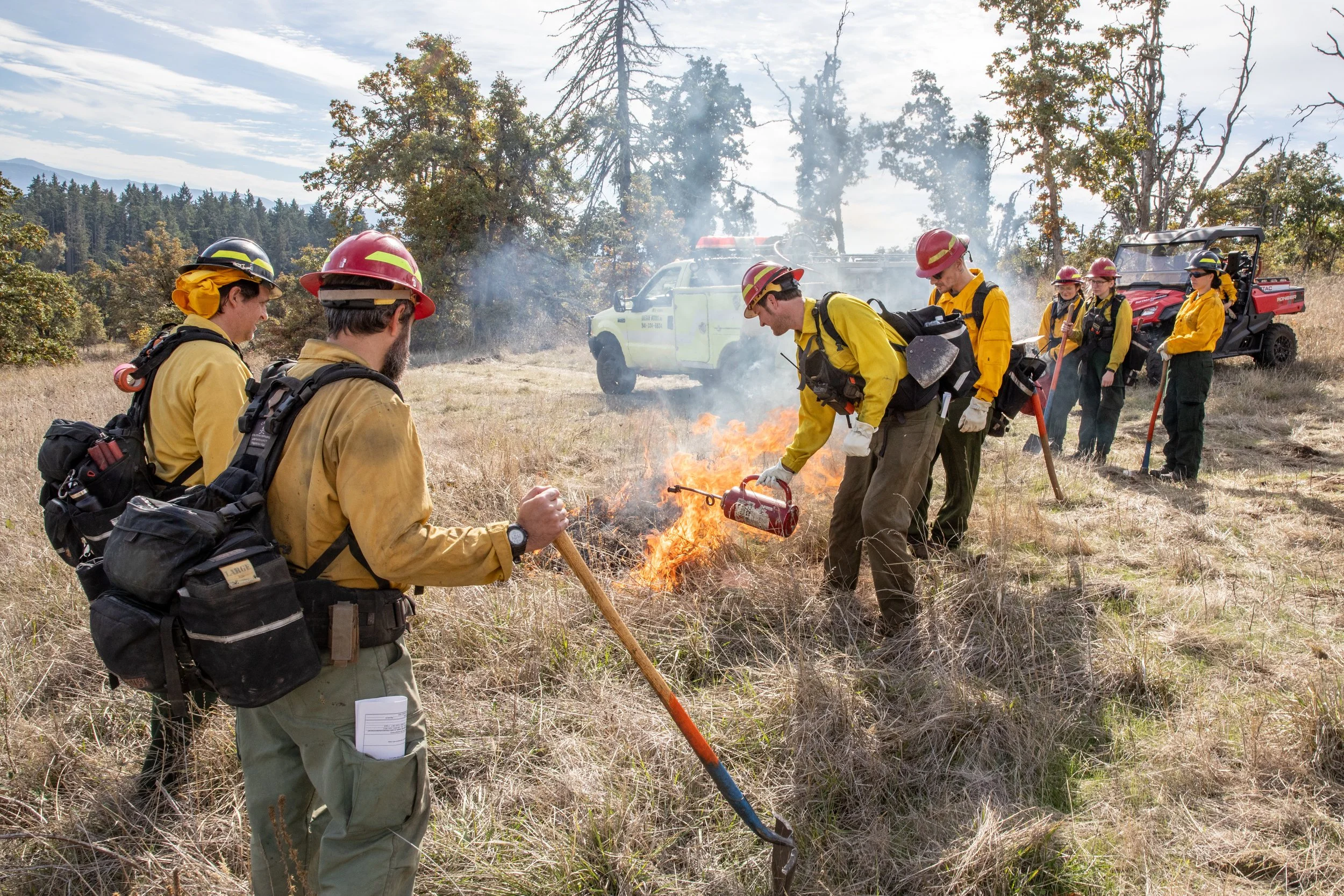
Wildland firefighters assisting with a prescribed burn at the Howard Buford Recreation Area at the base of Mount Pisgah light a test fire to see how the fire behaves before lighting the entirety of the 7.5 acre burn unit.
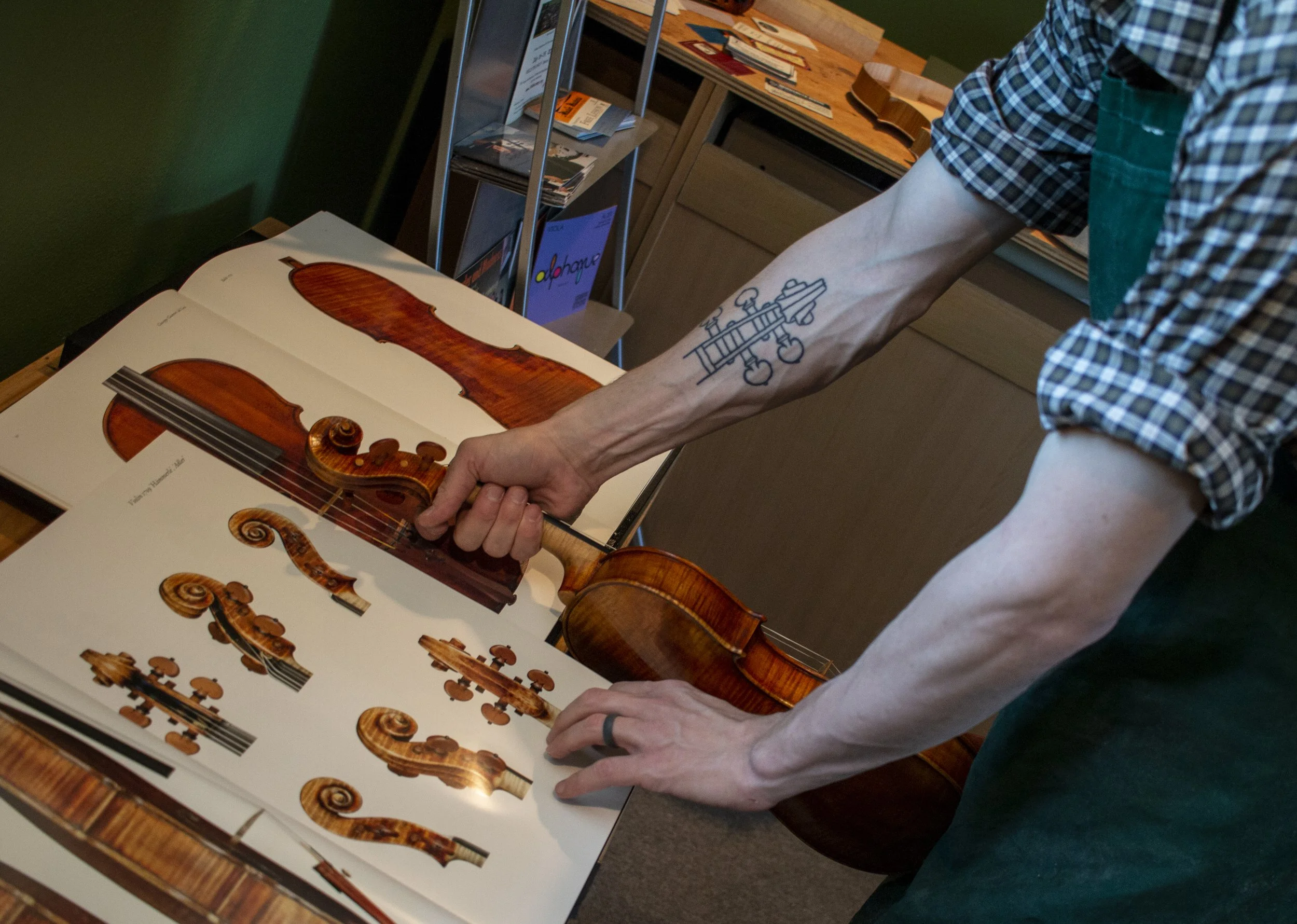
Zack Johnson compares a violin he is repairing to diagrams in a book at his business, Eugene Violin, located on 2045 W. 12th Ave. in Eugene, Oregon.
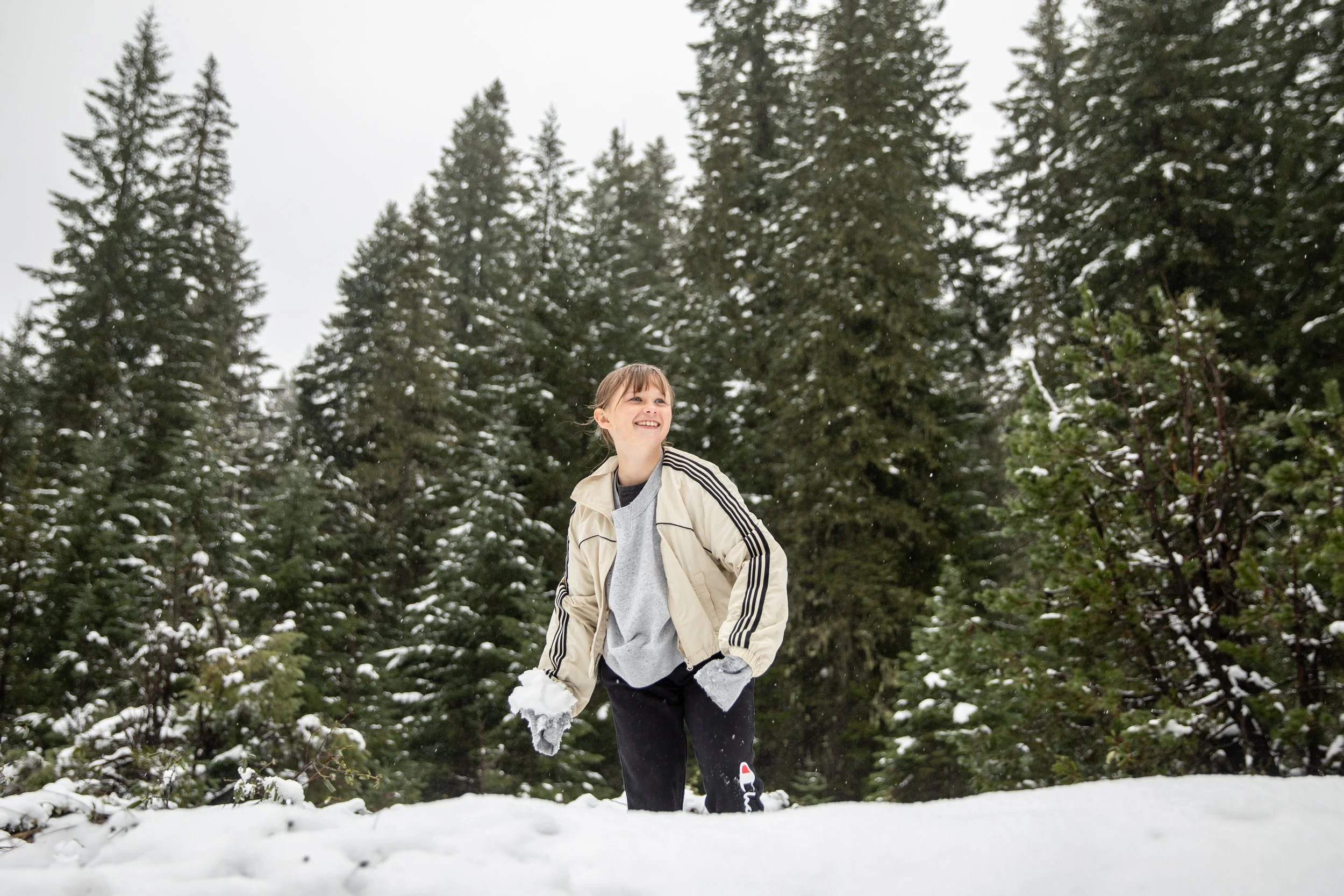
Mia Simpson gets ready to throw a snowball at her dad, Thomas Simpson, after they stopped on the side of the highway to play in the snow during their commute through the Santiam Pass on Oct. 26, 2025.
Local musician Brian Swislow plays the keyboard with his band during a concert at Whirled Pies in Eugene, Oregon.
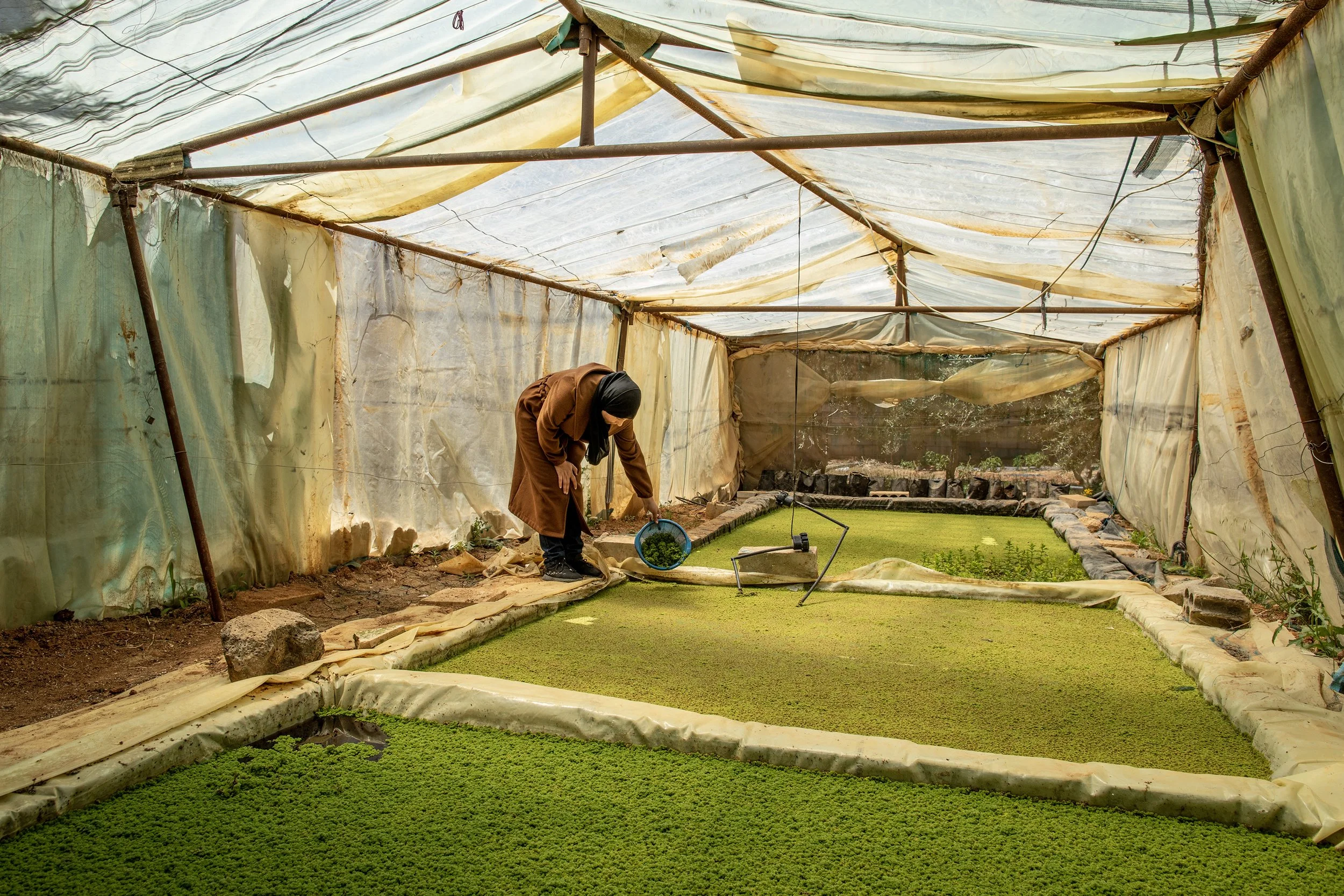
Nisreen al-Eneze holds a basket of Azolla inside a greenhouse at a farming collective she contributes to in Jordan's water-scarce Mafraq governorate. With aid from ACTED, a humanitarian NGO, more farmers and gardeners in Mafraq are using Azolla as an alternative fertilizer and animal feed that requires less fresh water to grow.
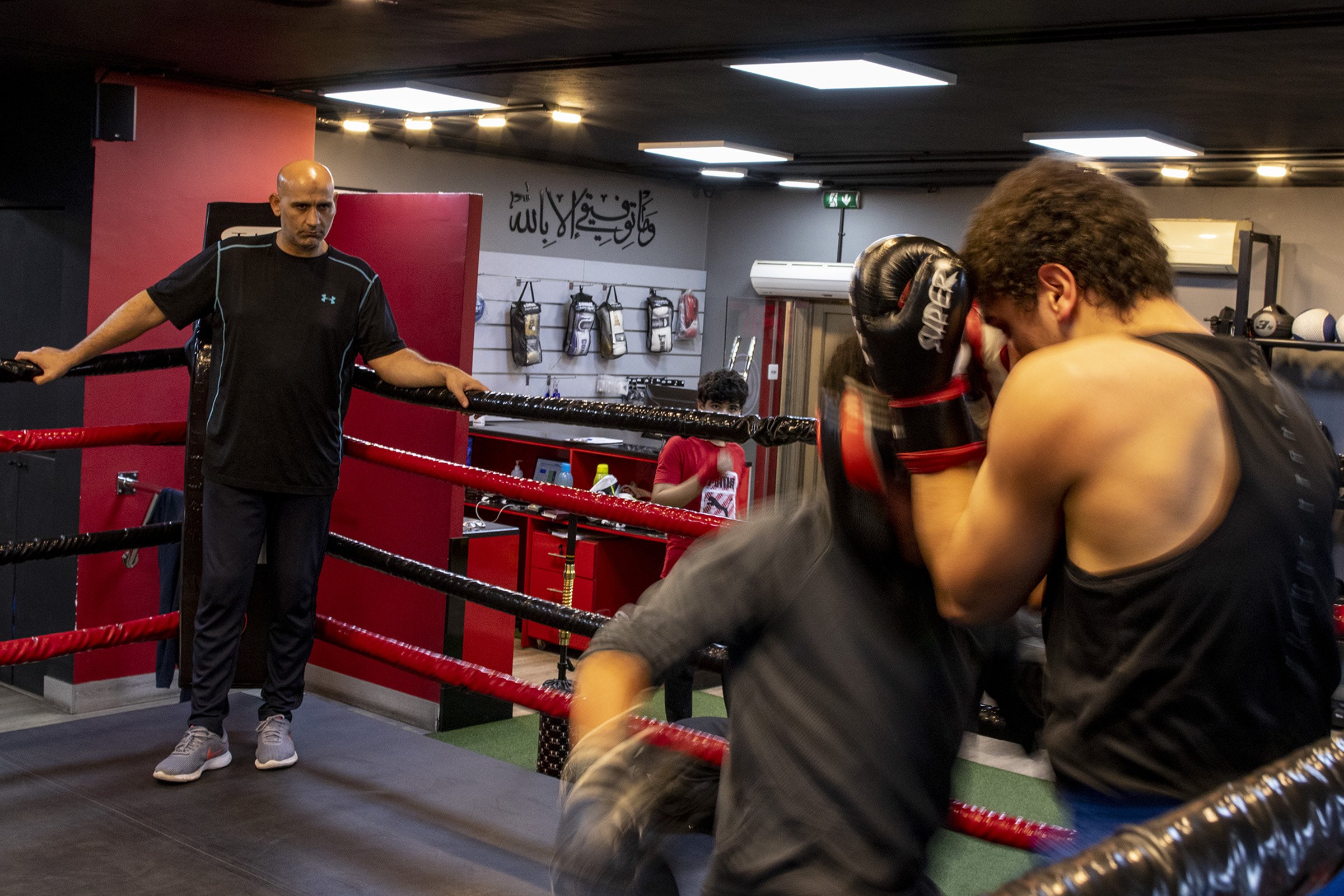
The Ring founder and head boxing coach, Mohammad Ibrahim, left, watches as Jaber al-Qaissi, center, and Raad Mesmar spar. Ibrahim said the Arabic calligraphy above The Ring entrance in the background translates to “my success is only by Allah.”
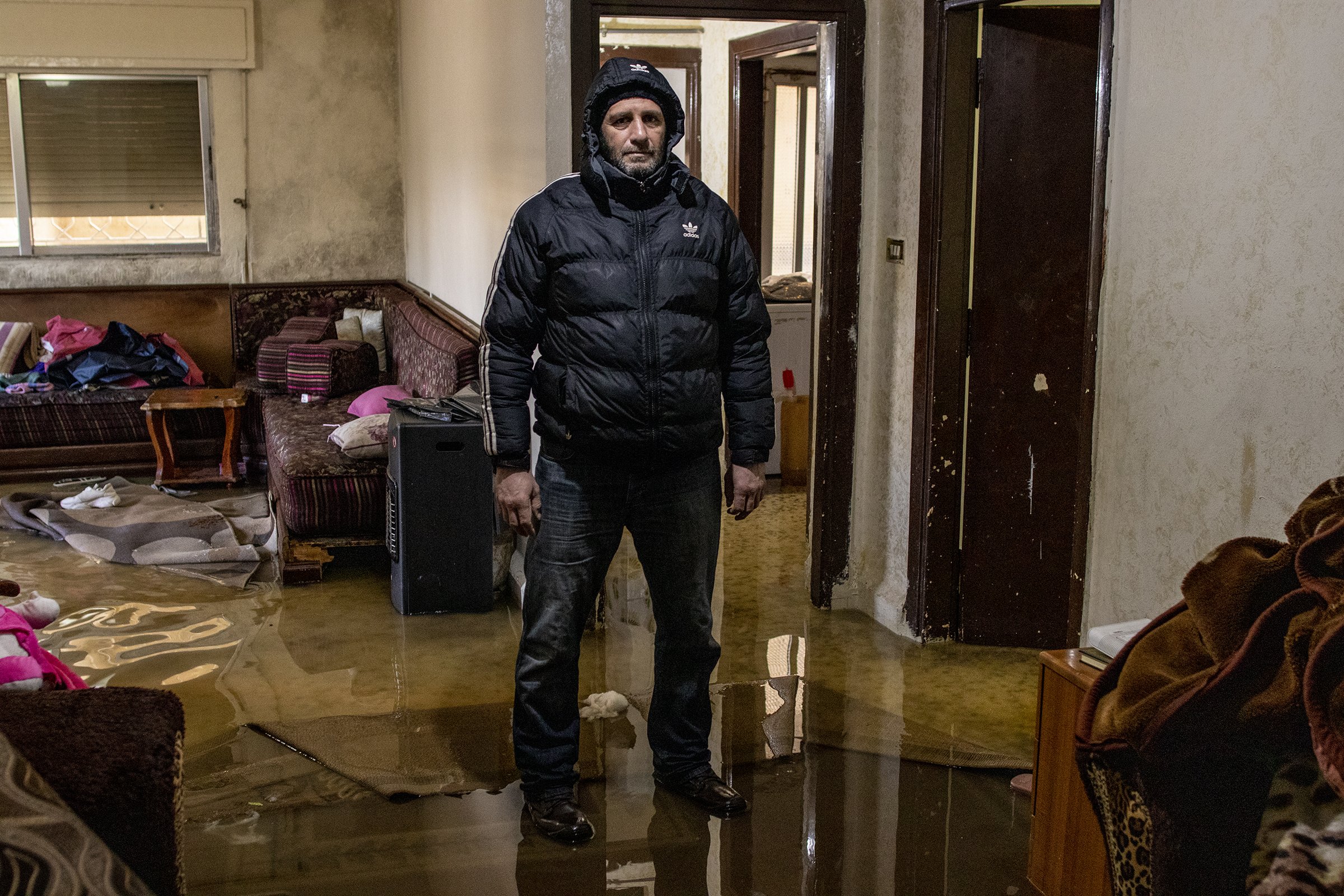
Amman, Jordan, resident Ahmad Jaber al-Attiat stands in the middle of his flooded apartment where he lives with his wife and four children. Alattiat's apartment flooded after approximately two feet of snow fell in Amman overnight.
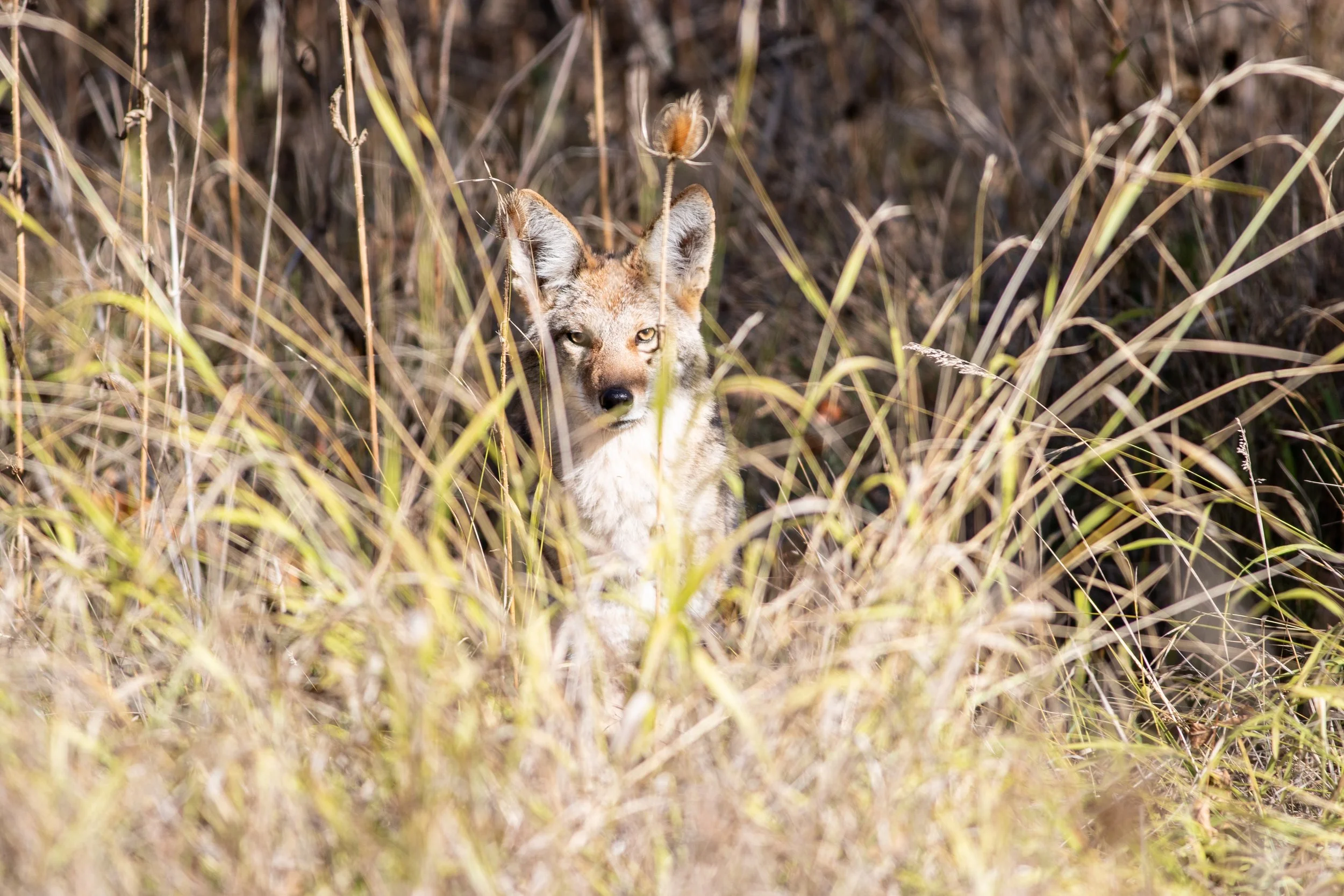
A coyote stares through the grass near Mount Pisgah in Eugene, Oregon.
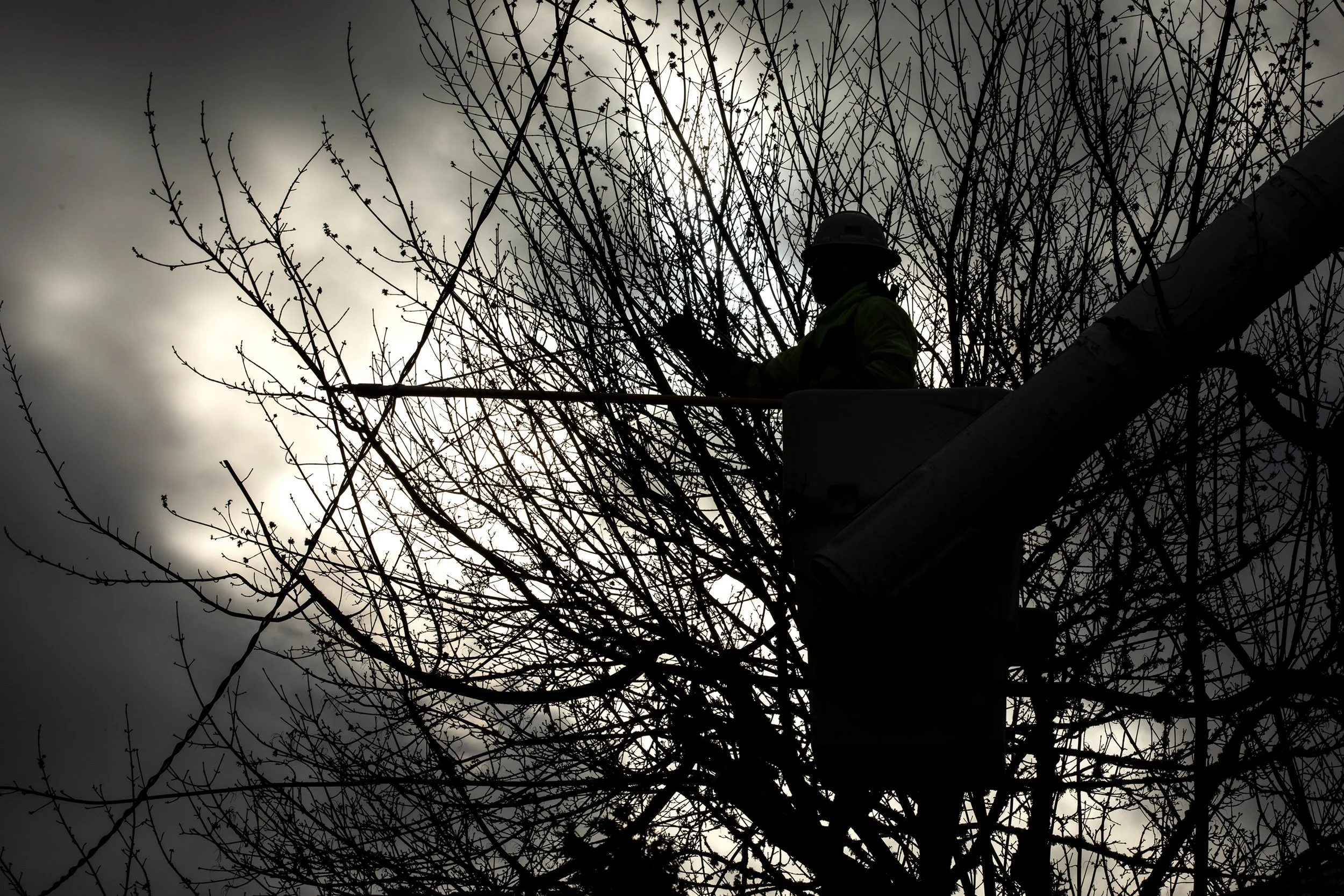
Springfield Utility Board Crew Lead Angel Arellano trims branches off a tree near a power line on 5th Street in Springfield, Oregon.
Steve Ibach unloads his car as he prepares to perform at Mulligans Pub for his regularly scheduled Tuesday-night performance. Ibach is a local musician living in Eugene, Oregon, and has played at Mulligans Pub once a week for the past two years. Mulligans, located at 2841 Willamette Street in Eugene, is a bar that hosts open mic performances and scheduled shows. Ibach describes Mulligans as a neighborhood bar with a unique crowd of regulars.
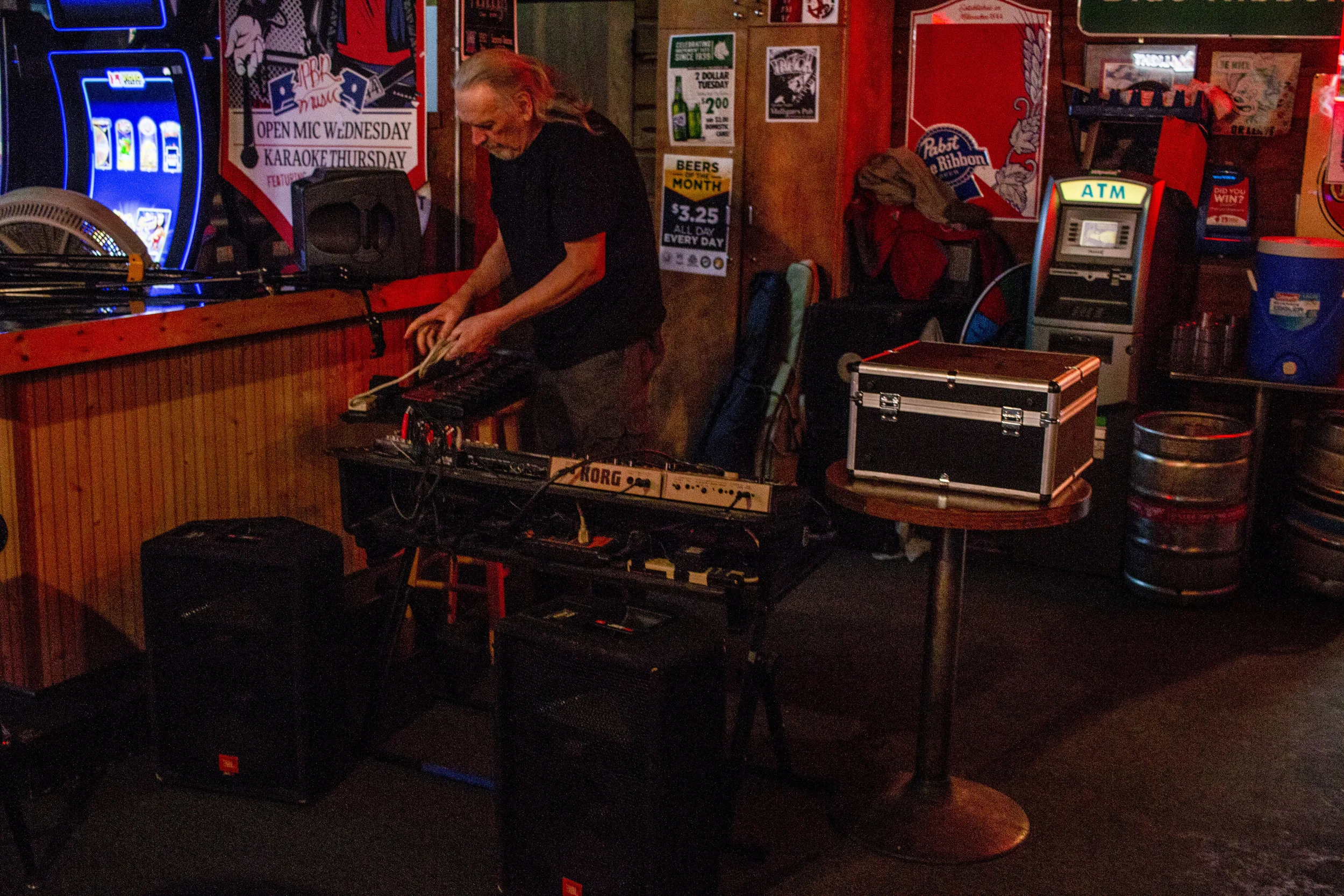
Ibach sets up his keyboard and sound equipment inside Mulligans Pub. Ibach plays several other instruments in addition to the keyboard. His preferred and primary instruments are the keyboard, guitar and trombone.
Ibach starts his Tuesday performances at 9 p.m. and end at midnight. Ibach said he receives 20% of all bar sales that take place during his performance, and he will stay later if there is a decent-sized crowd. Ibach said, “It’s like a fun neighborhood bar to play at pretty much. People in other parts of town don’t go there.”
Currently, Mulligans is the only venue Ibach performs at. He has performed at other venues in town, such as Sweet Cheeks Winery, but said he prefers Mulligans because he fits in better. He said, “Playing at Sweet Cheeks Winery was not one of those gigs I liked; I was asked to change ‘son of a bitch’ to ‘son of a gun’ in my song and that’s when I realized I didn’t belong there.”
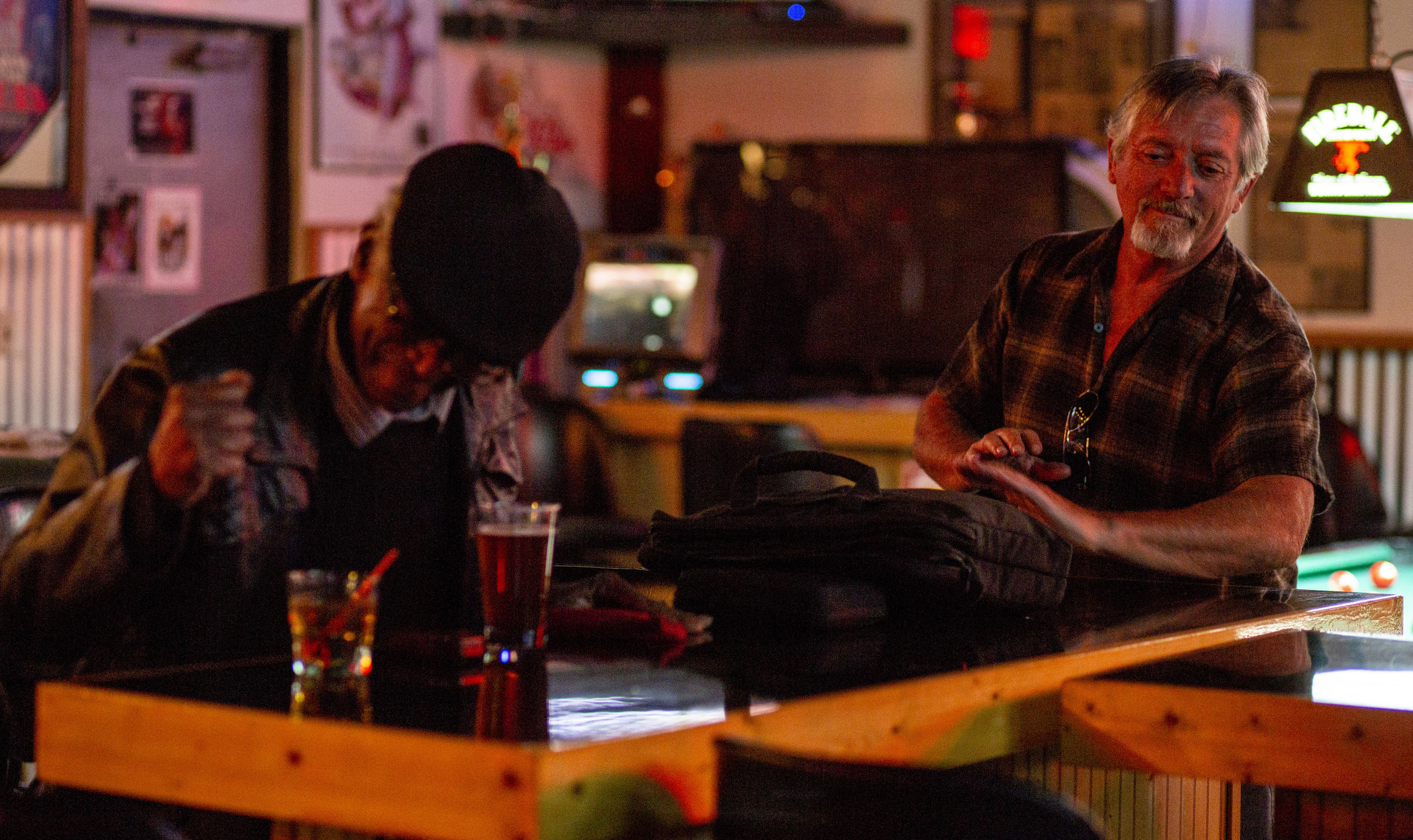
Mulligans customer Steve Chadsev puts money in Ibach’s tip jar. Ibach said that of all of the venues in Eugene, he makes the most money playing at Mulligans. “I make 20% of what they sell that night on top of the tips I get.” Ibach said on a good night, he can earn around $200 to $300.
Ibach first came to Eugene from his hometown in Madison, Wisconsin, in 1977. Ibach left Madison and dropped out of college so he could play with a band he had just started to play for. He said the band was successful, and as a 14-year-old when he joined, Ibach said he was able to make a significant amount of money from his performances. “I was getting paid 15 dollars a gig at a time when minimum wage was like 60 cents an hour and a gallon of gas was 15 cents.”
Eric Procter, left, and Denis Banks, right, bang on a table at Mulligans to the beat of Ibach’s performance. Procter and Banks are regulars at Mulligans Pub and make a point to come to the bar when Ibach performs.
Ibach started playing music when he was 12. His first instrument was the trombone, but he quickly moved on to the guitar at age 13. Ibach said the first time he played music in public, he played a rock song from a 1960s TV show at a Wisconsin church. However, Ibach said, “The preacher was really pissed; he stopped me and said that rock music was evil.” He summarized by saying, “My first time playing in public, I got stopped for playing devil’s music.”
Ibach has a few fans who regularly make an appearance during his shows. Two of Ibach’s friends and followers, Procter and Banks, will support Ibach with their own musical abilities during Ibach’s performance. Banks prefers to support with a harmonica, and Procter supports with whatever’s on hand. Procter said as he pounded his fist to Ibach’s music, “Not everyone knows, but one of the best instruments is this table right here.”
From left to right, Aden Bumpas, Whitney Brooks and Steve Chadsev stand behind Ibach as he performs his guitar solo. Although Ibach is friends with several of his fans, there are some fans he said he is less than familiar with. “Most of them I don’t even know their names,” said Ibach. He said Mulligans usually attracts an interesting crowd.
“This is just part of the show,” said Ibach as he smokes a bowl of weed during a performance break. He told of one story dating back to the 70s when he was chased by a group of people high on LSD. “I was really into Dracula at the time, so I showed up to a party dressed as a vampire. They were all tripping on acid, so they chased after me, trying to kill me, thinking I was a real vampire.”
Ibach talks with regular customers of Mulligans in the bar’s back patio. Ibach takes a 15-minute break halfway through his performance every Tuesday night. He uses this time to smoke, drink and socialize with friends and fans.
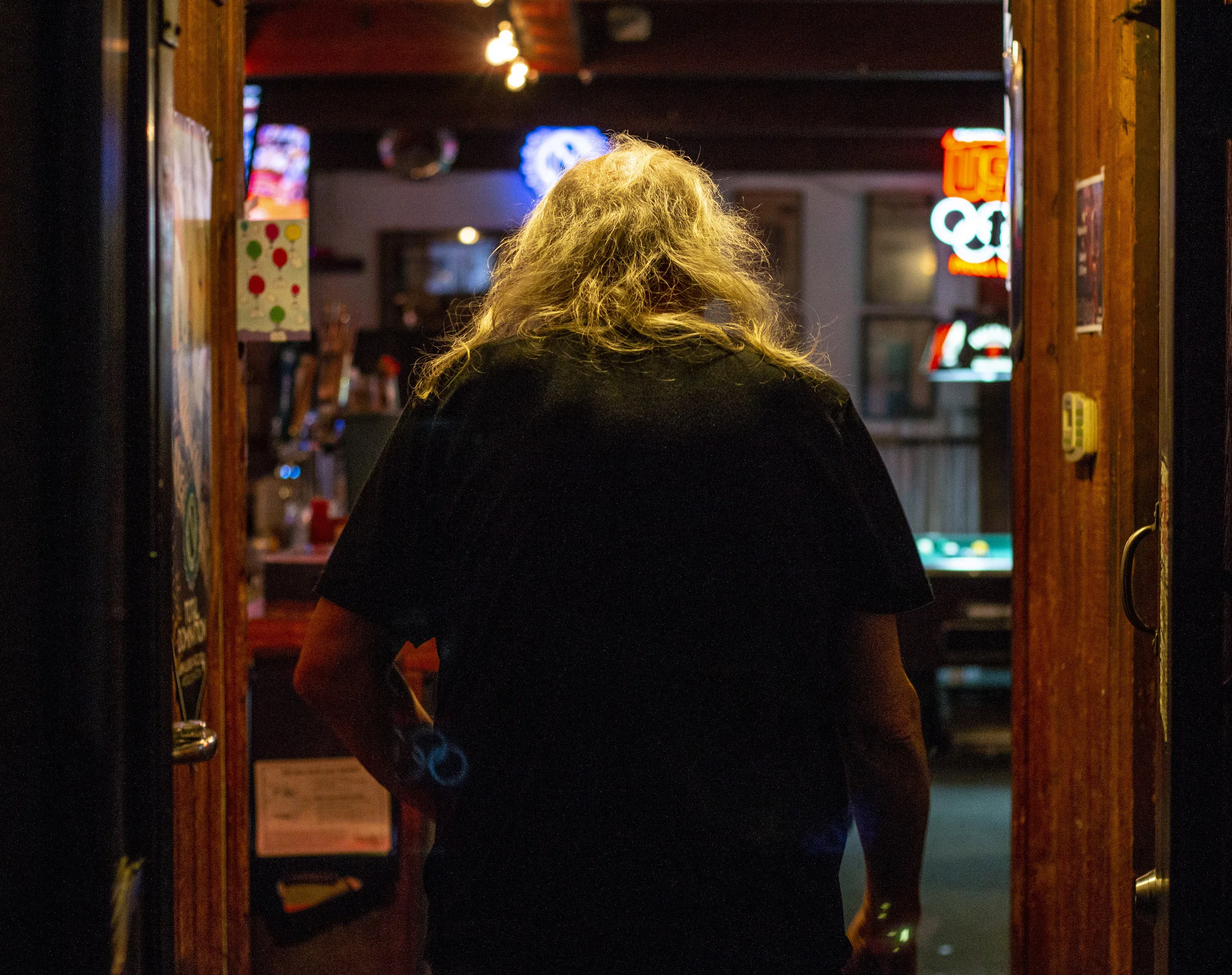
Finished with his break, Ibach walks back into Mulligans to finish out his performance for the night. Ibach said, “I have fun playing here, so I’m not going to quit until I’m either too old or not healthy enough.” The aspects of performing at Mulligans that Ibach enjoys the most are its atmosphere and people. “Everyone there seems to really appreciate what I’m doing, and it makes it fun,” he said.
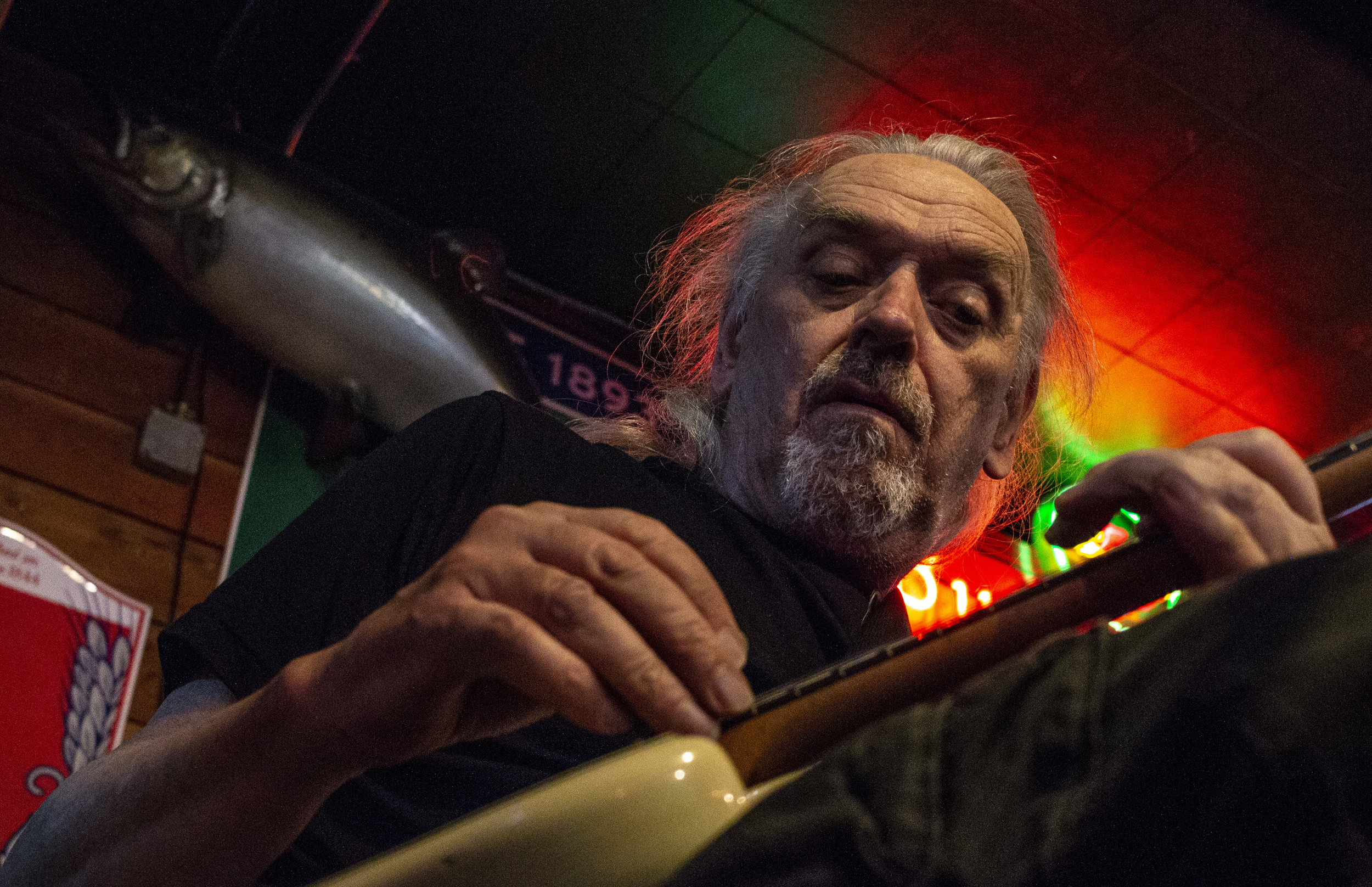
Ibach performs live music every Tuesday at Mulligans Pub in Eugene, Oregon, and has performed at other local venues, including the Veterans Club and Hult Center for the Performing Arts. Ibach, referring to his acoustic guitar, said it was nothing special, just a “$60 piece of junk I got from a flea market.”
Ibach said he took guitar lessons at first, but he hated the teacher, so he quit and taught himself.
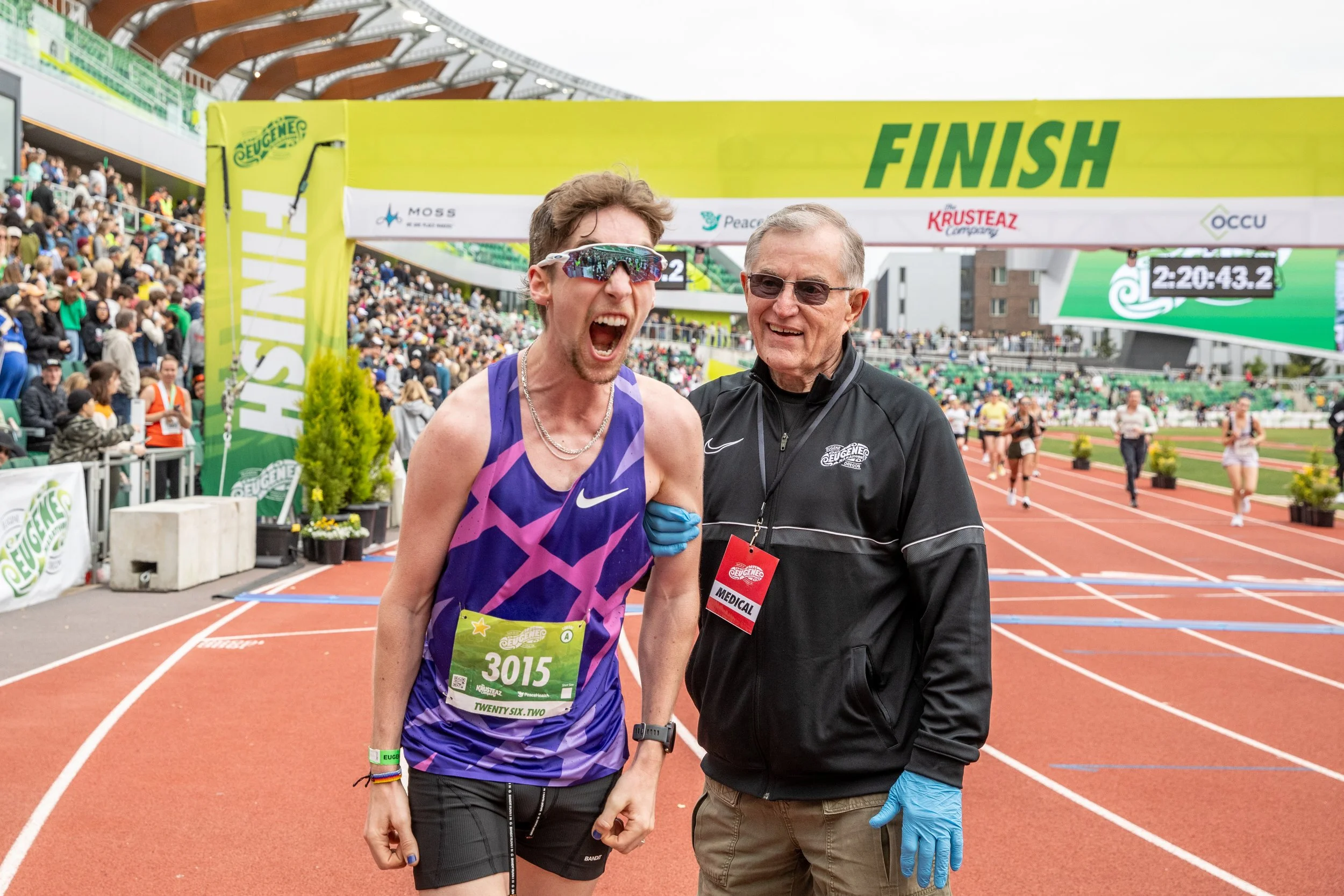
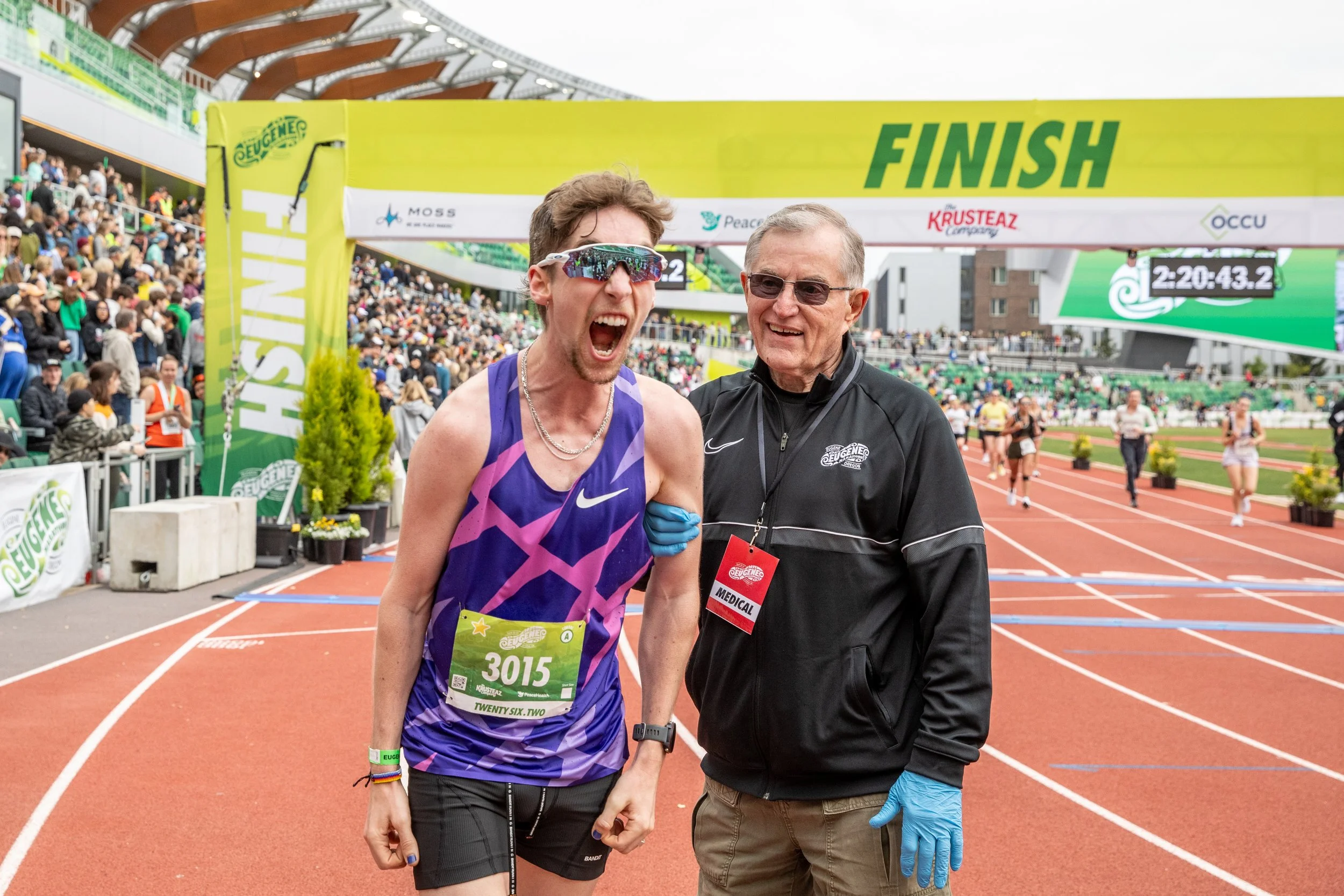
Springfield local Logan Auxier screams with excitement after finishing second in the male's marathon event of the Eugene Marathon with a final time of 2:20:27 (2 hours, 20 minutes, 27 seconds) on April 27, 2025.
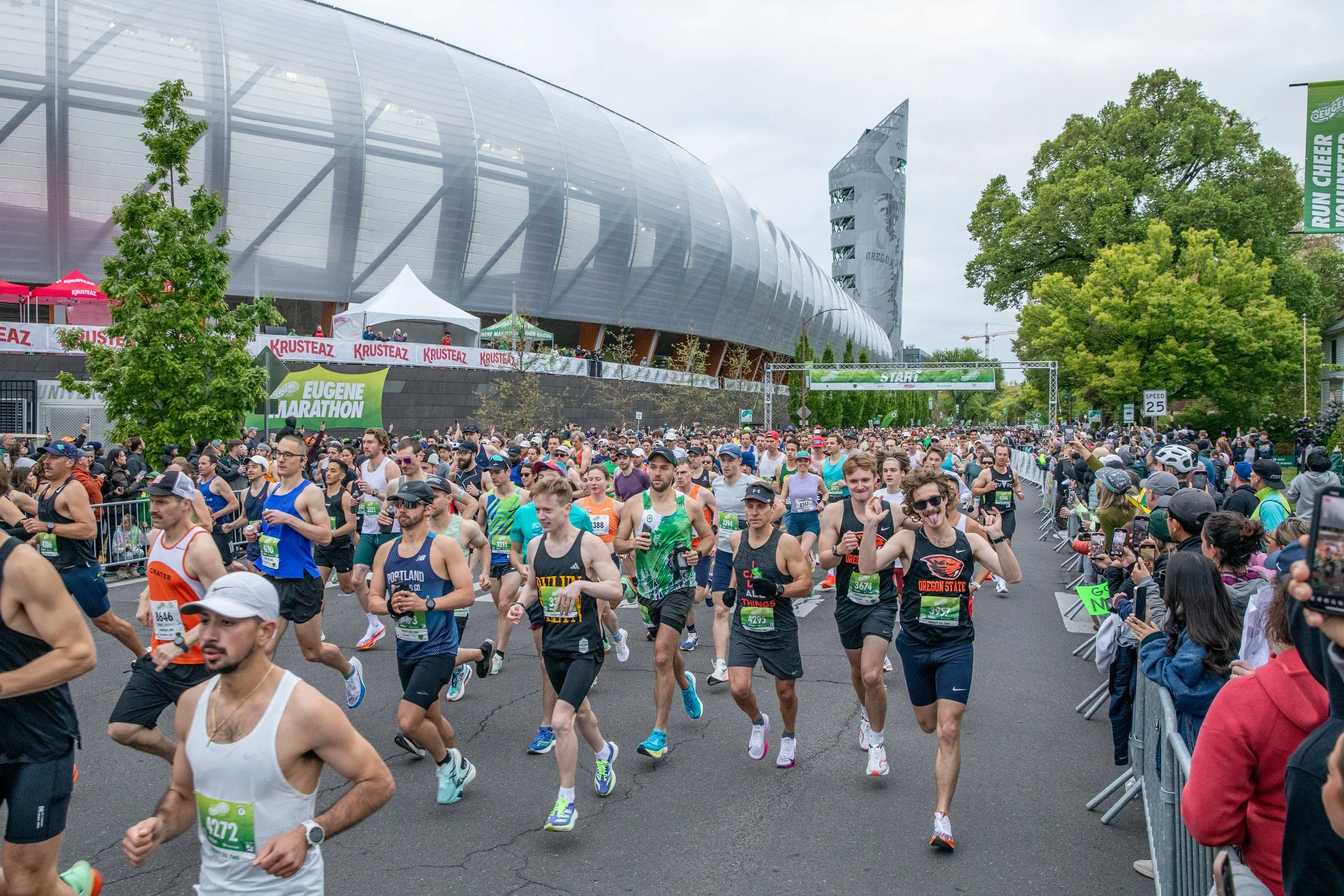
Thousands of runners take off past Hayward Field after crossing the starting line of the Eugene Marathon on April 27, 2025.
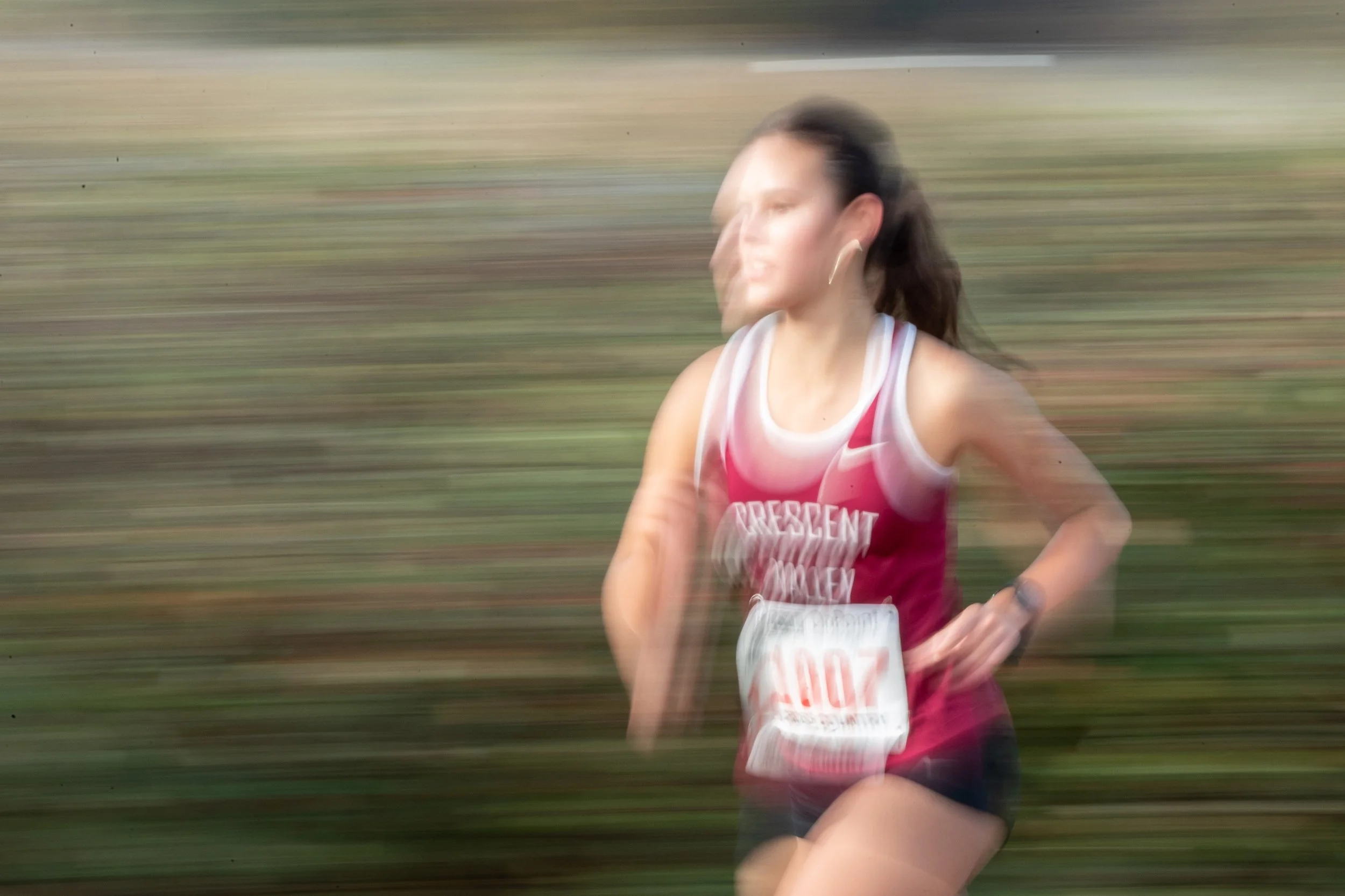
Crescent Valley's Jennifer Sebring runs past spectators during her race in the OSAA State Cross-Country Championships girls 5A 5000m division on Nov. 8, 2025.
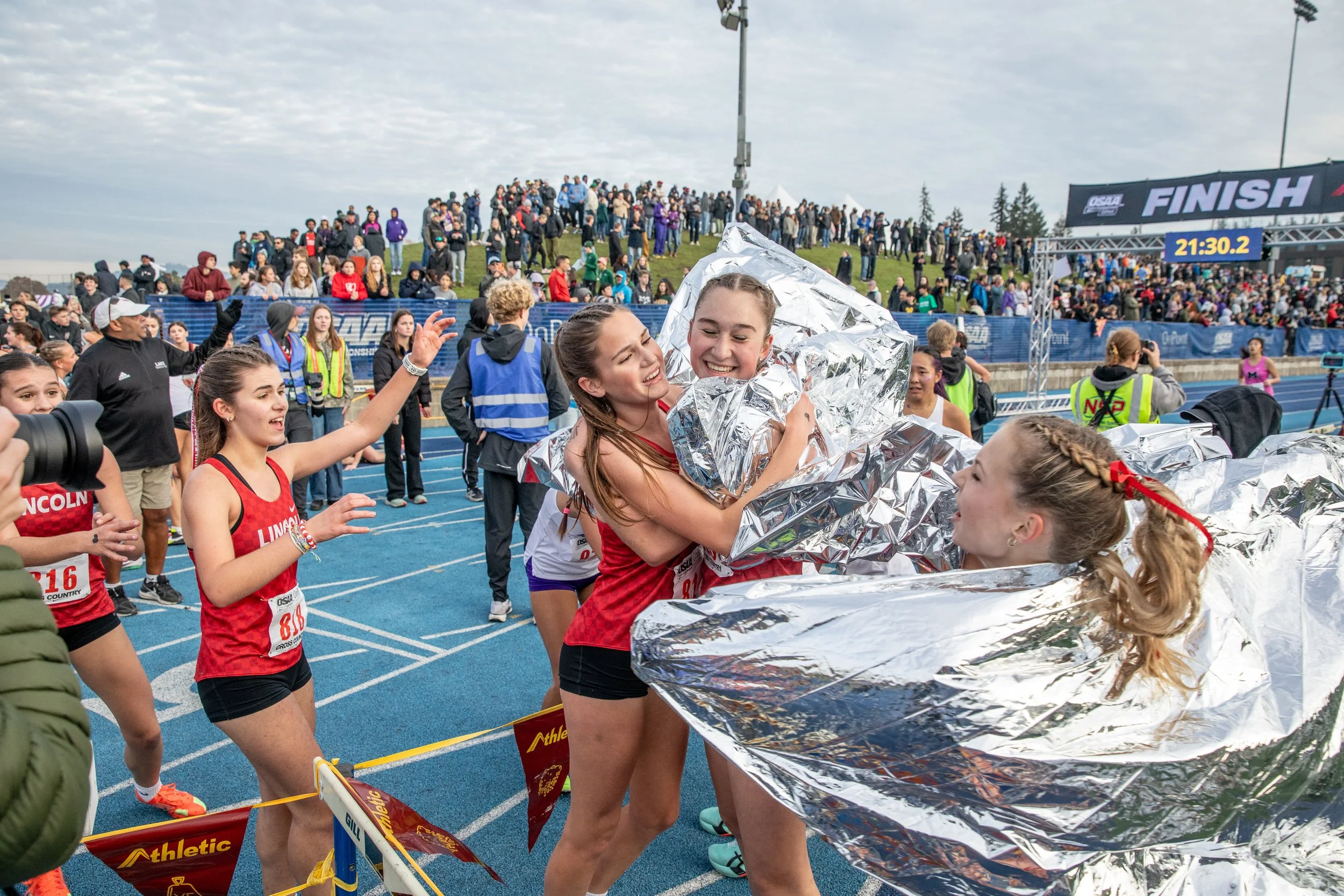
Lincoln High School competitors hug and celebrate after their team took first in the girls 6A division of the OSAA State Cross-Country Championships on Nov. 8, 2025.
Springfield's Adrian Estes runs past the finish line, placing eighth after competing in the OSAA State Cross-Country Championships 5A 5000m division on Nov. 8, 2025.
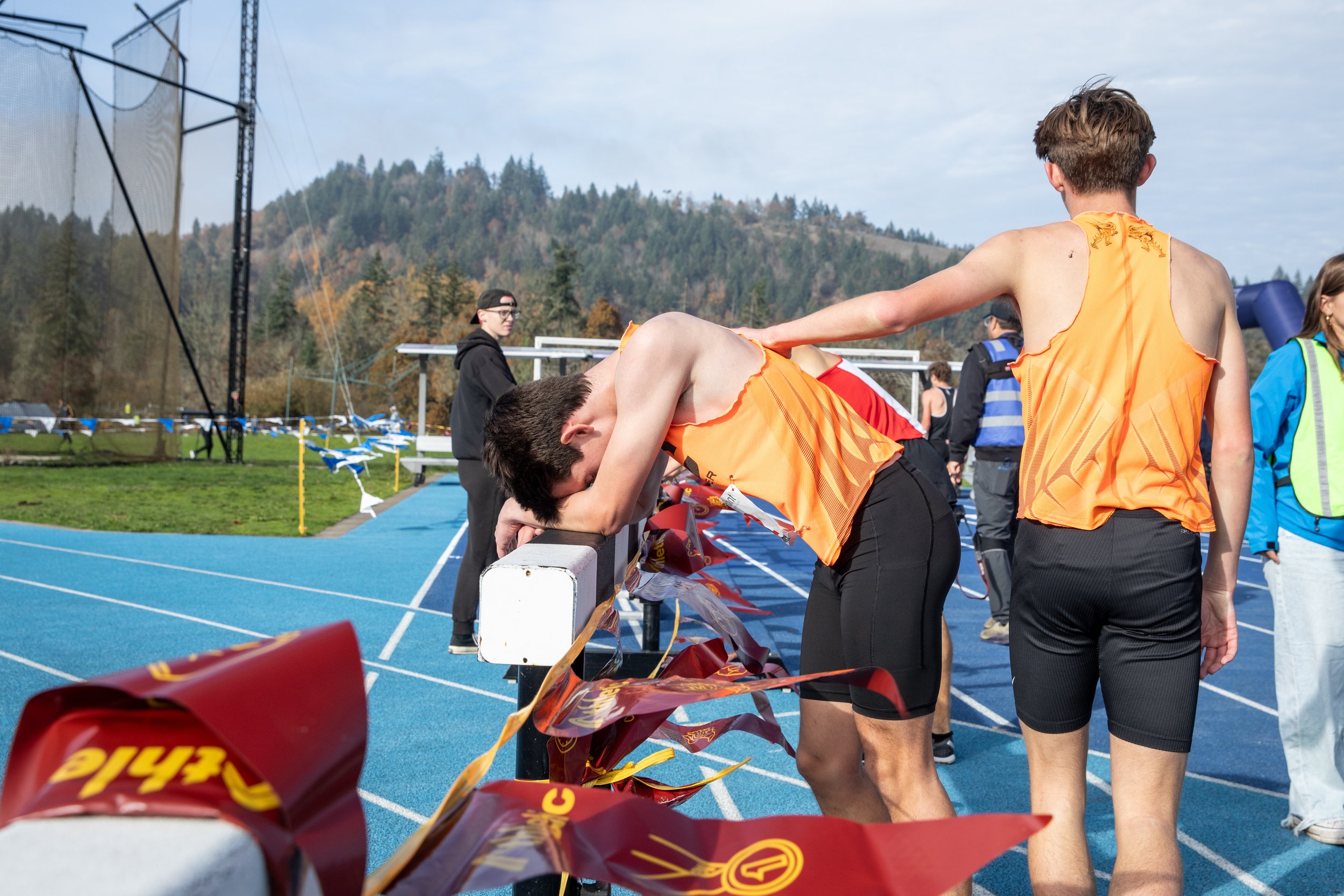
A Crater High School student consoles his teammate after competing in the OSAA State Cross-Country Championships on Nov. 8, 2025.
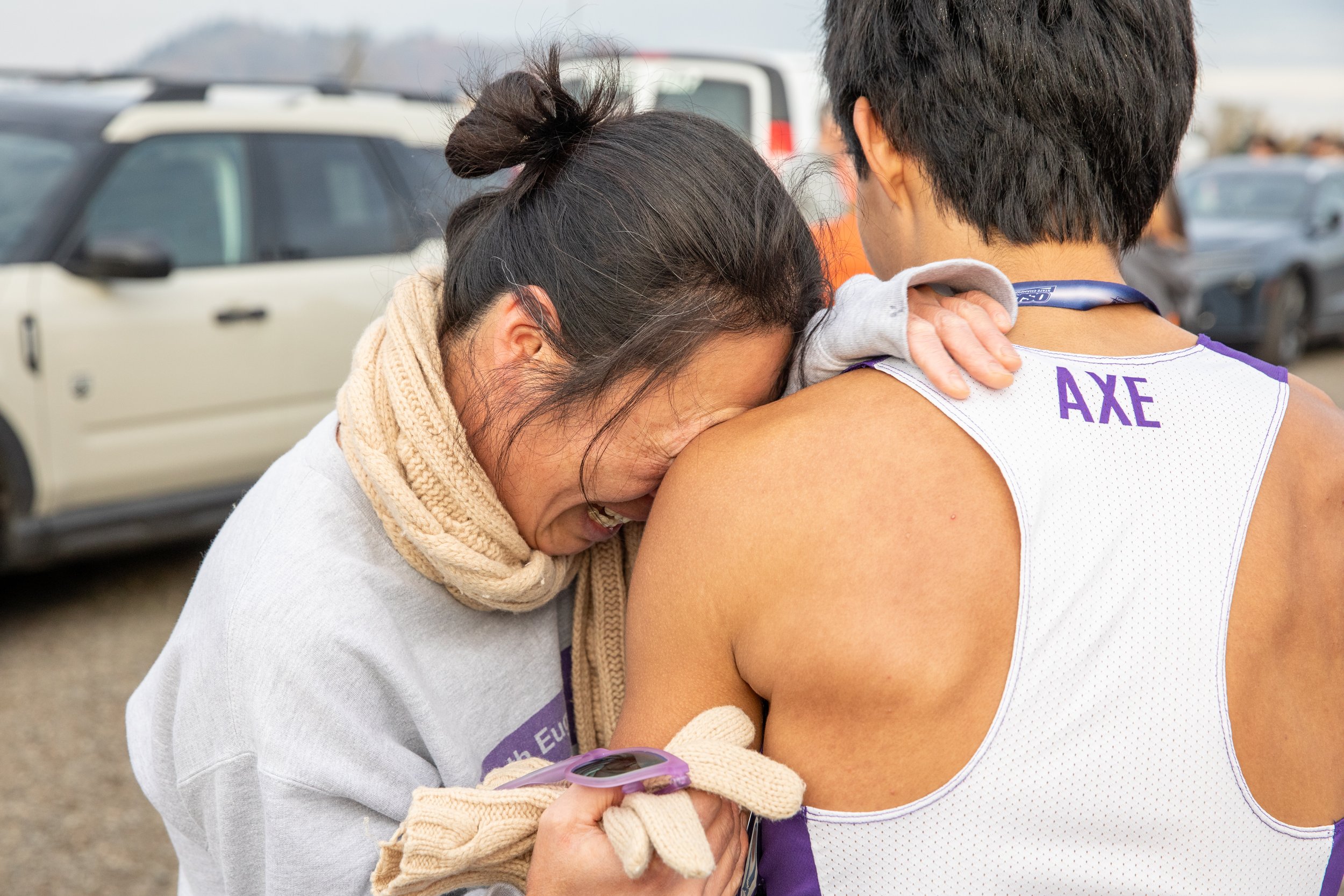
Tomoko Shibata cries into her son Yosuke Shibata's shoulder after he took first place for South Eugene High School in the 6A division of the OSAA State Cross-Country Championships on Nov. 8, 2025.
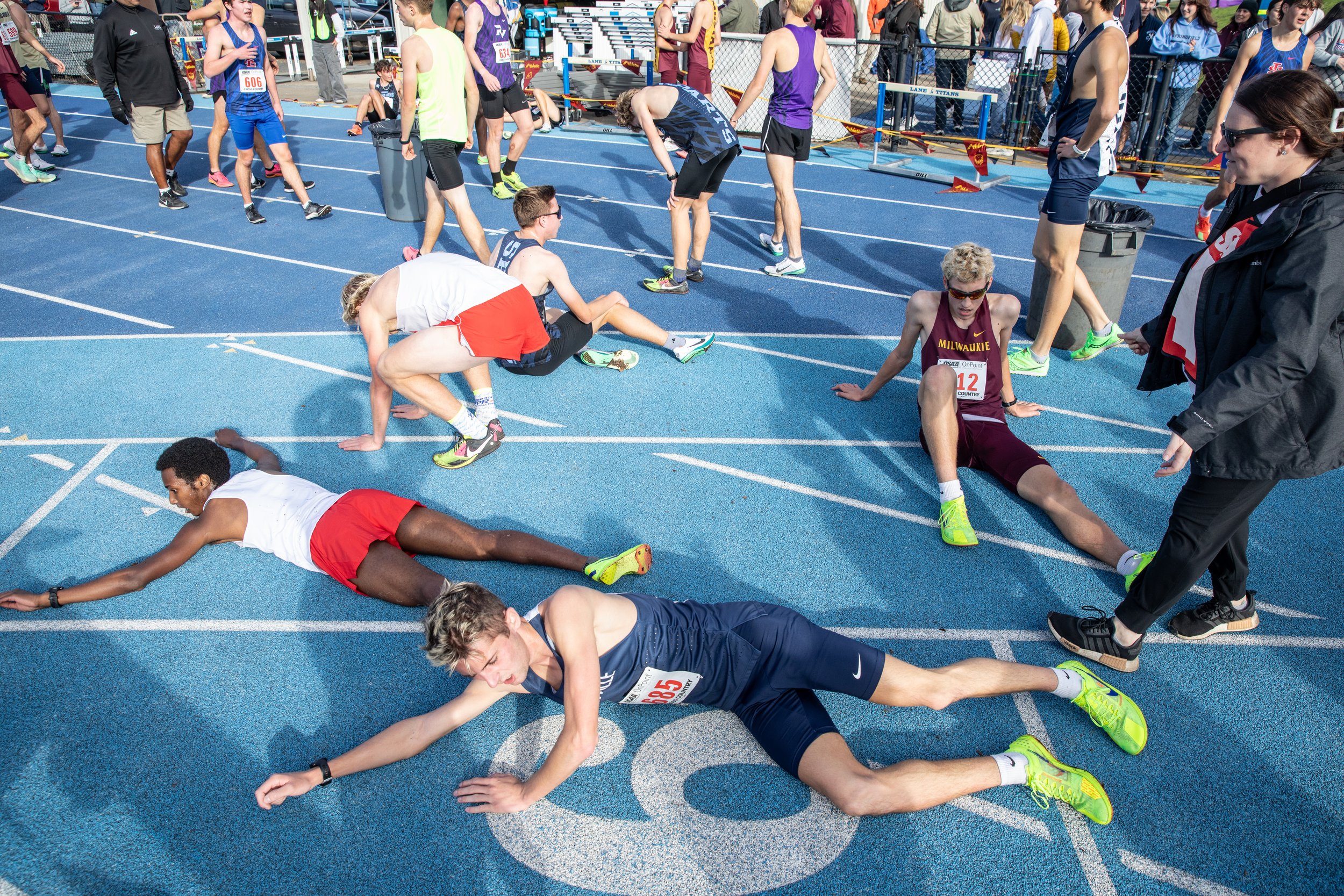
Runners collapse on the ground after crossing the finish line at the OSAA State Cross-Country Championships in Eugene.
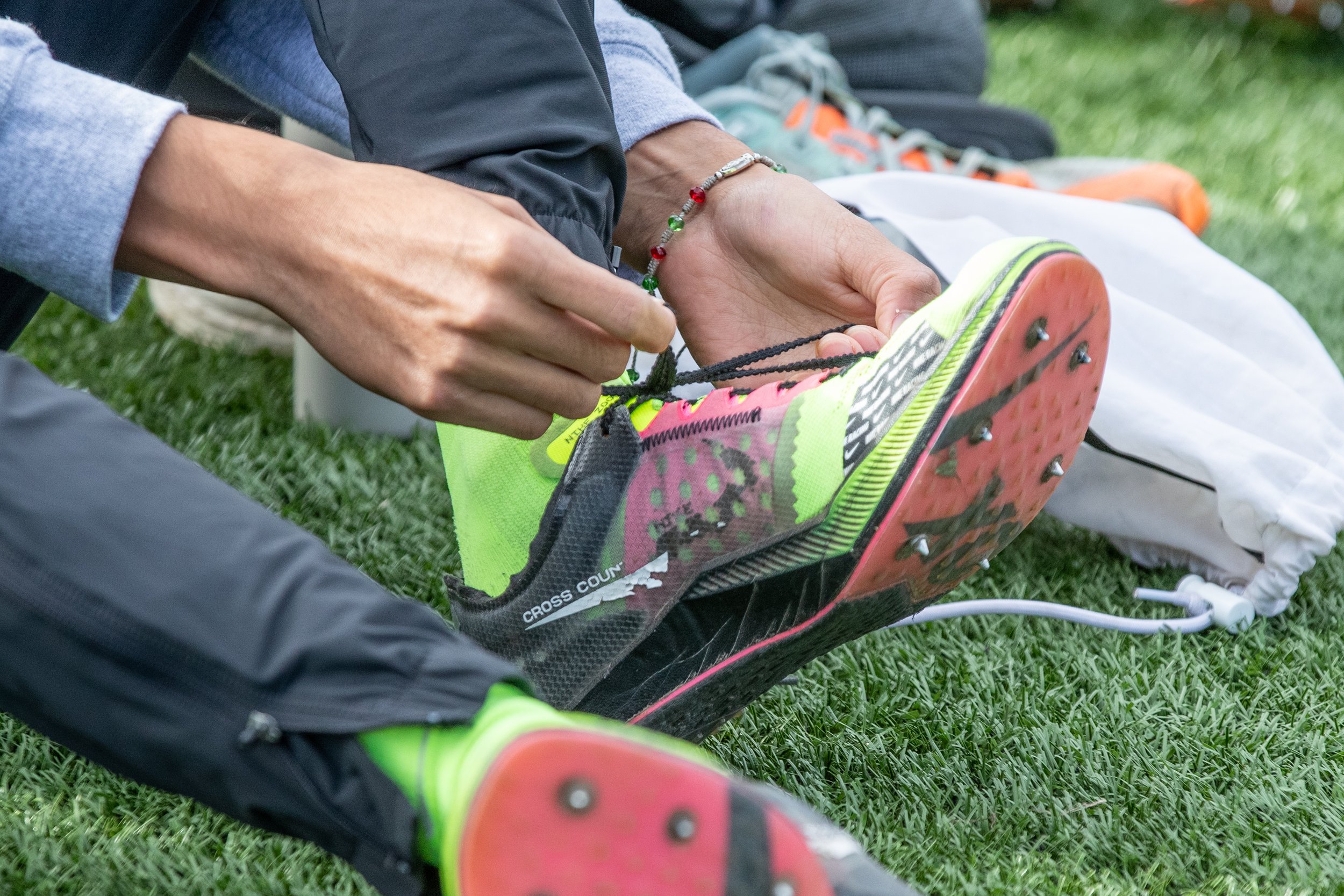
A runner laces his shoes before competing in the OSAA State Cross-Country Championships on Nov. 8, 2025.
Central Catholic's Benjamin Canaday shouts and celebrates with his team after upsetting Willamette 27-20 in the OSAA 6A championships quarterfinals at Willamette High School in Eugene.
Oregon Ducks Head Coach Dan Lanning, left, and ESPN's College GameDay host Pat McAfee rip their shirts off and yell to a crowd of fans at the University of Oregon campus in Eugene on Saturday, Oct. 11, 2025.
Fans cheer and yell as hundreds of people gather for ESPN's College GameDay held at the University of Oregon campus in Eugene Saturday morning, Oct. 11, 2025.
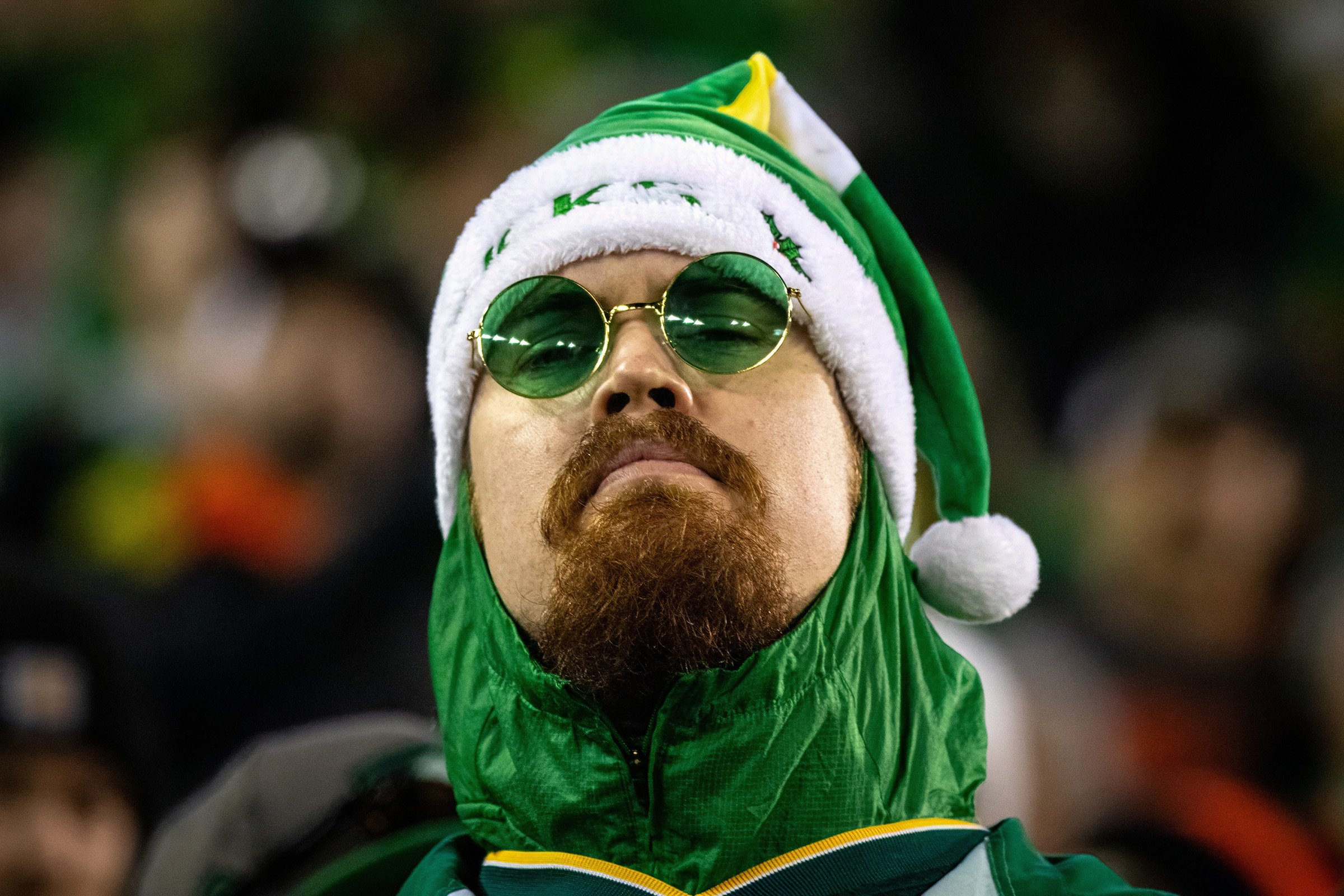
A spectator looks on after the University of Oregon Ducks score a touchdown against the Oregon State Beavers. The Ducks defeated the Beavers 31-7 in what could be a historic end to the teams’ rivalry as the Ducks leave the Pac-12 to join the Big Ten conference.
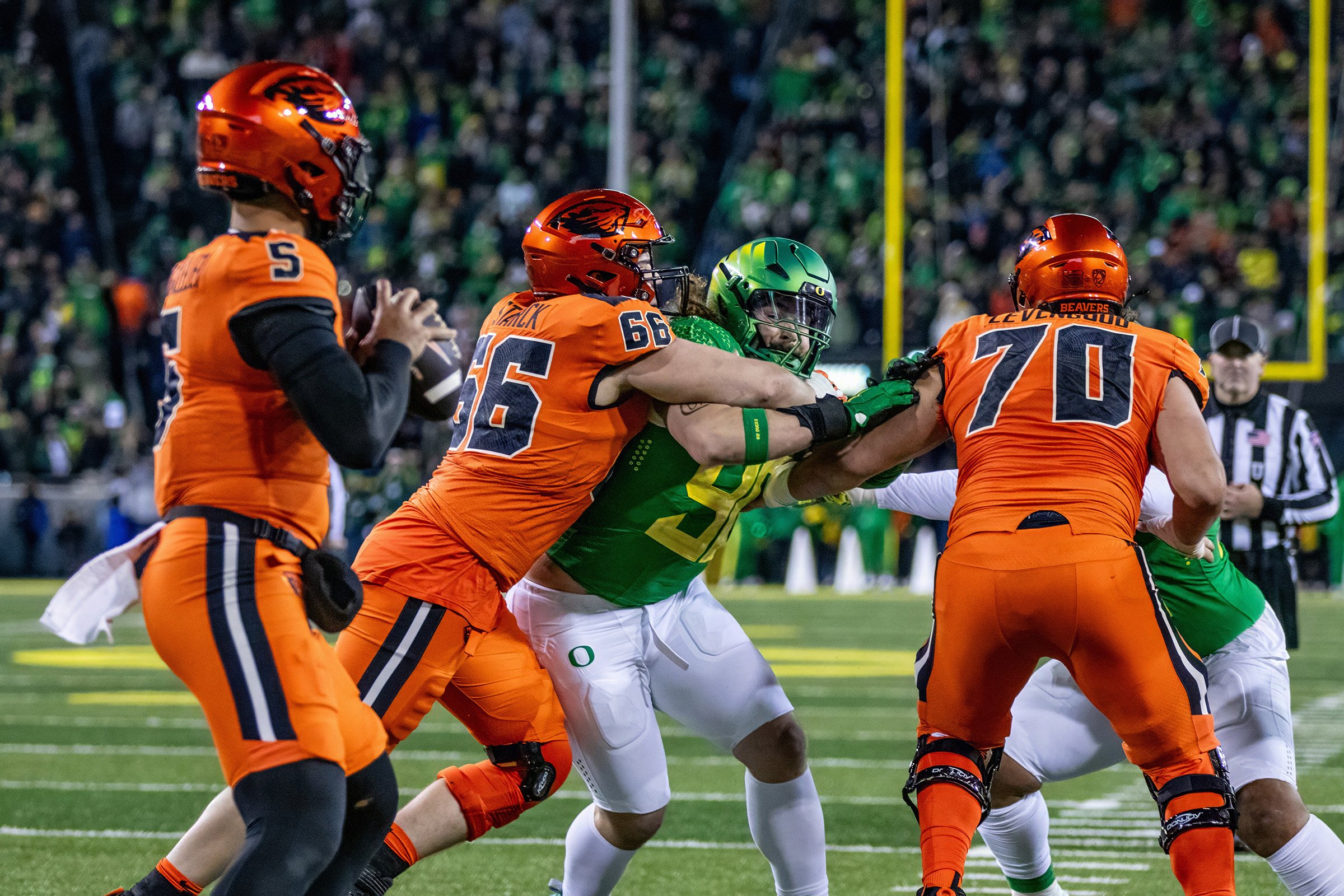
Ducks defensive lineman Casey Rogers (#98) tries to force his way to Beavers quarter back DJ Uiagalelei (#5). The University of Oregon Ducks defeated the Oregon State University Beavers 31-7 in what could be a historic end to the teams’ rivalry as the Ducks leave the Pac-12 to join the Big Ten conference.
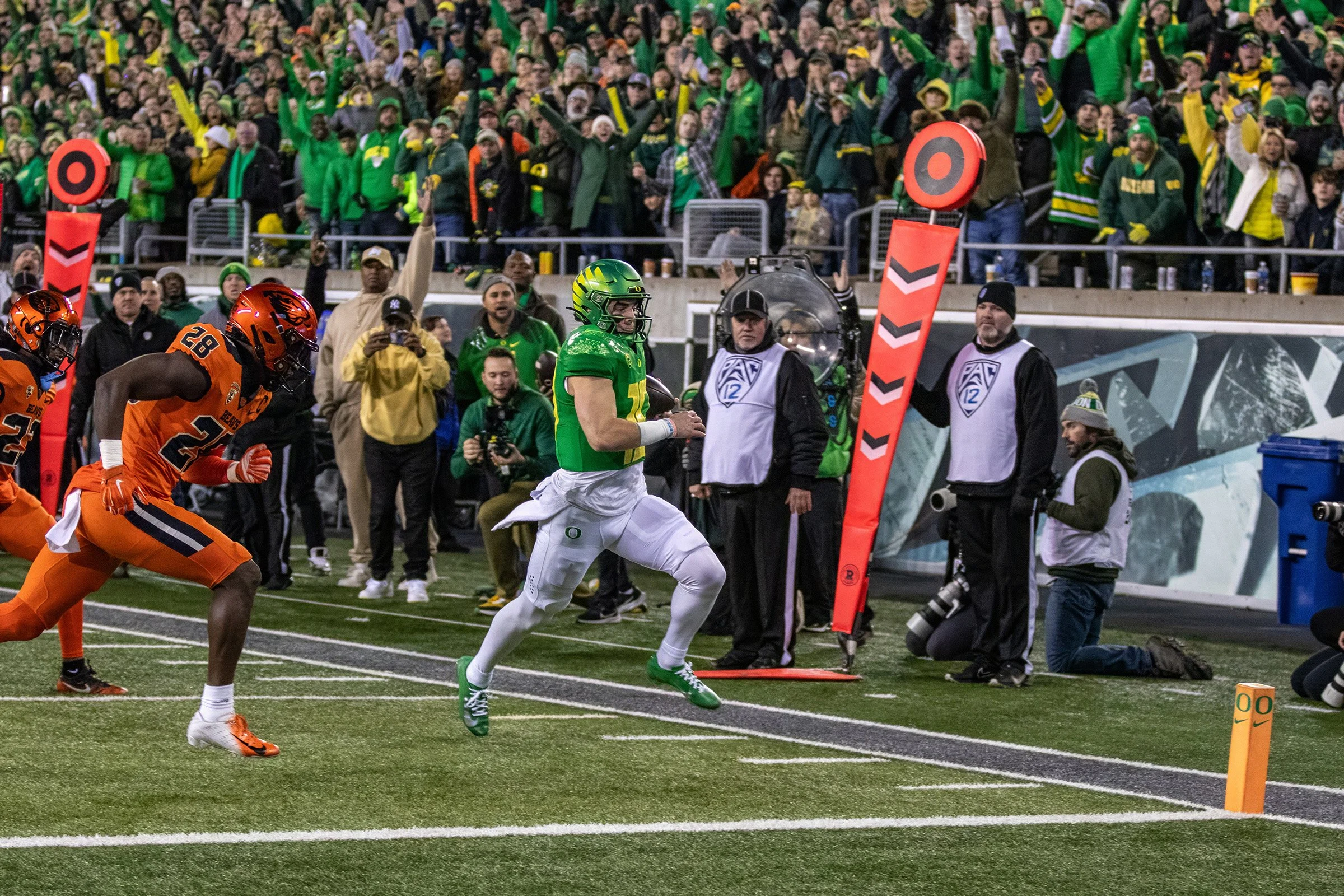
Ducks quarterback Bo Nix (#10) carries the ball to the end zone.
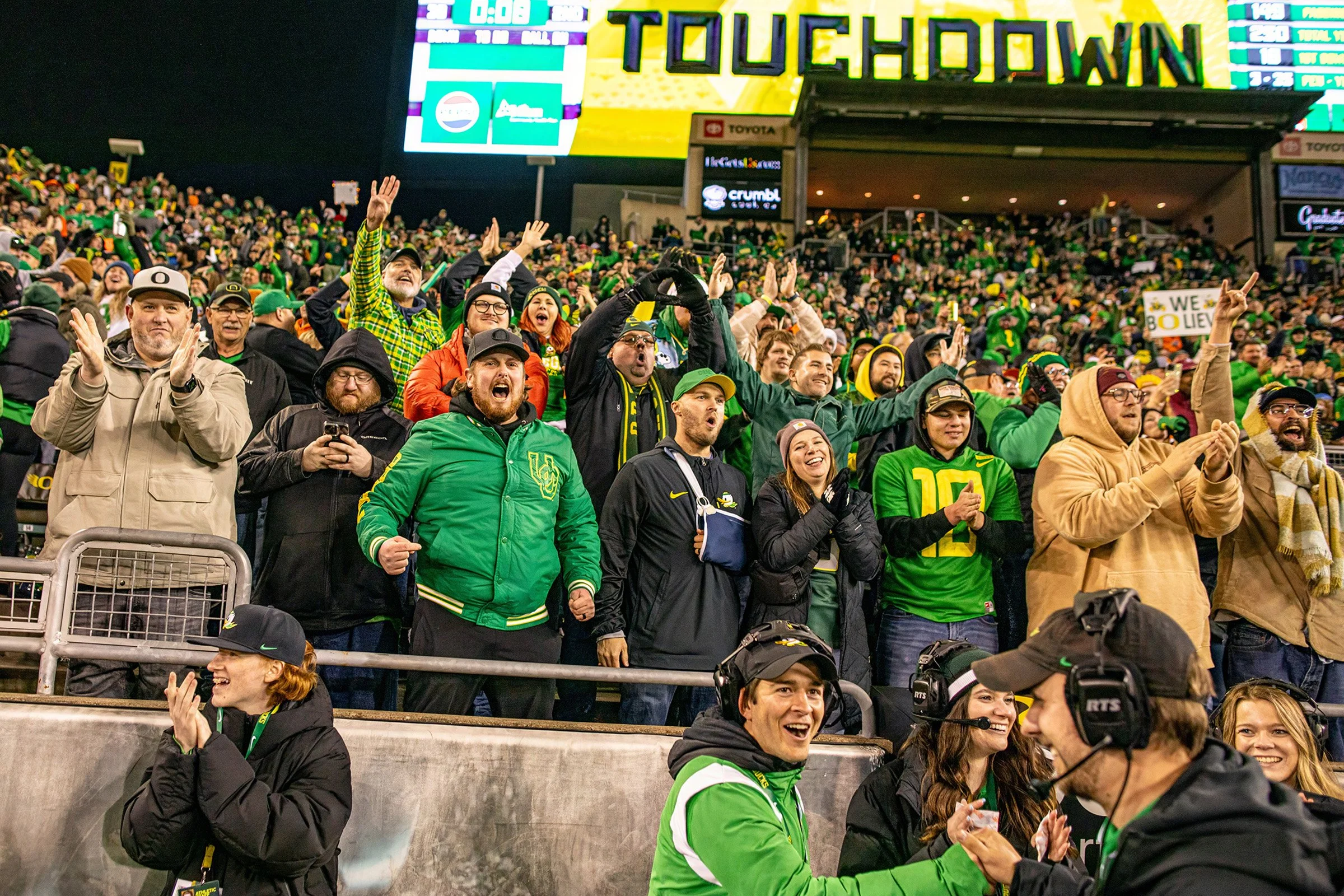
Fans cheer after Ducks quarterback Bo Nix scores a touchdown against the Beavers.
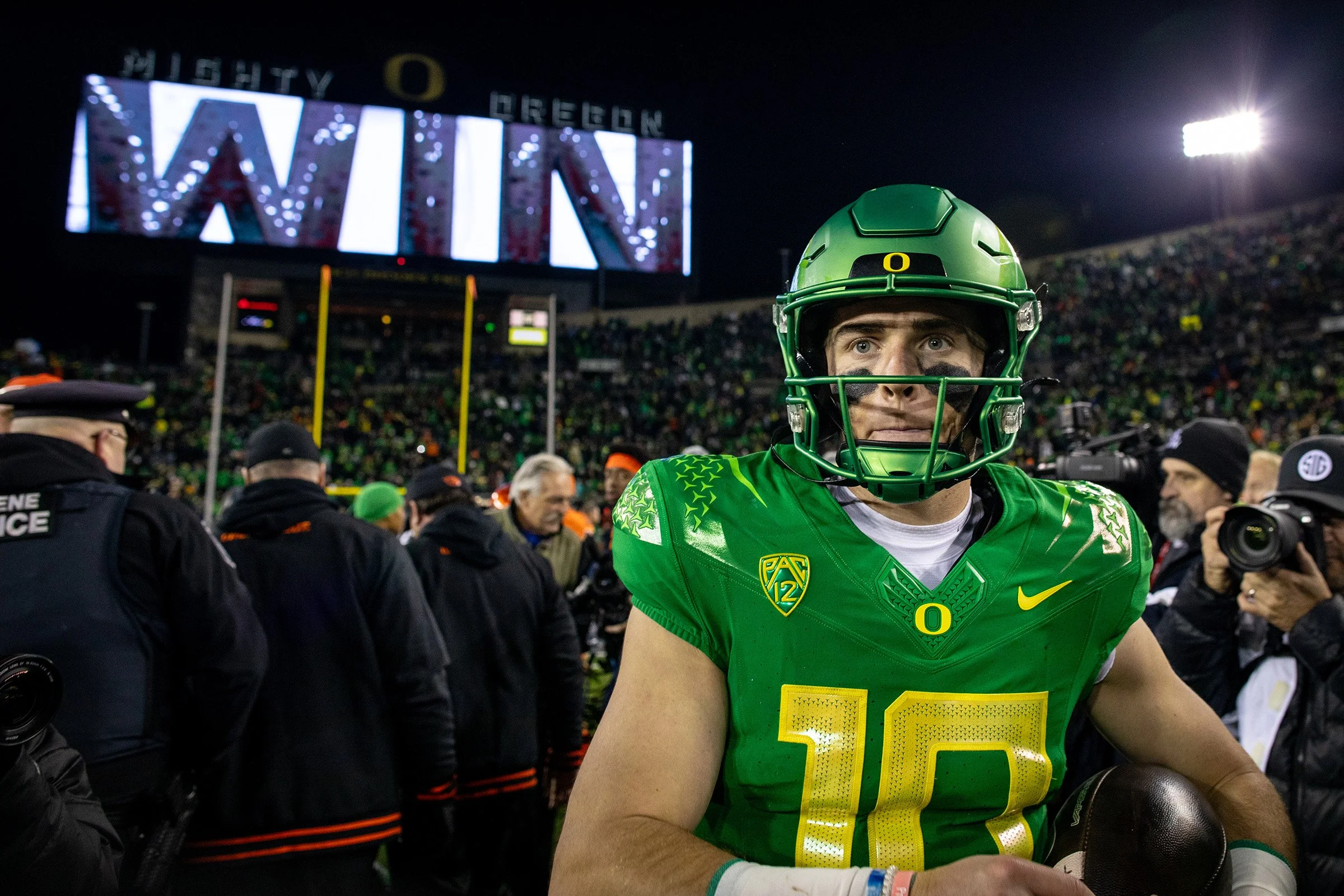
Ducks quarterback Bo Nix stands at the center of the field after defeating the Beavers.
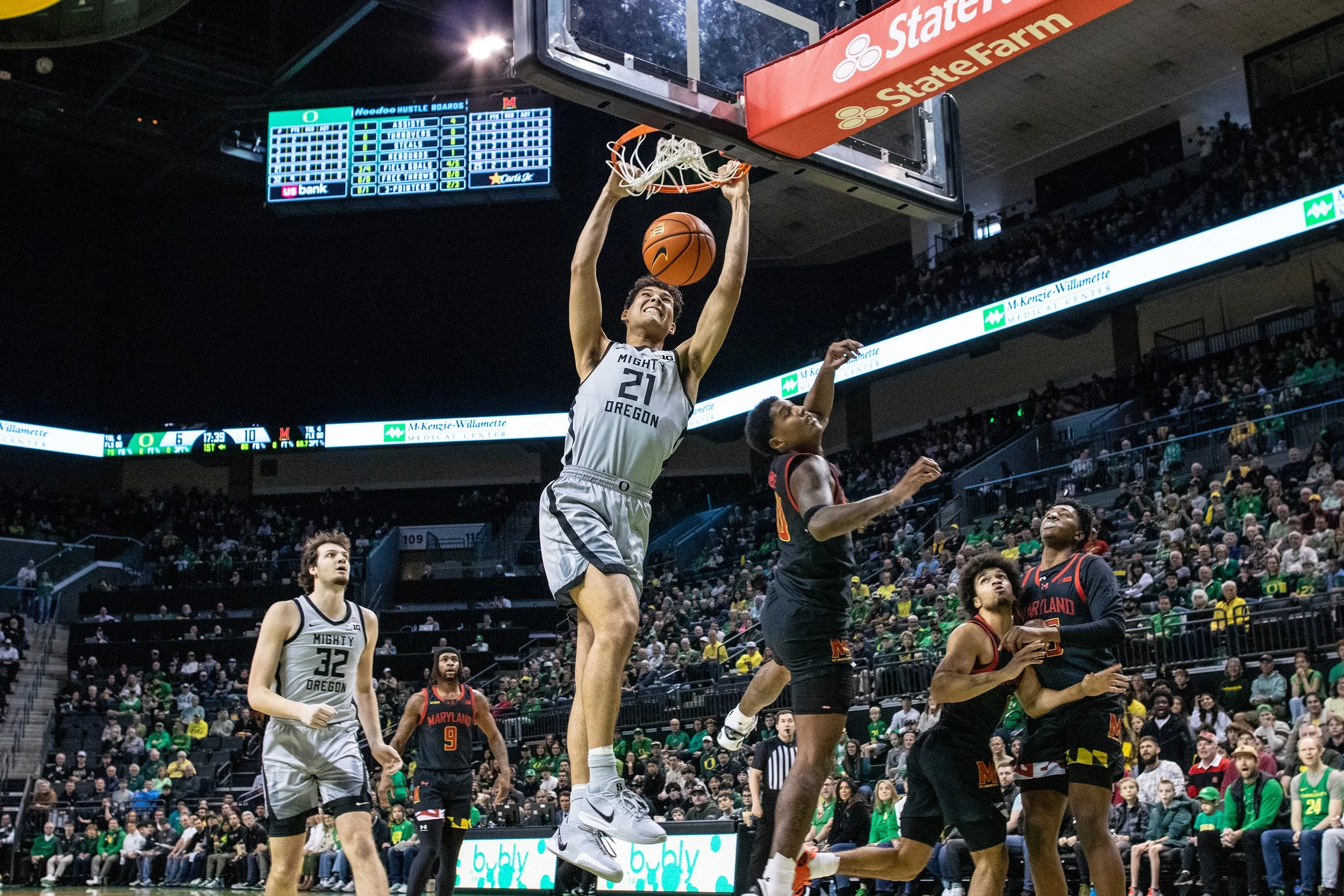
Ducks Brandon Angel (#21) dunks the ball. The University of Oregon Ducks men’s basketball team defeated the Maryland Terrapins 83-79 in Matthew Knight Arena on Jan. 5, 2025.
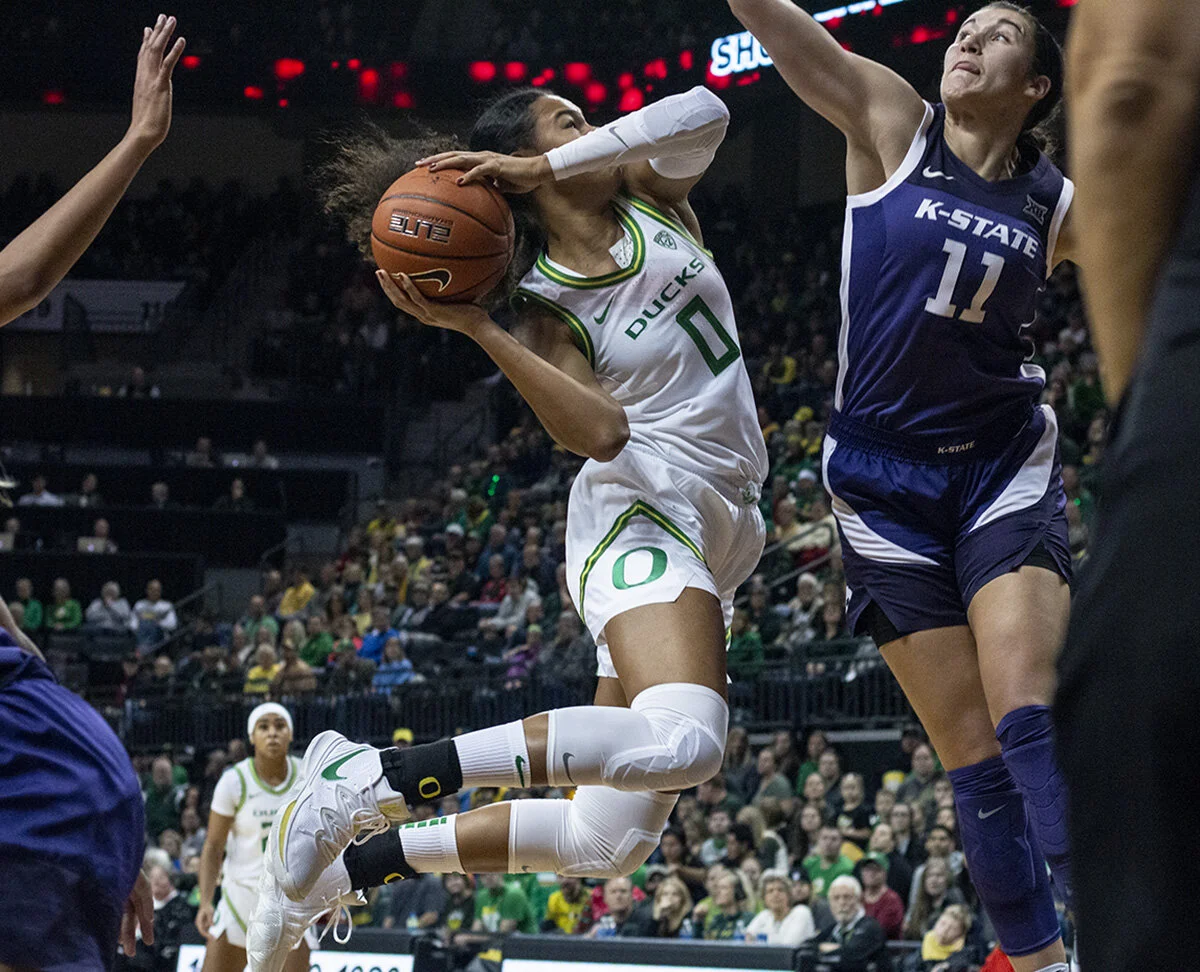
University of Oregon Ducks Satou Sabally (#0) jumps and tries to shoot past Kansas State Wildcats Peyton Williams (#11). The University of Oregon Ducks women’s basketball team defeated the Kansas State Wildcats 89-51 in Matthew Knight Arena Saturday. Sabrina Ionescu ran up her 21st triple-double with 21 points, 10 rebounds and 11 assists.
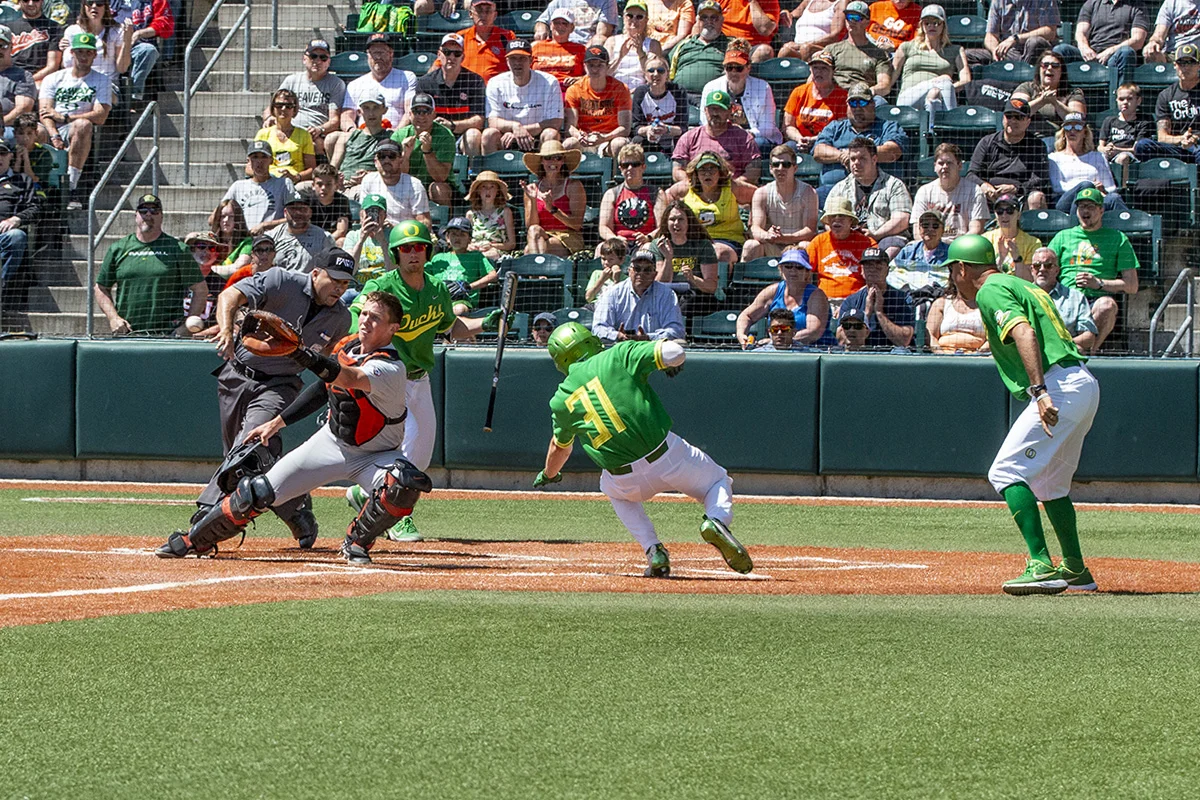
University of Oregon Ducks batter Tanner Smith (#31) tries to slide to home base before he can be tagged out by Oregon State University Beavers catcher Adley Rutschman (#35).
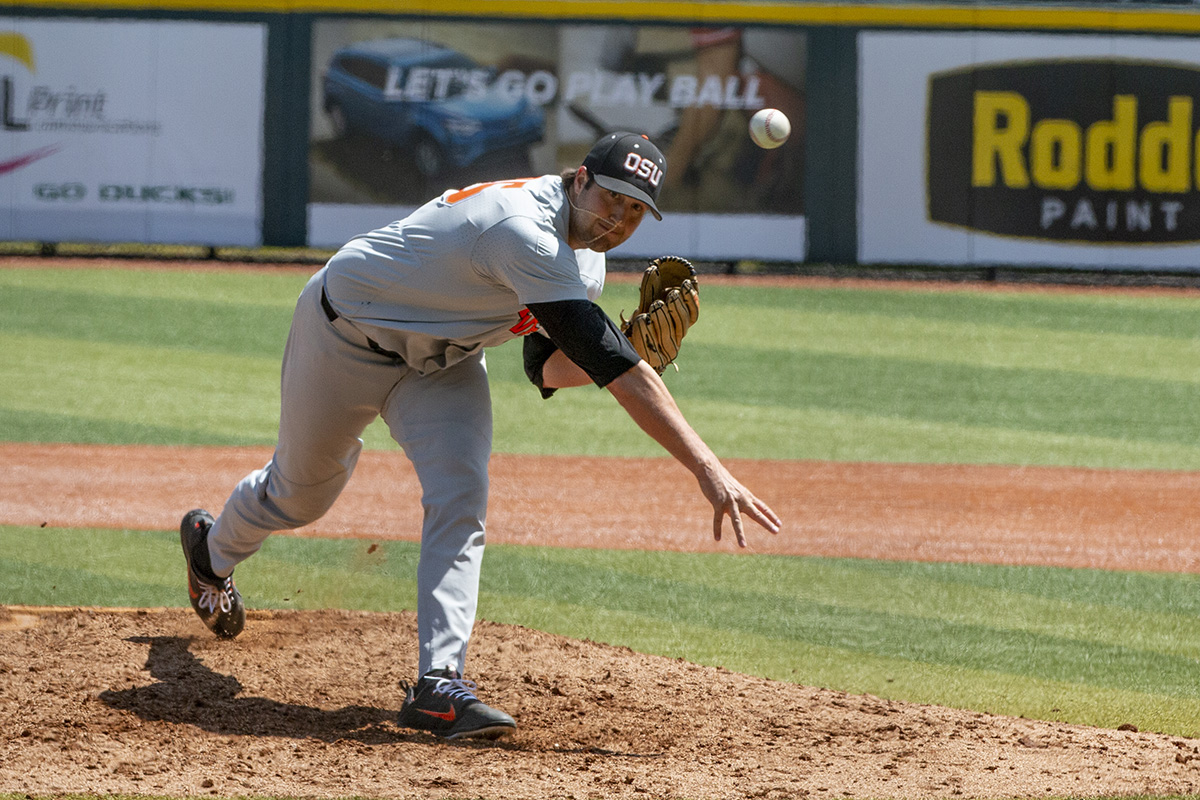
Oregon State University Beavers pitcher Joey Mundt (#25) pitches the ball to a University of Oregon Ducks batter. The University of Oregon answered back to yesterday’s loss by defeating Oregon State University 3-2 in an evenly matched game between the two teams.
University of Oregon Ducks batter Max Foxcroft (#18) connects his bat to the ball. In a one-sided game between the University of Oregon Ducks and Standford University, Stanford beat the Ducks with a decisive score of 10–0.
In Eugene, Oregon, the Eugene Islamic Center located on 1856 W Broadway is the only mosque in the city. Founded on May 28, 2012, the mosque serves as a local gathering place for the Muslim community of Eugene.
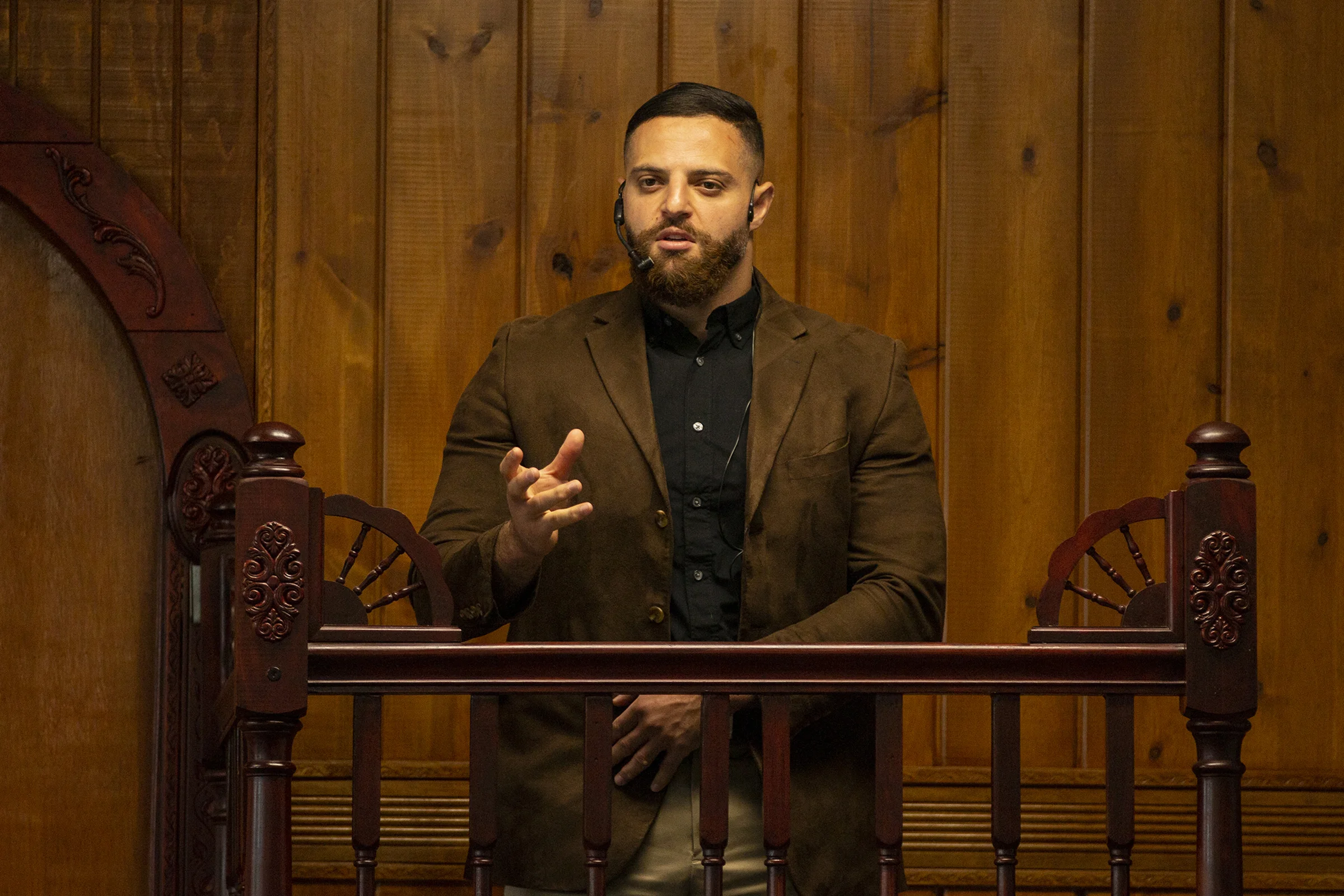
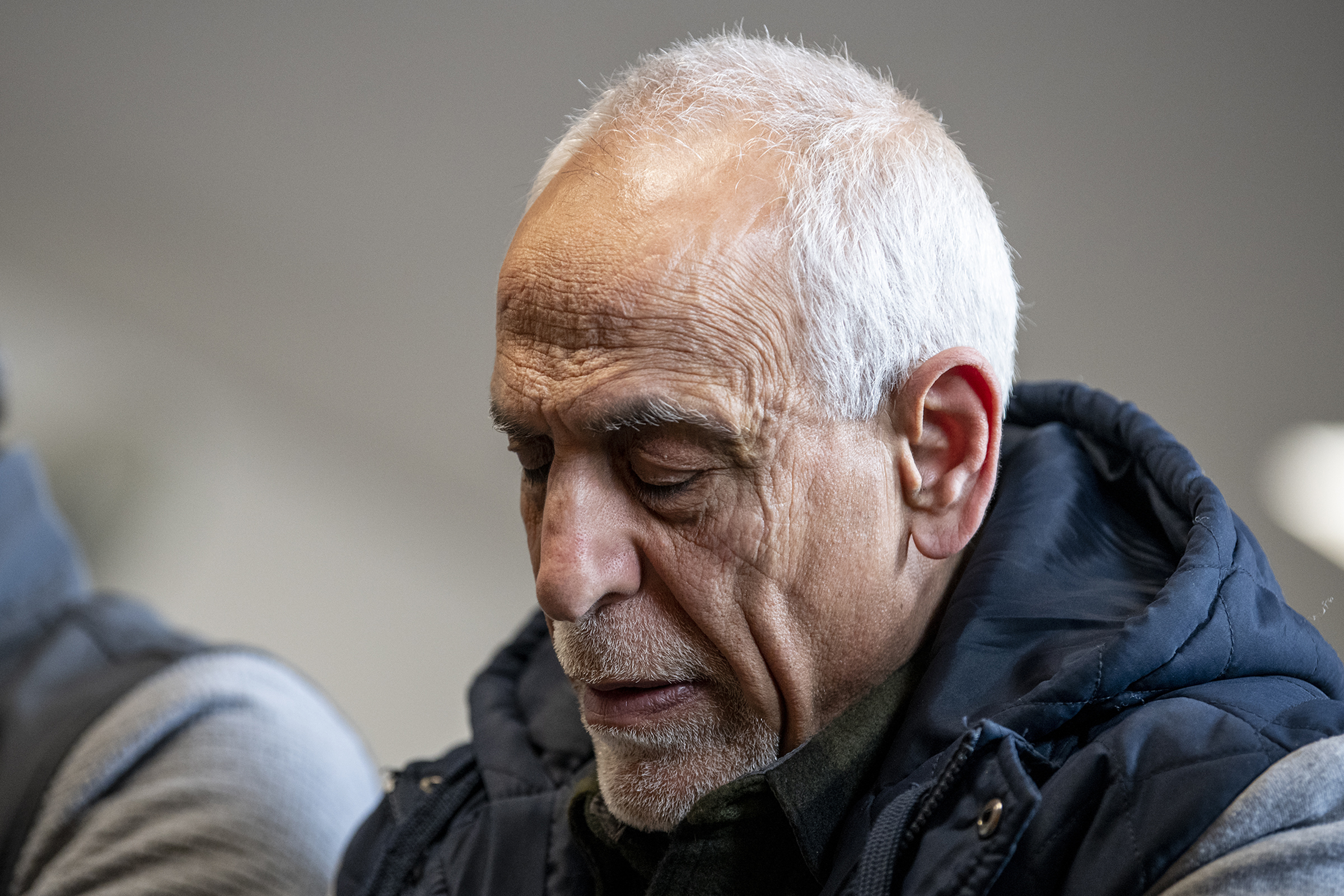
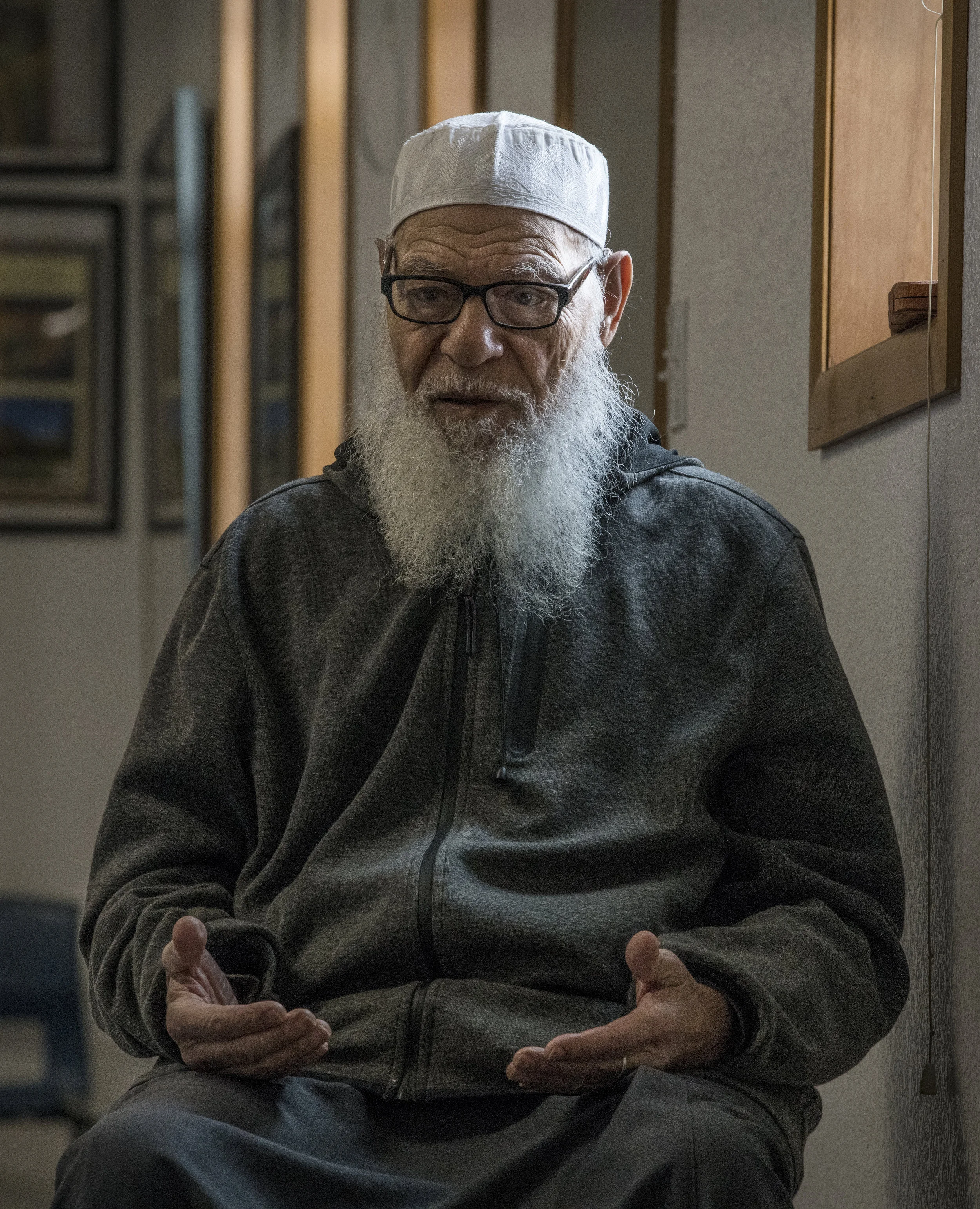
Eugene Islamic Center Imam Yosof Wanly speaking to worshipers attending Friday prayer. In a mosque, the individual who leads payer, provides religious guidance and serves as a community leader is known as an imam.
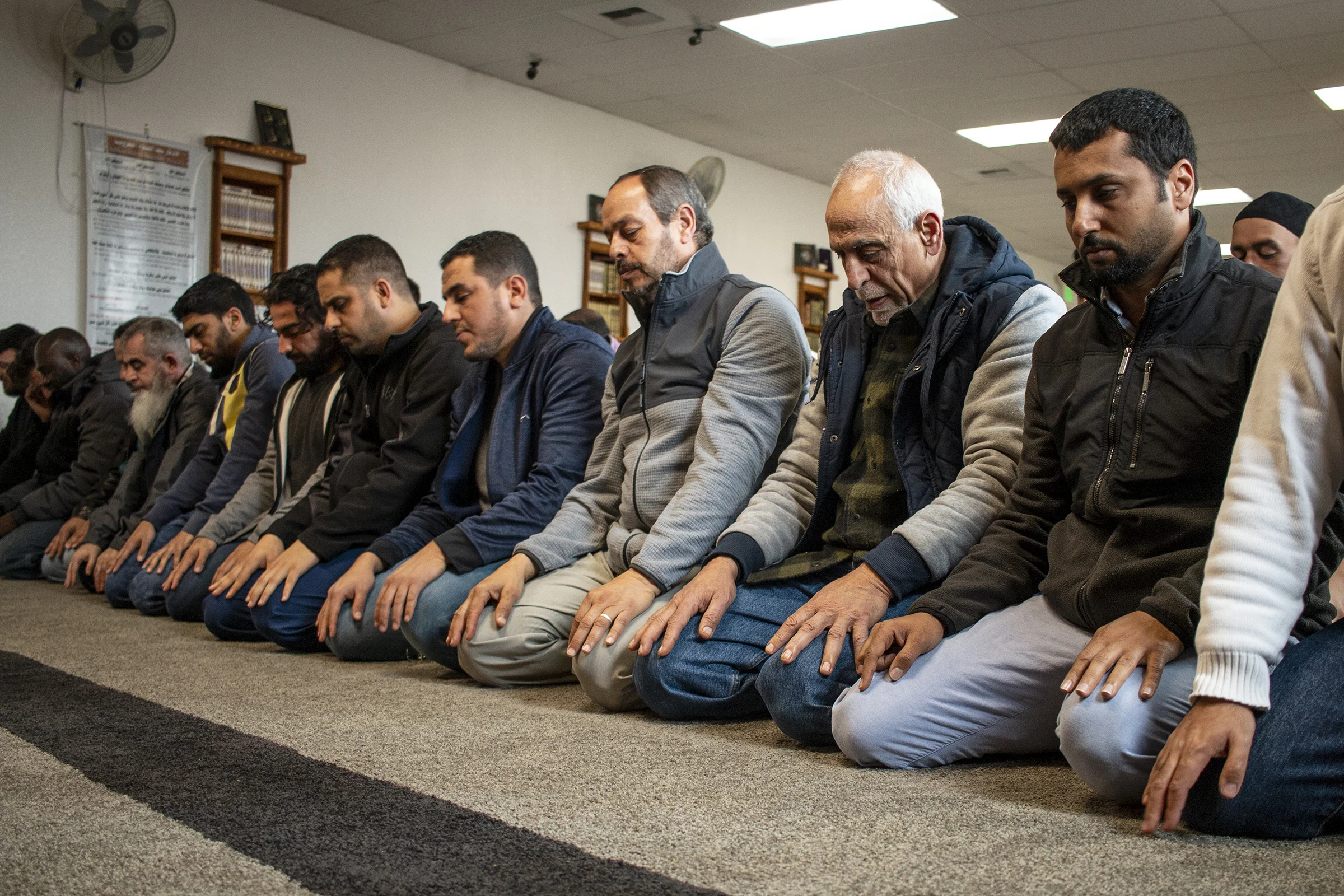
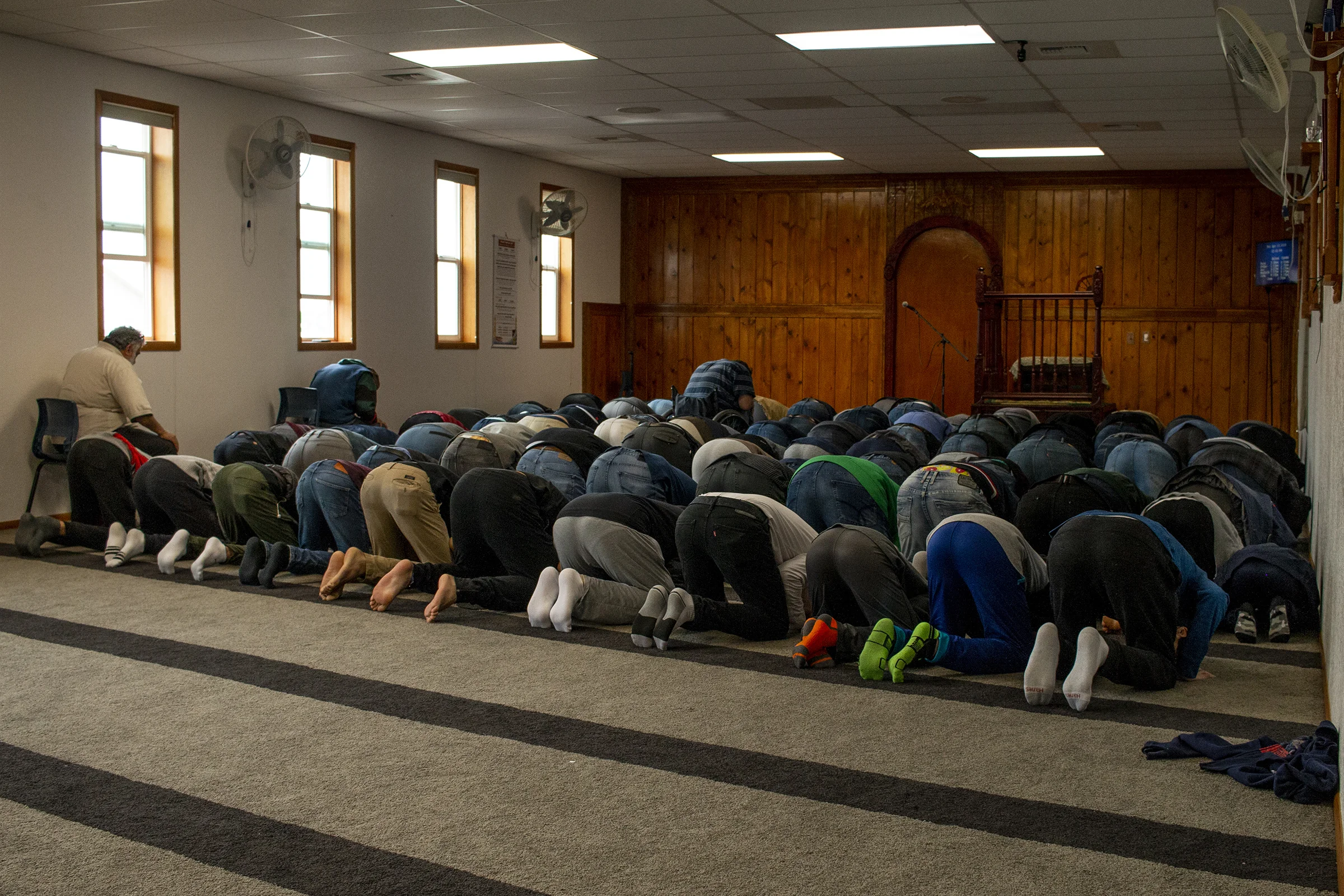
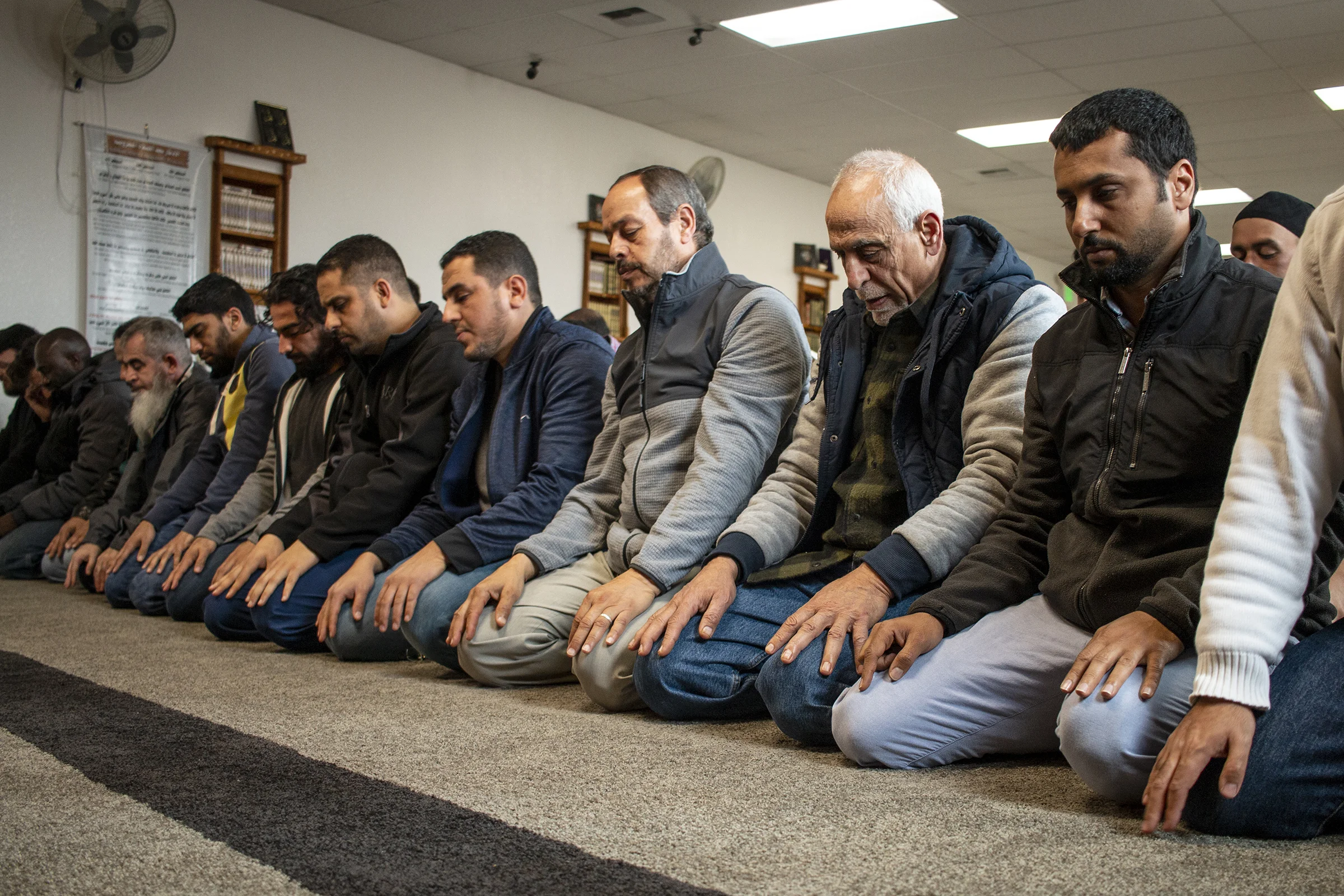
Muslim worshipers pray during Salat al-Jummu’ah (Friday Prayer). Prayer is just one of the five core beliefs, known as The Five Pillars of Islam, that Muslims satisfy as part of the religion of Islam. The remaining pillars entail sincerity during Shahadah (statement of faith), giving charity to the poor, fasting during the month of Ramadan and pilgrimage to Mecca.
Ibrahim Hamide prays during the midday prayer, Salat al-dhuhr. There are five daily prayers in Islam: Salat al-fajr, Salat al-dhuhr, Salat al-‘asr, Salat al-maghrib and Salat al-‘isha. Each prayer takes place at different times throughout the day in accordance with the timing and positioning of the Sun.
Muhamad Elsherif prays at the Eugene Islamic Center during Friday prayer. Elsherif wears a skullcap known as a taqiyah. The taqiyah is commonly worn by Muslims in order to emulate the founder of Islam The Prophet Muhammad. A taqiyah is traditionally white in color.
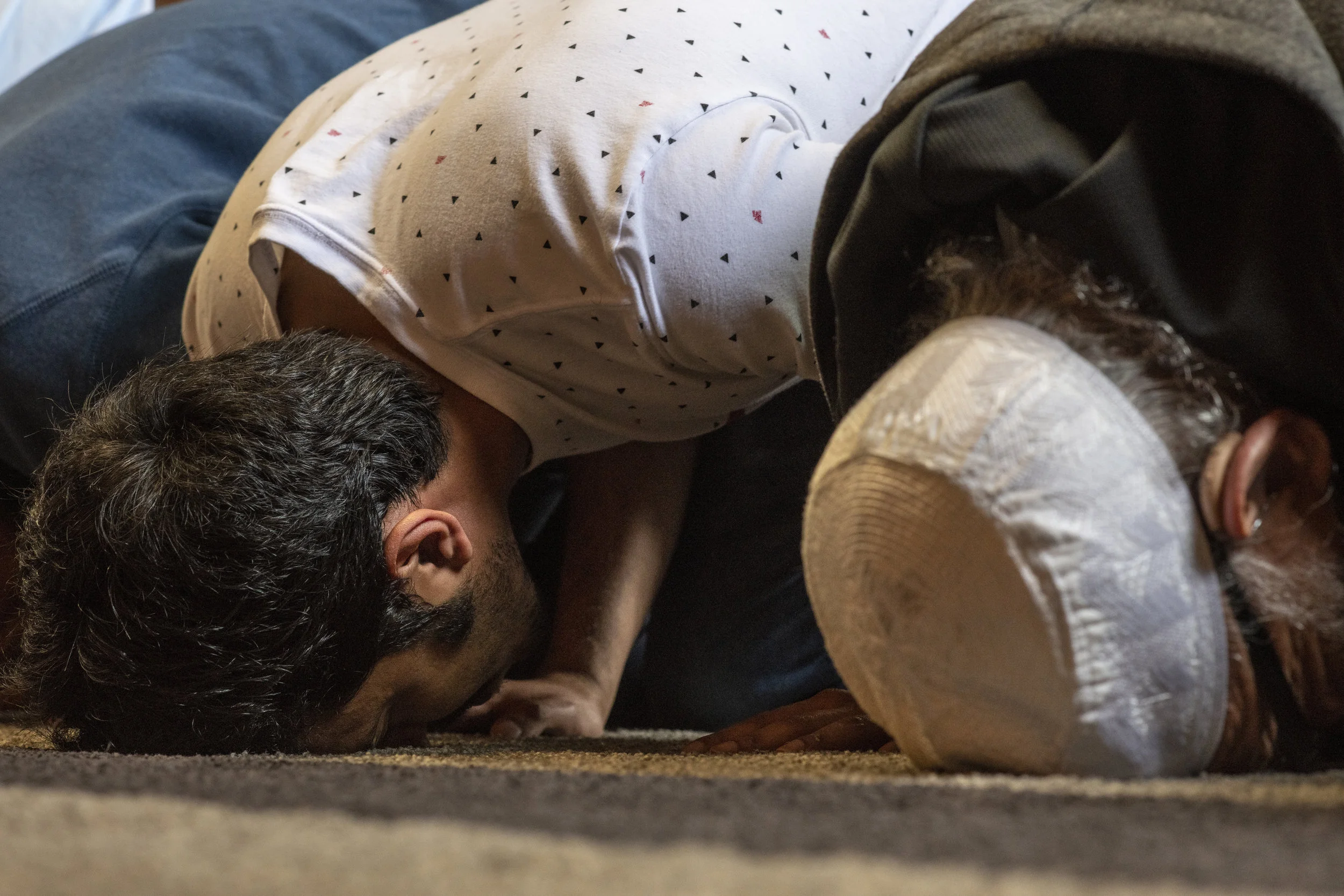
Badr Alsultan, left, and Elsherif, right, bow during prayer at the Eugene Islamic Center. Muslims place their foreheads on the ground during prayer in order to demonstrate prostration and faith in Allah, the sole god in Islam.
Worshipers and guests are expected to wear modest clothing when entering a mosque. Anything beyond pants and T-shirts, such as shorts or tank tops, are viewed as disrespectful to wear inside a Mosque. Women wear a hijab or other traditional clothing to cover their hair when in a mosque, and they have a separate room for prayer in the building that men are not allowed to enter.
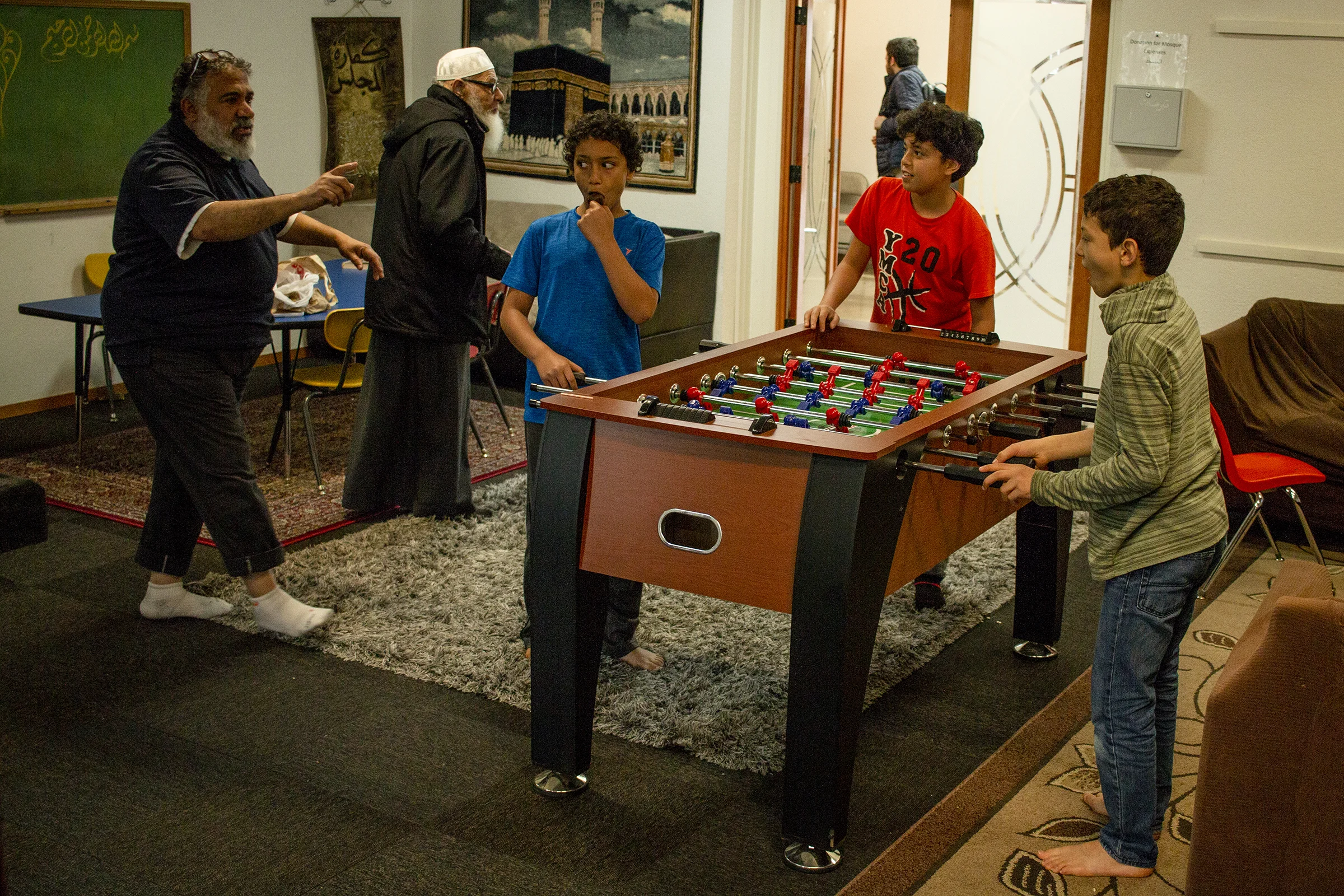
The Eugene Islamic Center has a foosball table in the main lobby of the building. Children who come to the Mosque play at the foosball table in-between prayers. In Islam, children typically do not practice Salat, the five daily prayers, until they reach puberty. In this case puberty being roughly defined as age 15.
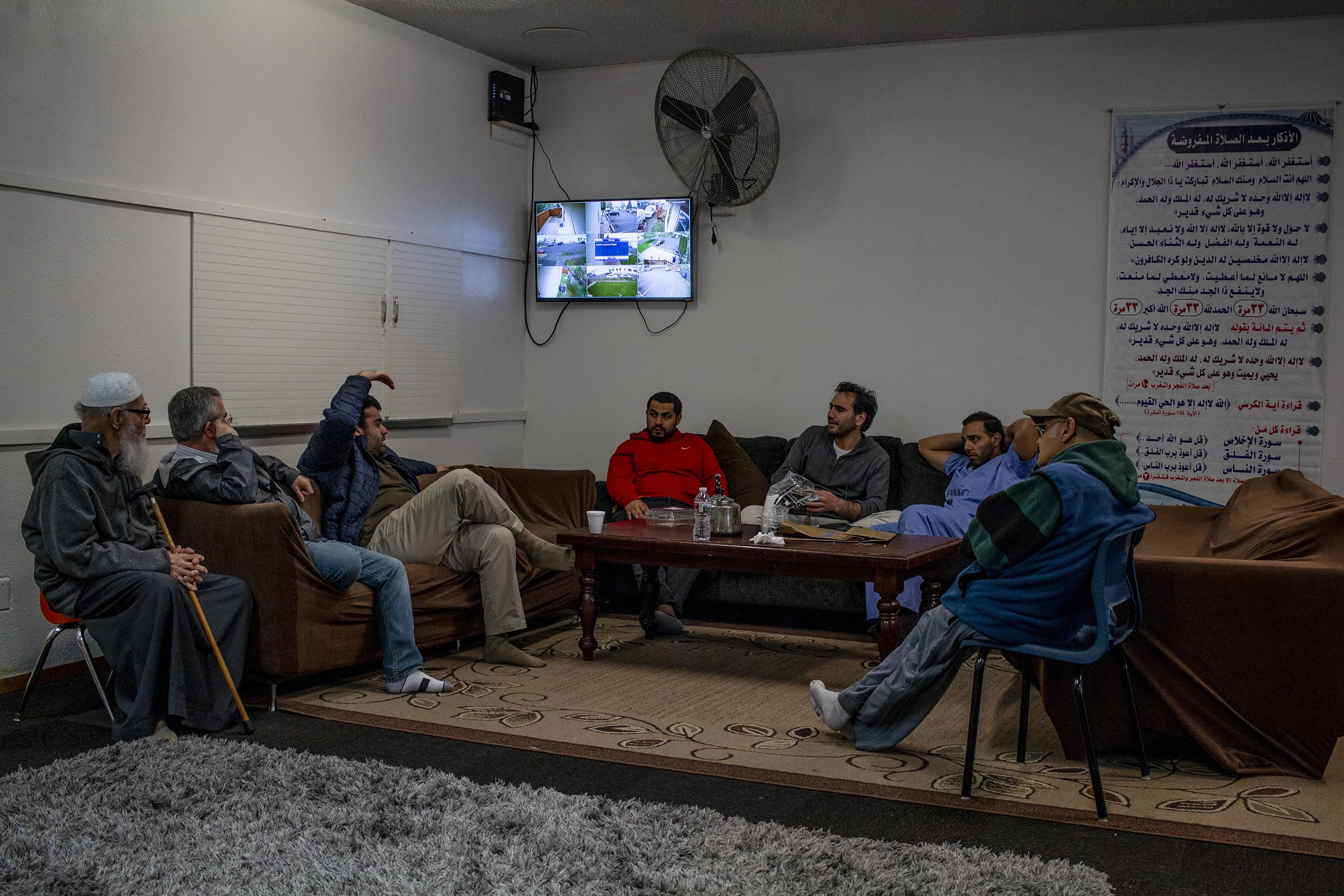
Worshipers at the Eugene Islamic Center talk after finishing the midday prayer. The mosque is a place of worship and a general gathering place for the Muslim community of Eugene.
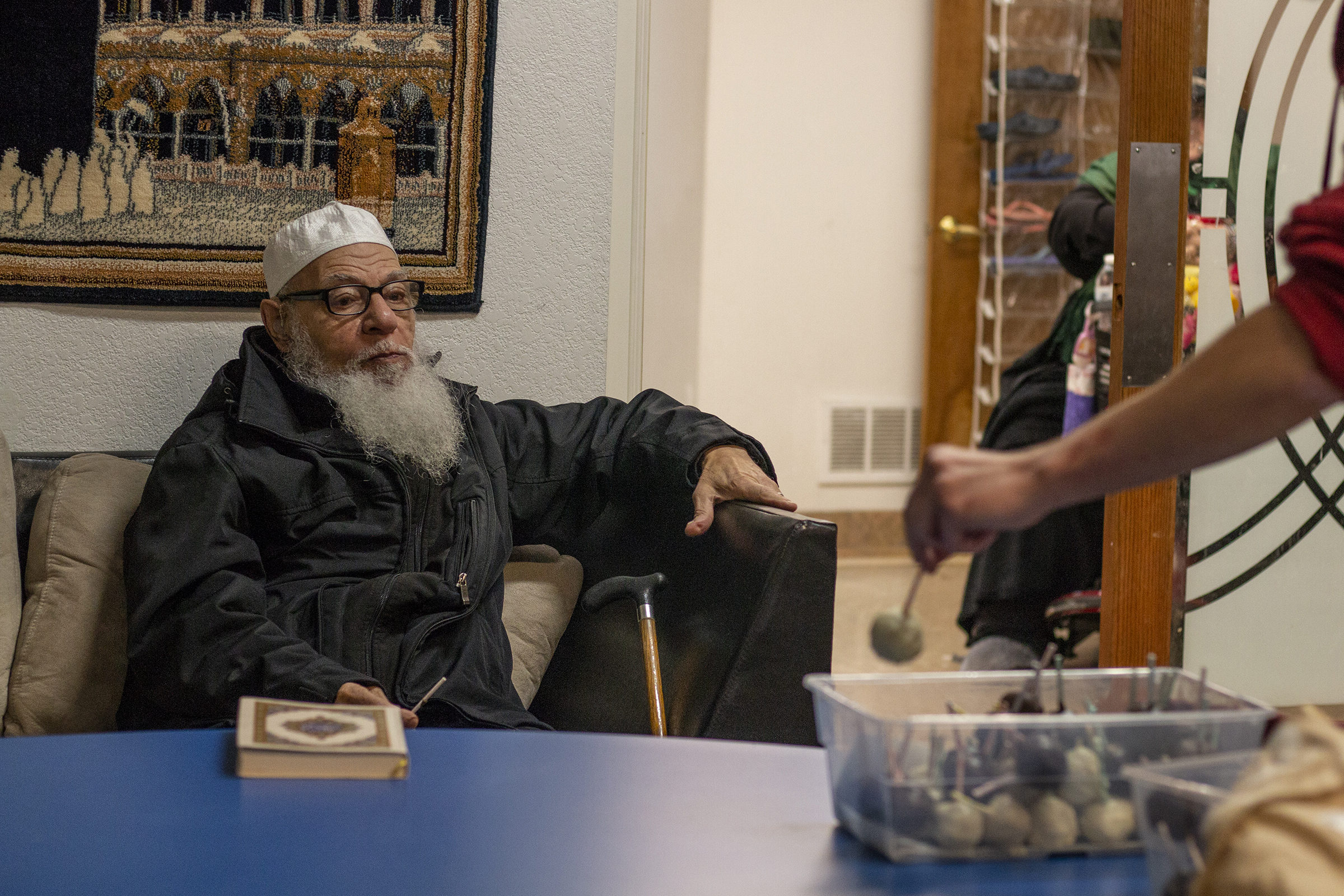
Elsherif eyes a cake pop after eating one of the freshly baked desserts. Community members of the Eugene Islamic Center commonly bring food in for snacks after prayer.
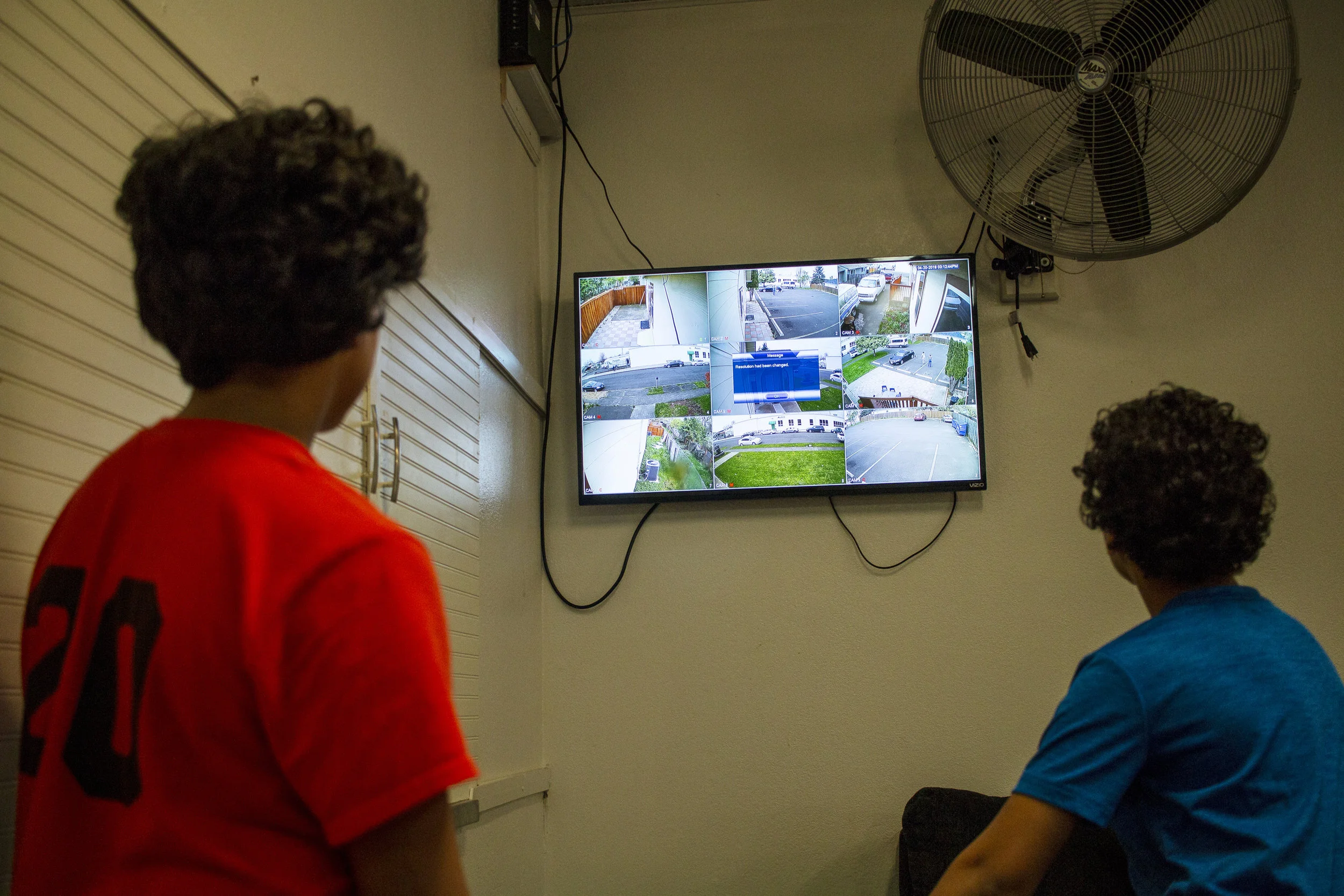
Hasan Eissa, left, and Belal Eissa, right, watch a flat-screen television connected to the security cameras setup around the Eugene Islamic Center. A security camera system was purchased for the mosque after a Eugene resident, Chad Russel, came to the mosque and threatened to kill the Muslim worshipers there. Russel was then arrested and charged with intimidation, menacing and harassment and carrying a concealed weapon.
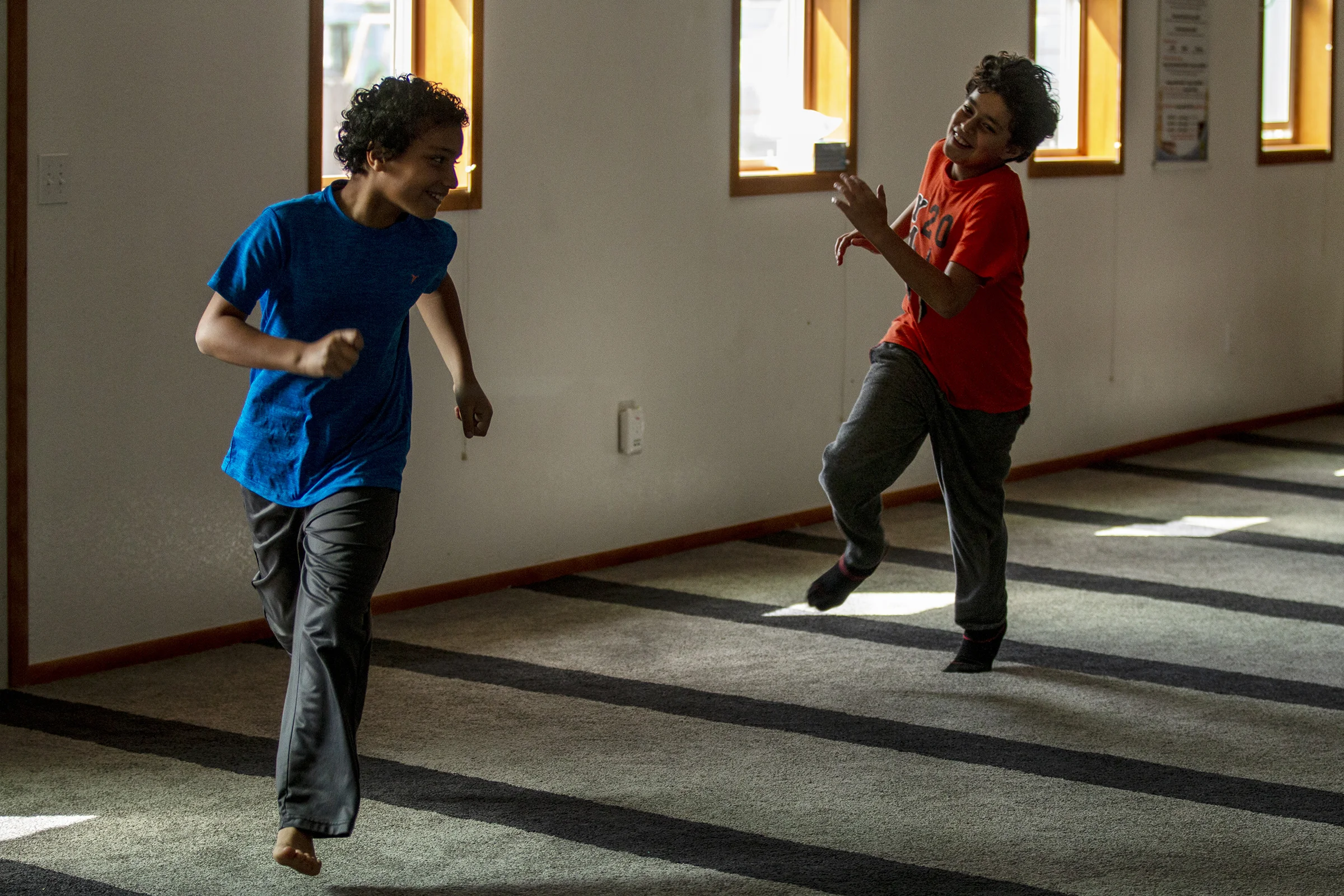
Hasan Eissa, right, and Belal Eissa play tag in the mosque’s prayer room. After prayer has been completed, children are welcome to play unhindered while they wait for their parents to take them home.
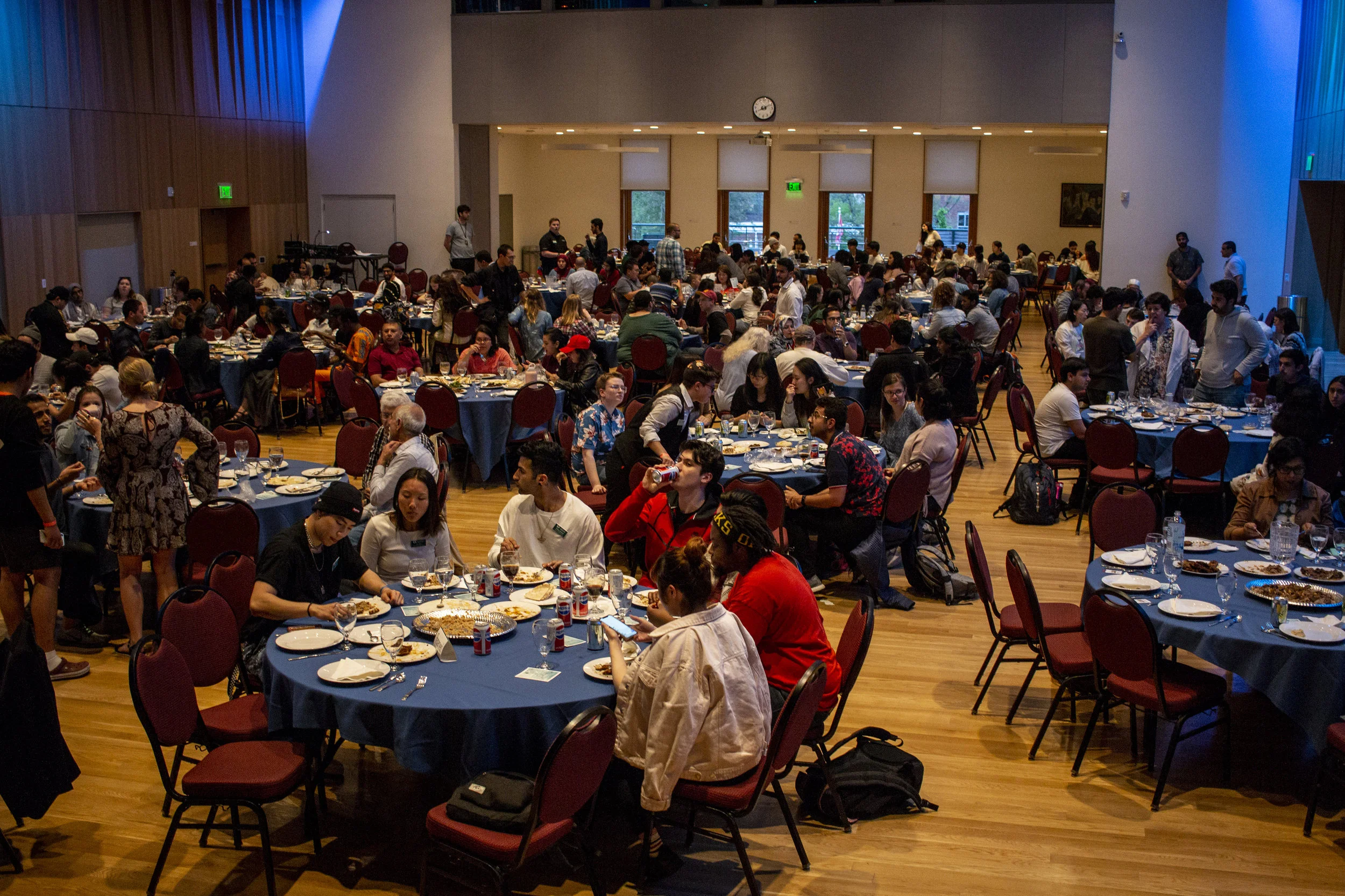
At the University of Oregon, several events are held by Arab and Muslim student groups throughout the school year. One annual event, Arabian Night, attracts hundreds of attendees every year.
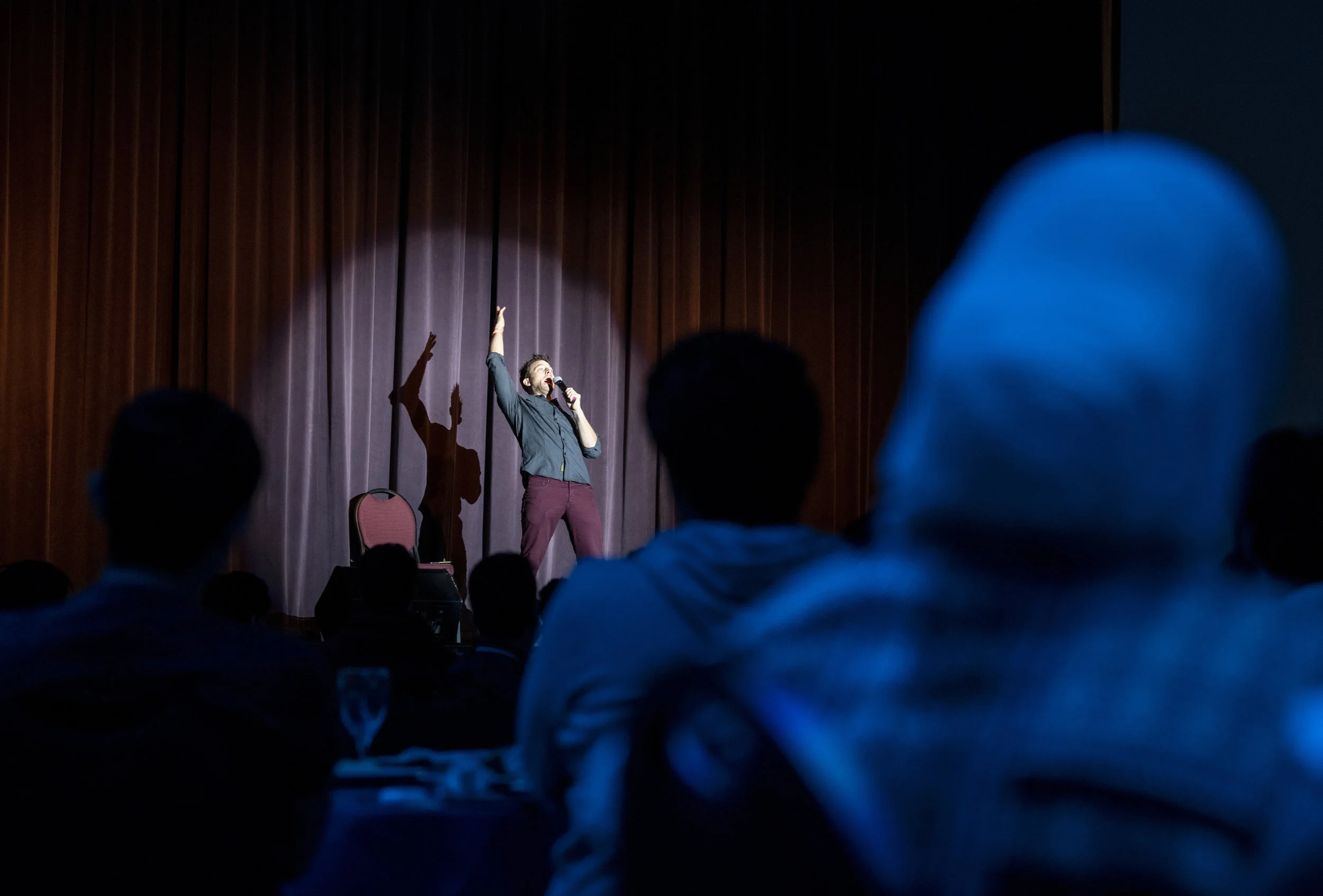
Iranian American comedian Kevan “K-von” Moezzi performs during the 2018 Arabian Night at the University of Oregon. Moezzi is a stand-up comedian who specializes in shows focusing on Middle Eastern culture and religion.
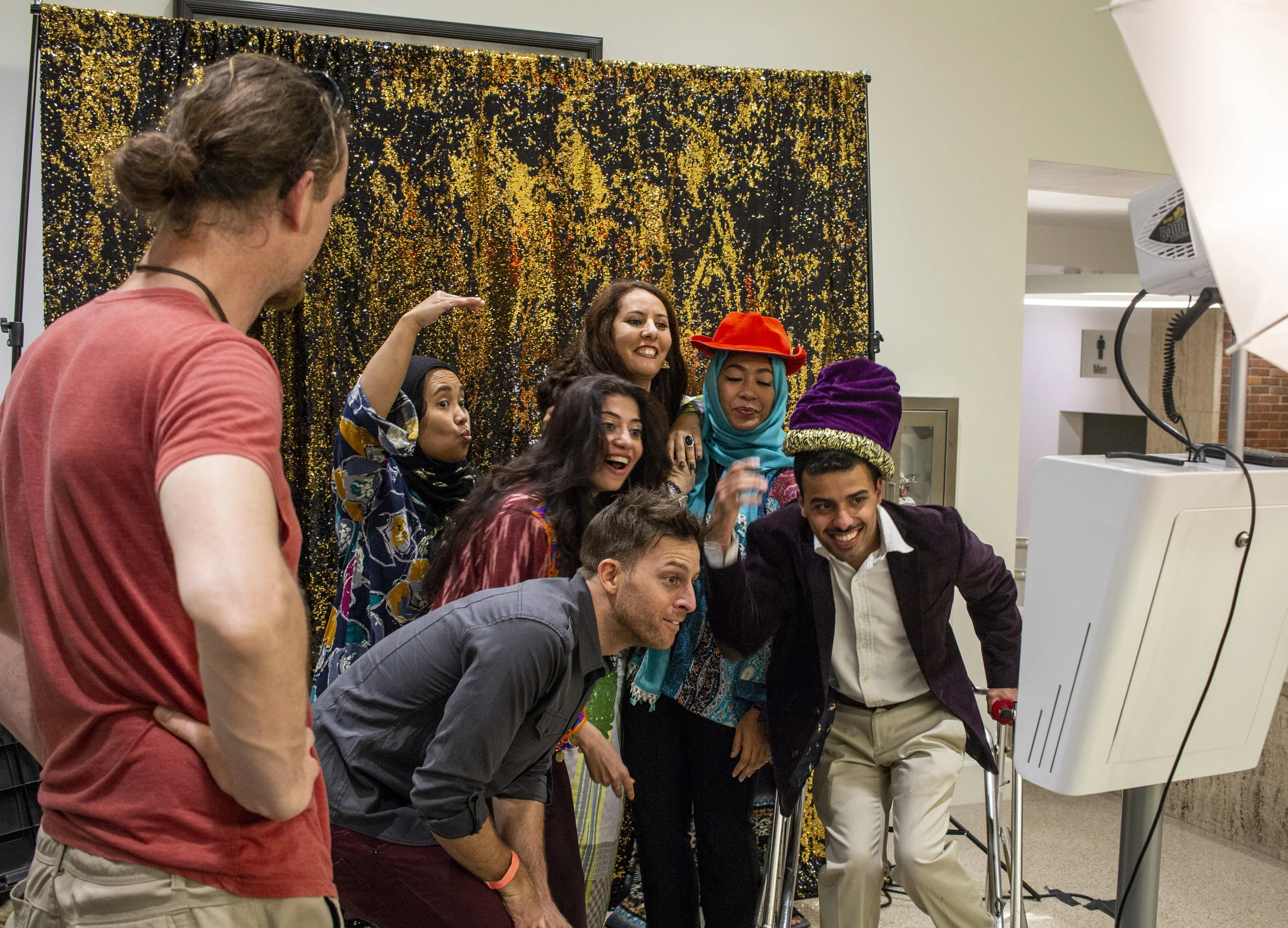
Attendees of Arabian Night pose for a photo with Moezzi after his comedy show concluded.
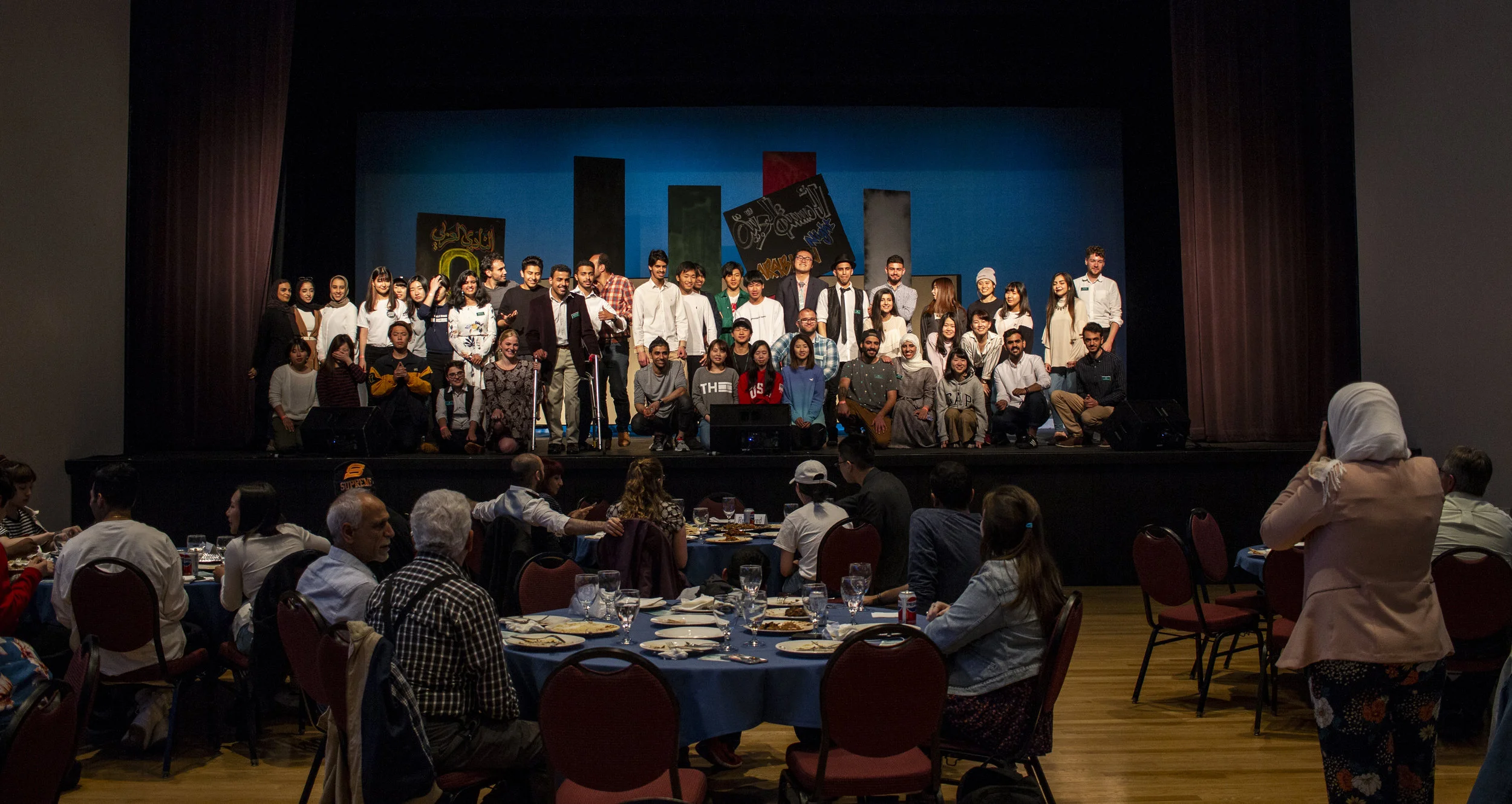
After Arabian Night concluded, everyone who helped run the event posed on stage for a final group-photo. Members of the Arab Student Union, Muslim Student Association and Saudi Student Association attended and assisted in hosting the event that night. These student-partnered organizations focus on catering to the Arab and Muslim communities at the University of Oregon.
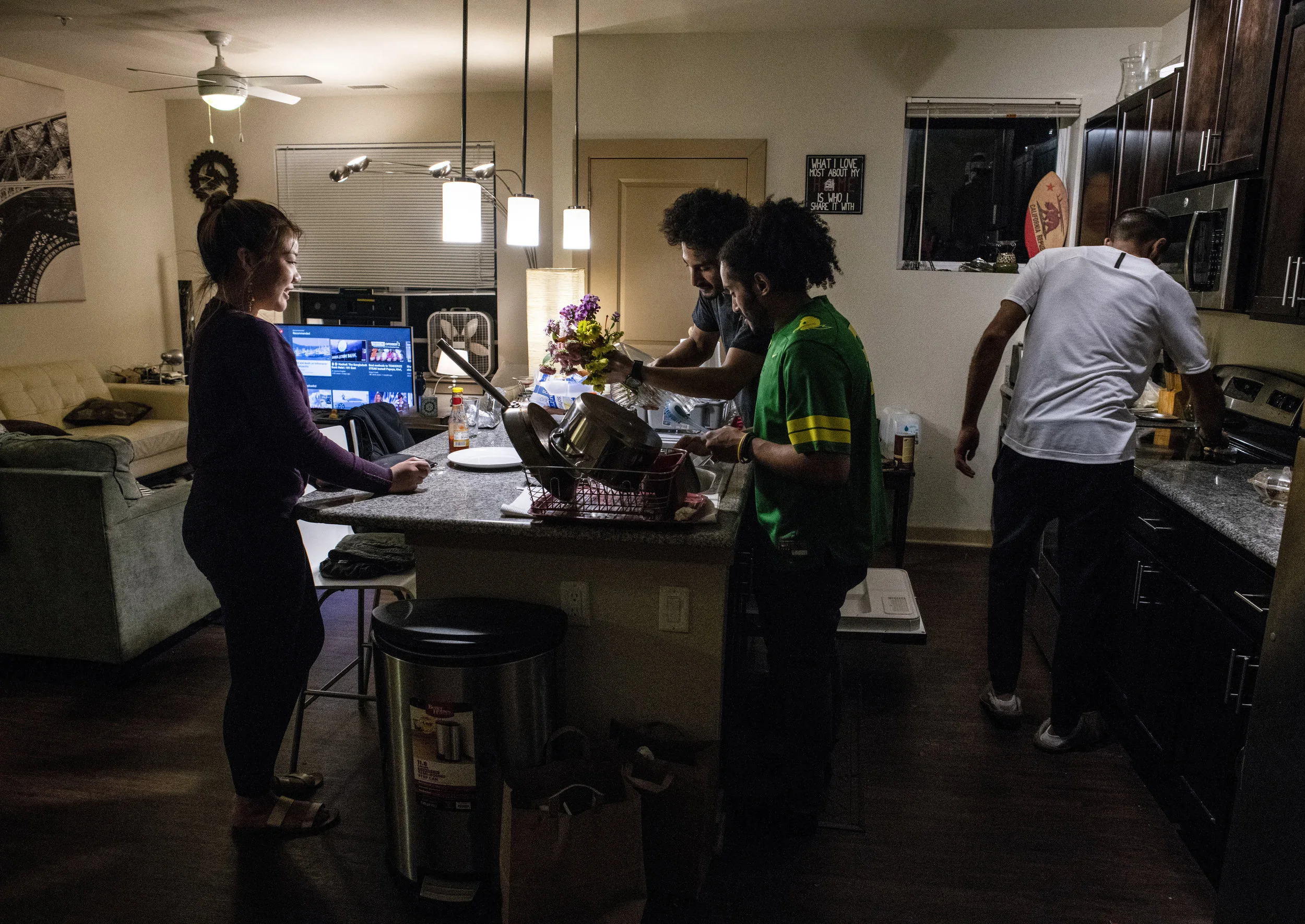
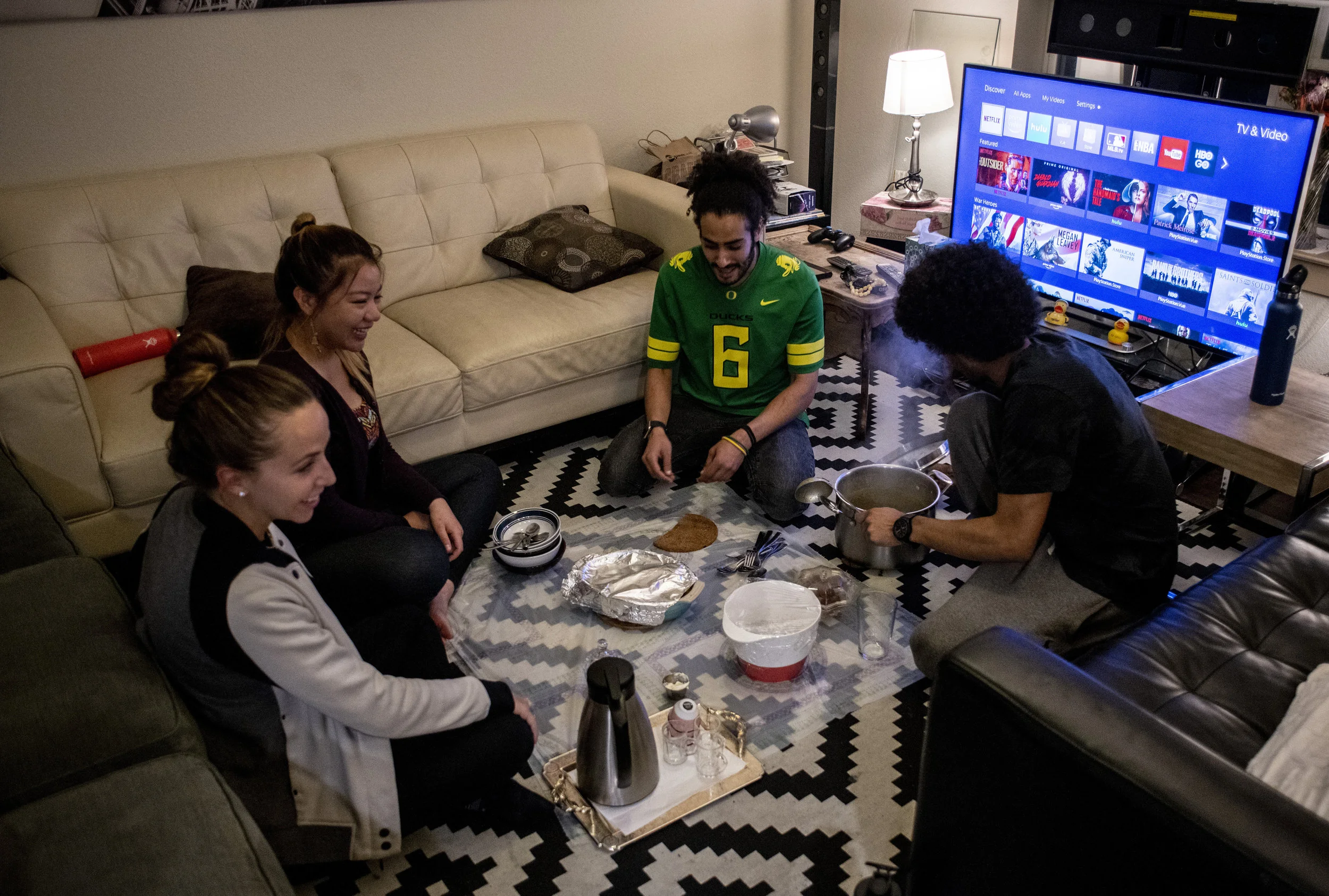
From left to right, Luna Tamimi, Abdulrahman Alarfas, Anas Babaeer and Aziz Ebinghannam gather to make dinner after fasting for Ramadan. Ramadan is a holy month in Islam when practicing Muslims fast from sunrise to sunset.
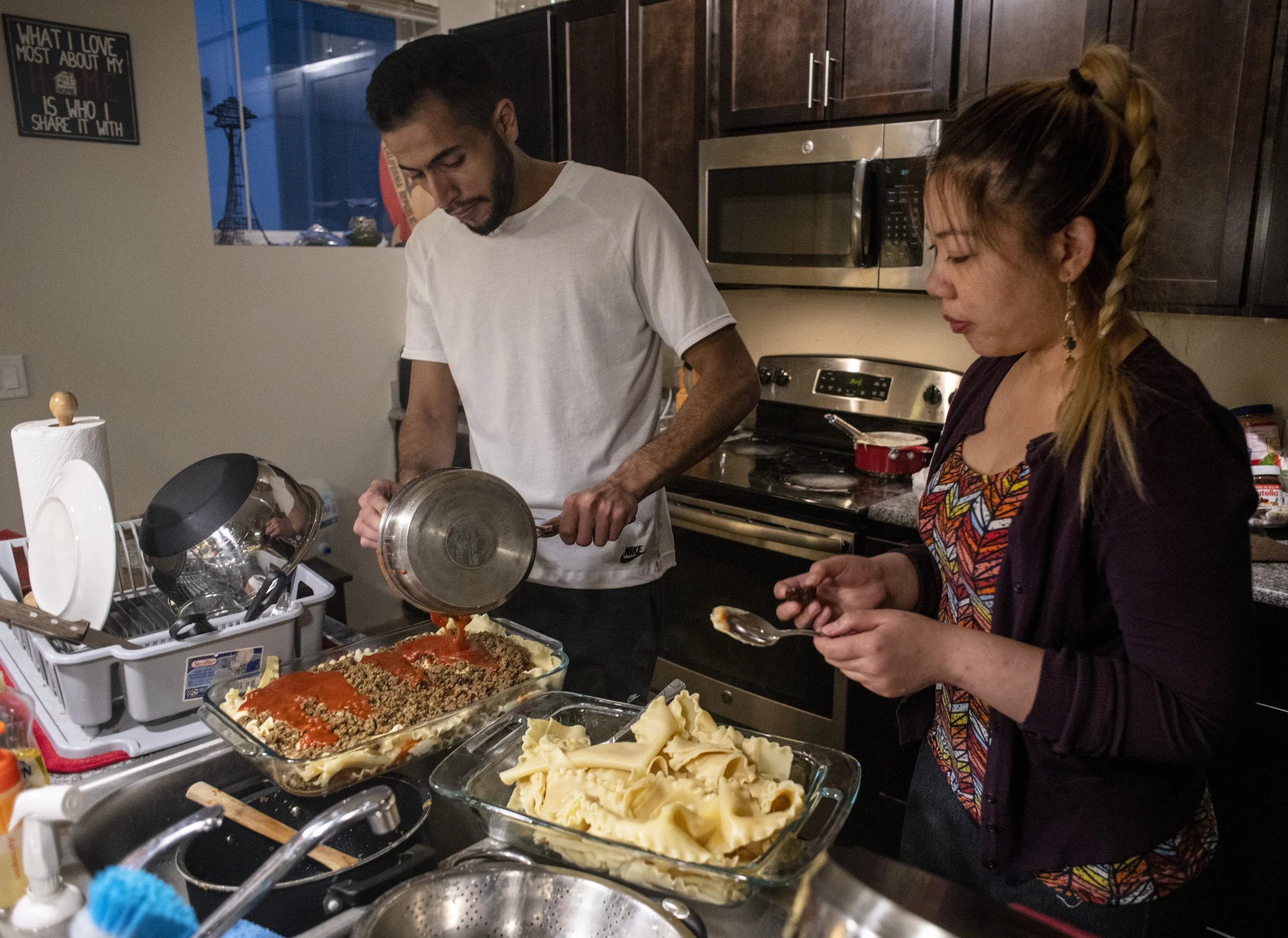
Ebinghannam and Tamimi prepare lasagna for dinner at Ebinghannam’s apartment. Tamimi and Ebinghannam are both students at the University of Oregon.
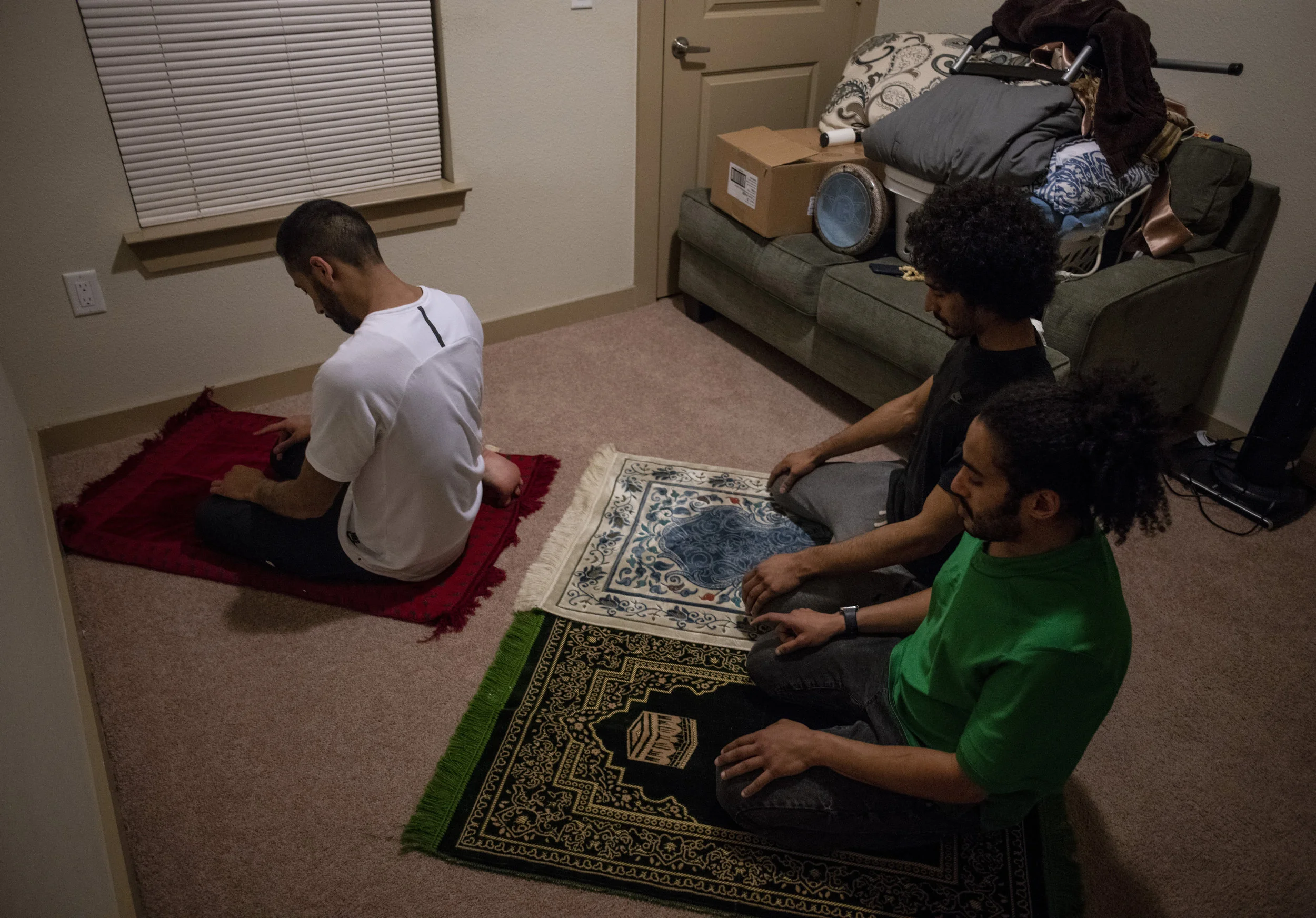
Babaeer, Ebinghannam and Alarfas praying before they break their Ramadan fast for the day. Babaeer, Ebinghannam and Alarfas all live together and have a dedicated room in their apartment for prayer.
The evening dinner held after a day of fasting during Ramadan is called Iftar. In Muslim culture, it is common practice to invite friends and family over for Iftar whether they have been fasting or not. Based on teachings in the Qur’an – the central religious text of Islam – it is customary for Muslims to welcome guests into their homes with comforts and luxuries.
Beyt Garden Café, like many other restaurants and businesses in Lebanon, has struggled to get by as a fuel shortage strains the country and leaves many without electricity. A manager with the cafe, Karima Algelany, said they’ve had to work with private generator owners to keep the lights on and the business running. “By the end of the month, we have three different electricity bills to pay, and of course, it’s a huge toll on the business,” Algelany said. “It’s easy to surrender and close our doors, but we don’t want to get to that level, so we’ve been trying to keep things going even if it’s a little bit challenging.”
A customer eating in the garden section of Beyt Garden Café. Algelany said people are welcome to sit in the garden and enjoy it as a free public space to unwind from the stresses of living without power. She said, “Even if we don’t have electricity, it’s better to be in a big open space with a garden than locked in your home. We’re aware of that and that’s why we don’t close even during the power cuts, and we tell people you can enjoy the space as much as you want.”
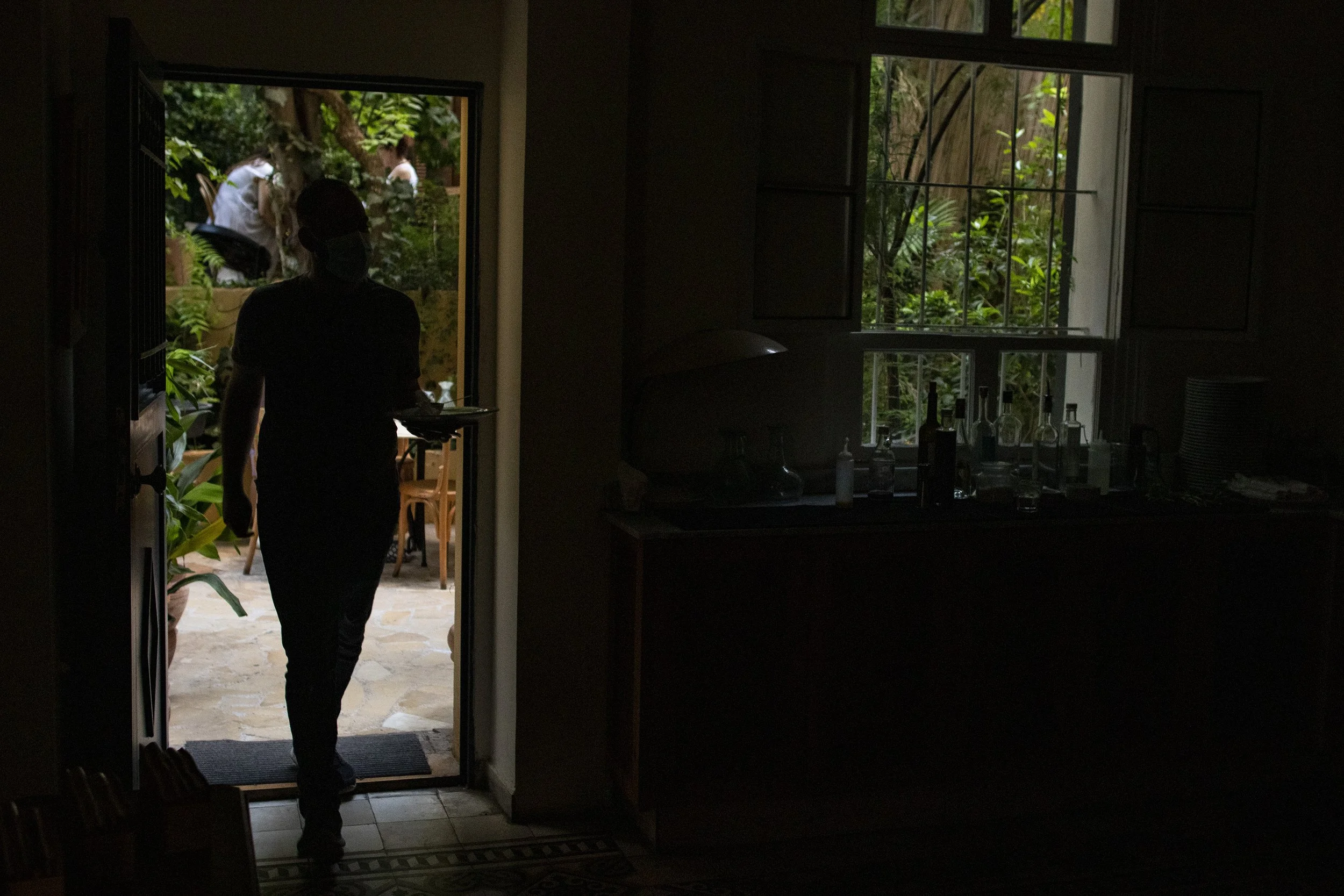
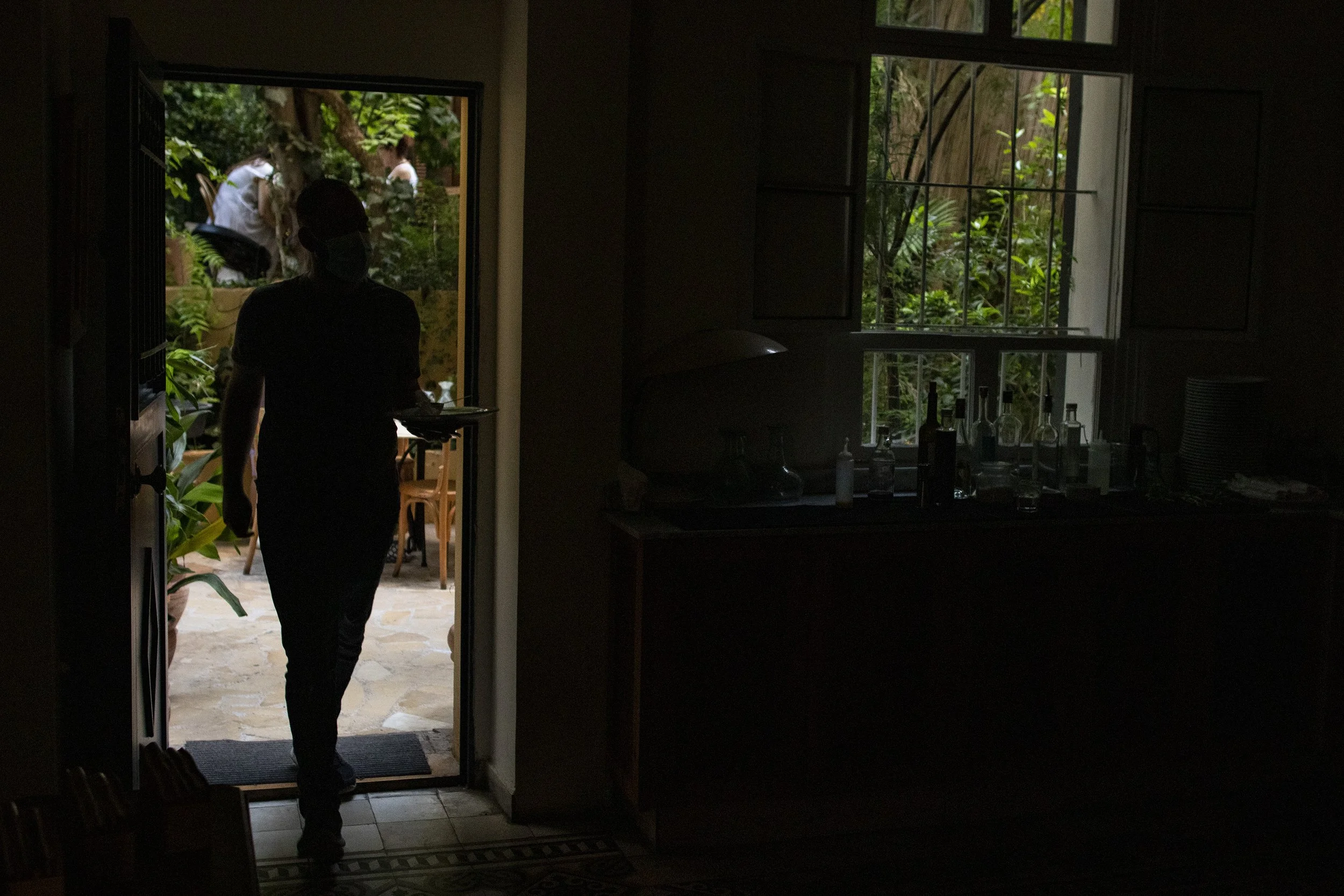
Beyt Garden Café Manager Ali Othman walking with a plate indoors while there is a power outage at the cafe. Algelany said even with three sources of electricity, one from the government and two from private generator owners, the power outages are unpredictable and there’s an average of five hours a day where there’s no electricity in the building.
Beyt Garden Café pizza chef Roni Najjar prepares a pizza in the kitchen of the cafe. Pizzas make up the majority of the food menu at the cafe, and Algelany said this became the case over time out of a desire to serve more food to customers while working around limited kitchen space.
A pizza baking in the gas-powered oven at Beyt Garden Café. Algelany said the pizzas are distinctly Lebanese rather than Italian with all the ingredients used being local and made in Lebanon. She said the ingredients are always fresh and this is partly due to necessity as limited electricity means limited time for refrigerators to run. “To avoid hazards, we don’t keep stocks of dairy or anything that can perish easily. We’re purchasing almost day by day to keep everything fresh,” Algelany said.
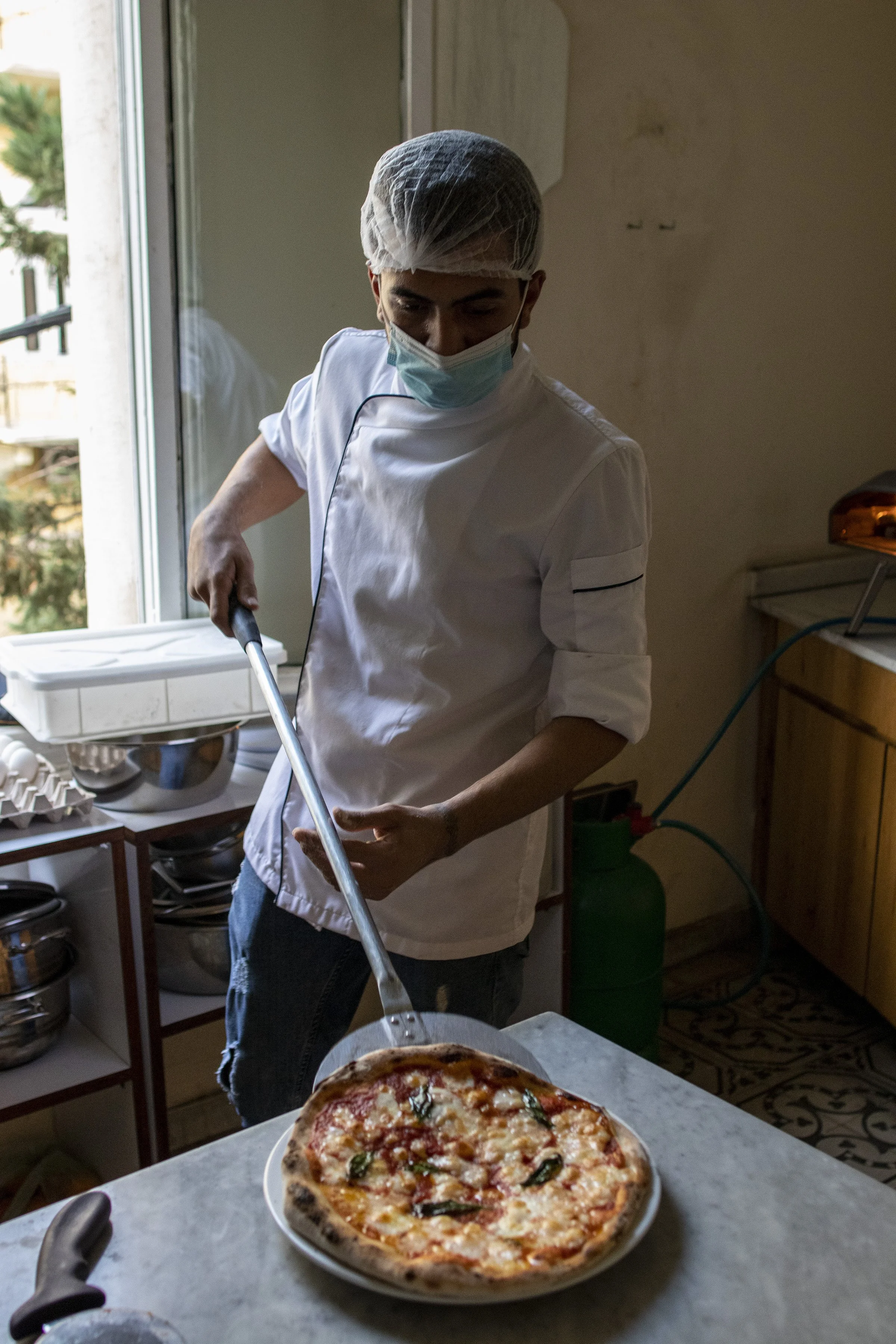
Najjar plating a finished pizza in the cafe kitchen. Pizzas are the staple on the menu, but Algelany said items previously on the menu like ice-cream had to be cut due to the power and fuel shortage. She said, “If there is a need to remove one item from the menu because it can get tricky, we’re ready to do that and we’ve done it already.”
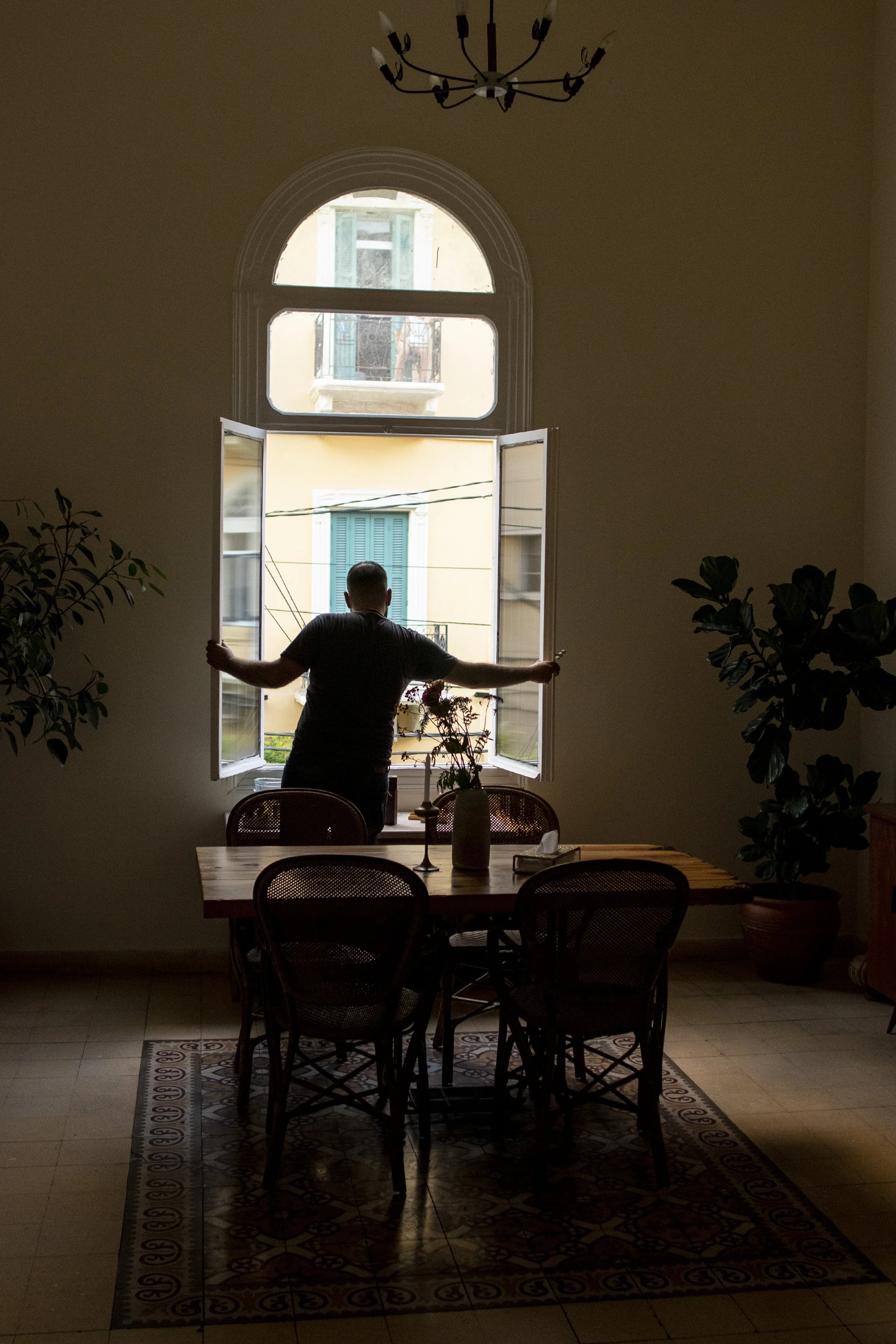
Othman opening a window to let in more light and fresh air during a power outage at the cafe. Algelany said that while the cafe building was not severely damaged by the port blast that took place in Beirut over a year ago on Aug. 4, 2020, the windows were completely shattered and much of the interior was damaged. She said the blast was yet another challenge the cafe had to overcome.
For Palestinian Christian Jack Giacaman and his family-owned souvenir shop in Bethlehem, times are hard. Tourists and their purchases that normally bolstered Giacaman's business and Bethlehem's local economy have disappeared since the Israel-Hamas war began on Oct. 7. Giacaman said, "We used to get at least 200 visitors a day before the war. Now we get zero."
To supplement this lost income, Giacaman said he's prioritizing online sales, but his shop, My Christmas House, is still struggling. "We're trying to keep workers as much as we can, but it's not easy," he said.
Between Israel's wartime ban on Palestinian workers, partial salary payments from the Palestinian Authority and a dried-up tourism industry, Giacaman said life in the occupied West Bank is not easy. "For Palestinians living in the West Bank it is a disaster," he said.
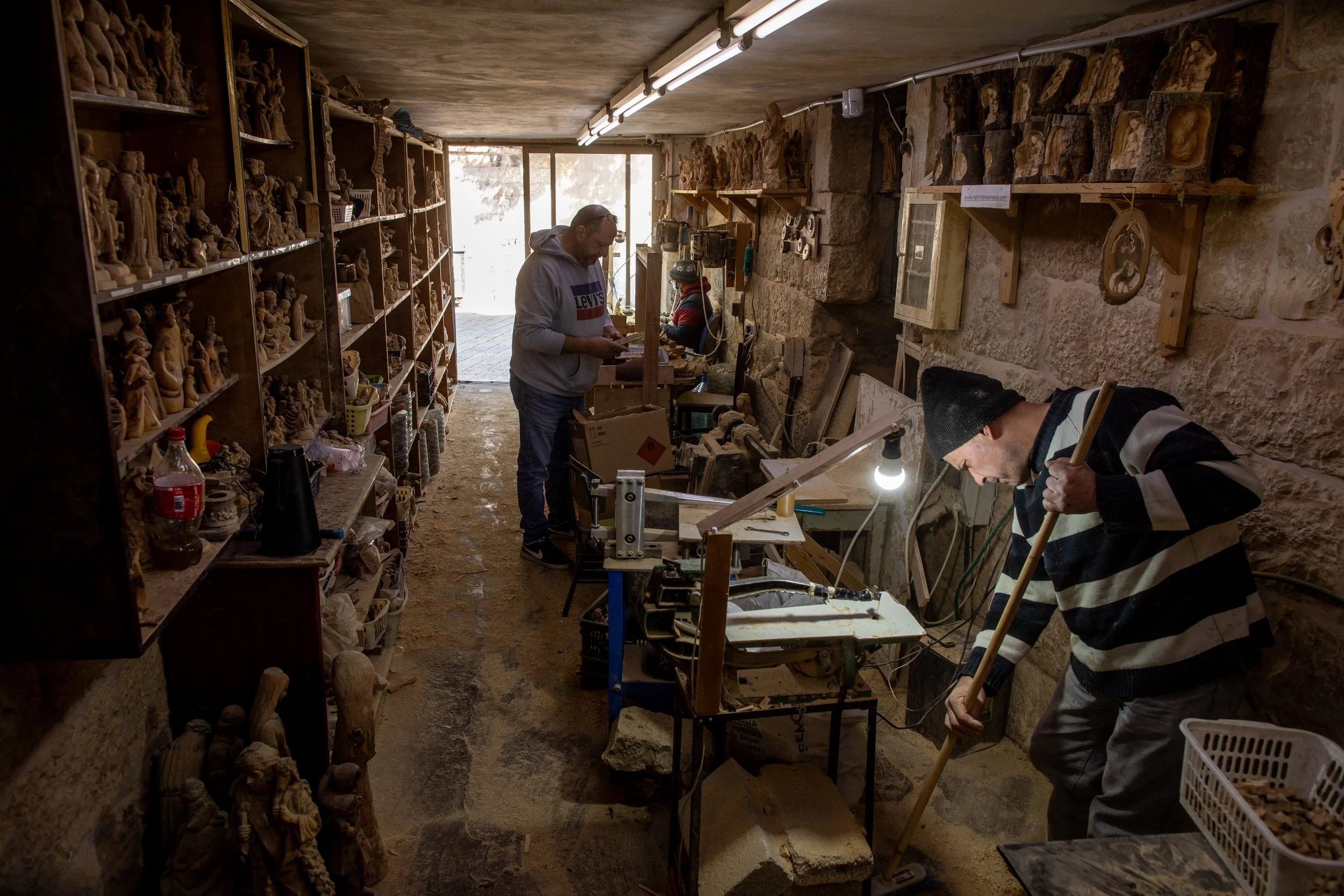
Jack Giacaman (gray sweatshirt) and employees of the My Christmas House souvenir shop in Bethlehem working inside the production area of Giacaman's family-owned store.
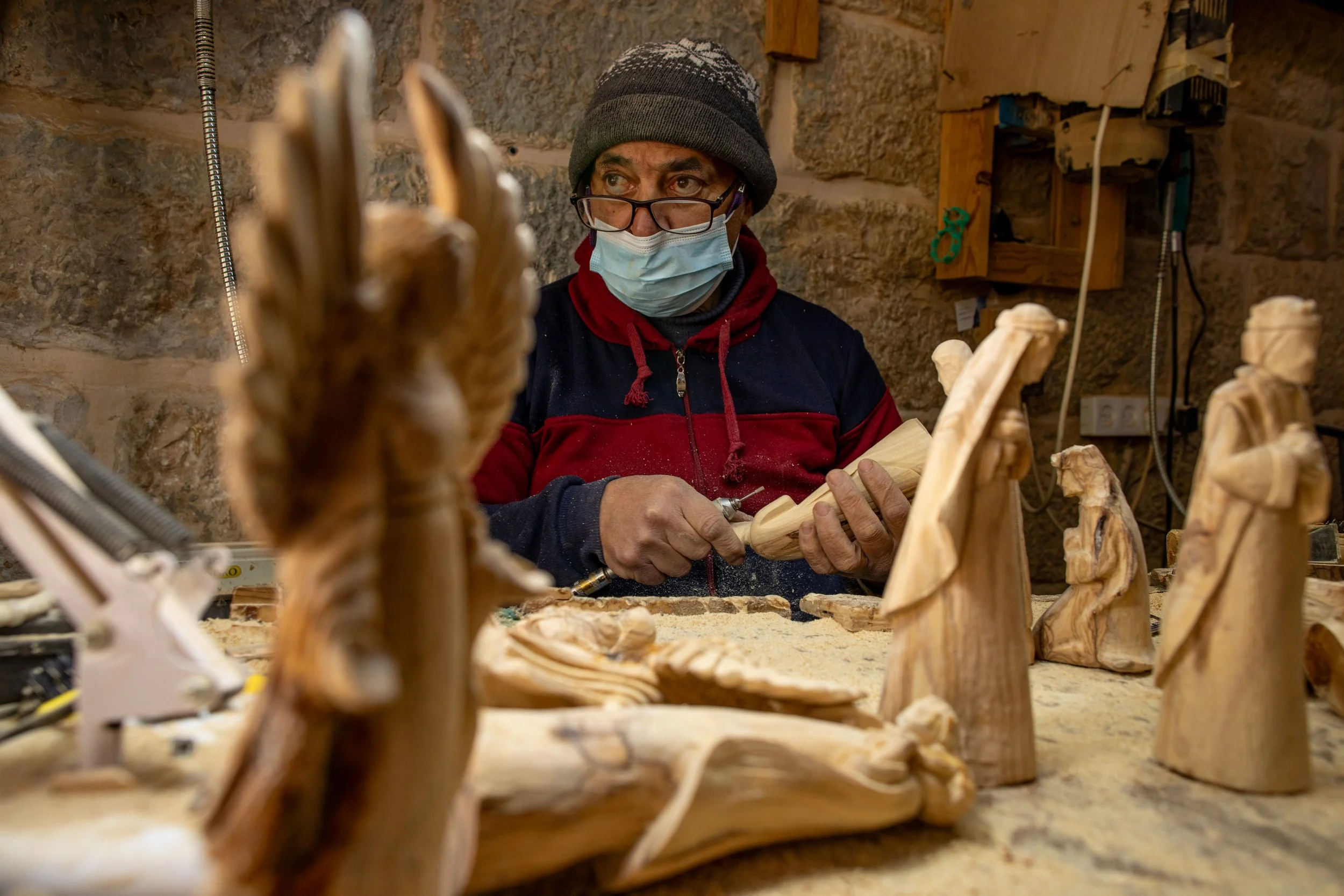
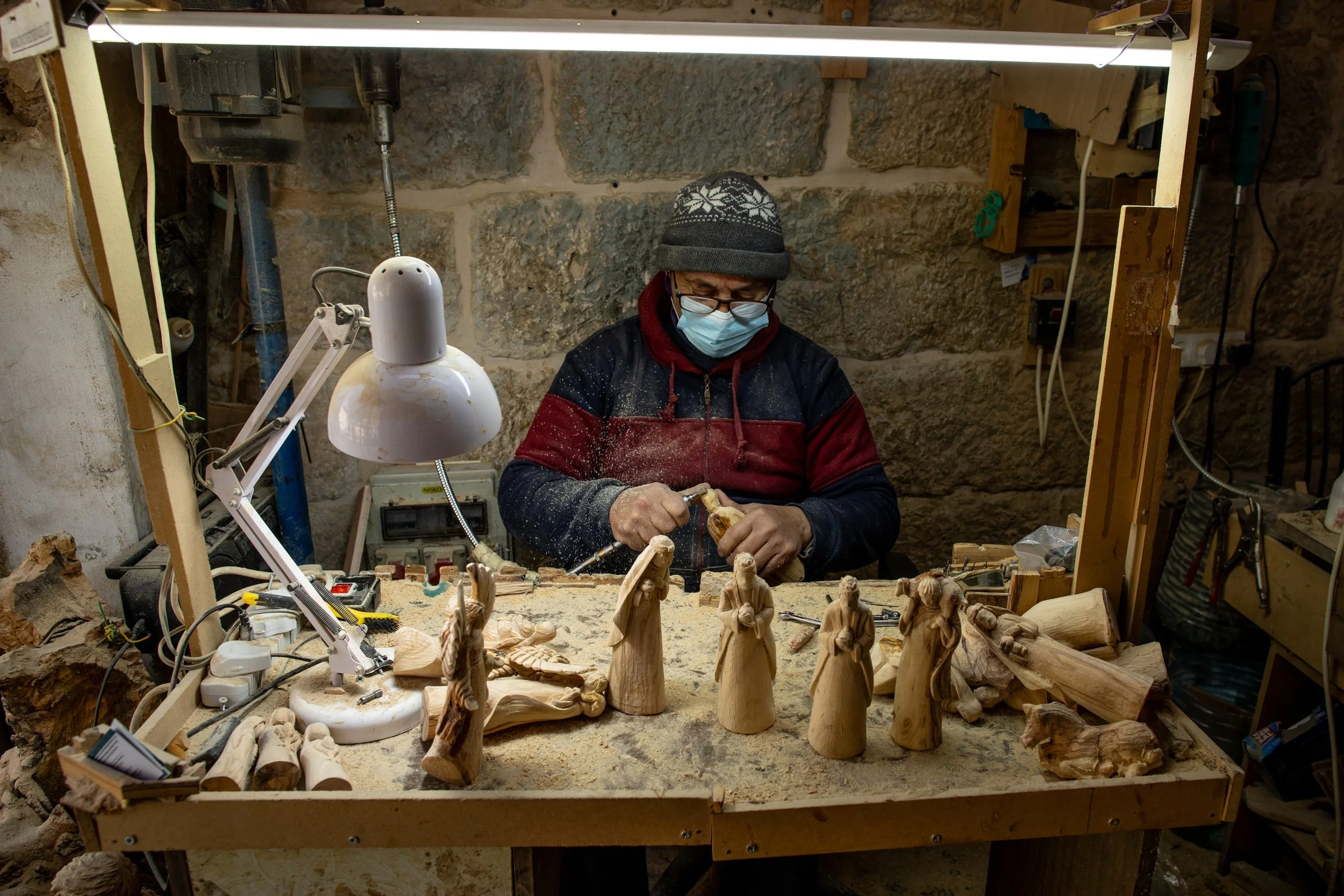
A. Giacaman (preferred name) producing wooden figurines at his workbench. The majority of the souvenirs sold at Jack Giacaman's store are hand-carved and themed around Christianity.
A. Giacaman using a grinder to shape a figurine made from olive wood. There are two My Christmas House souvenir shop locations in Bethlehem. One next door to Jack Giacaman's workshop on Milk Grotto Street, and another in Manger Square across from the Church of the Nativity, widely believed to be the birthplace of Jesus Christ.
A. Giacaman looking out a window by his workstation lined with Christian figurines carved from wood.
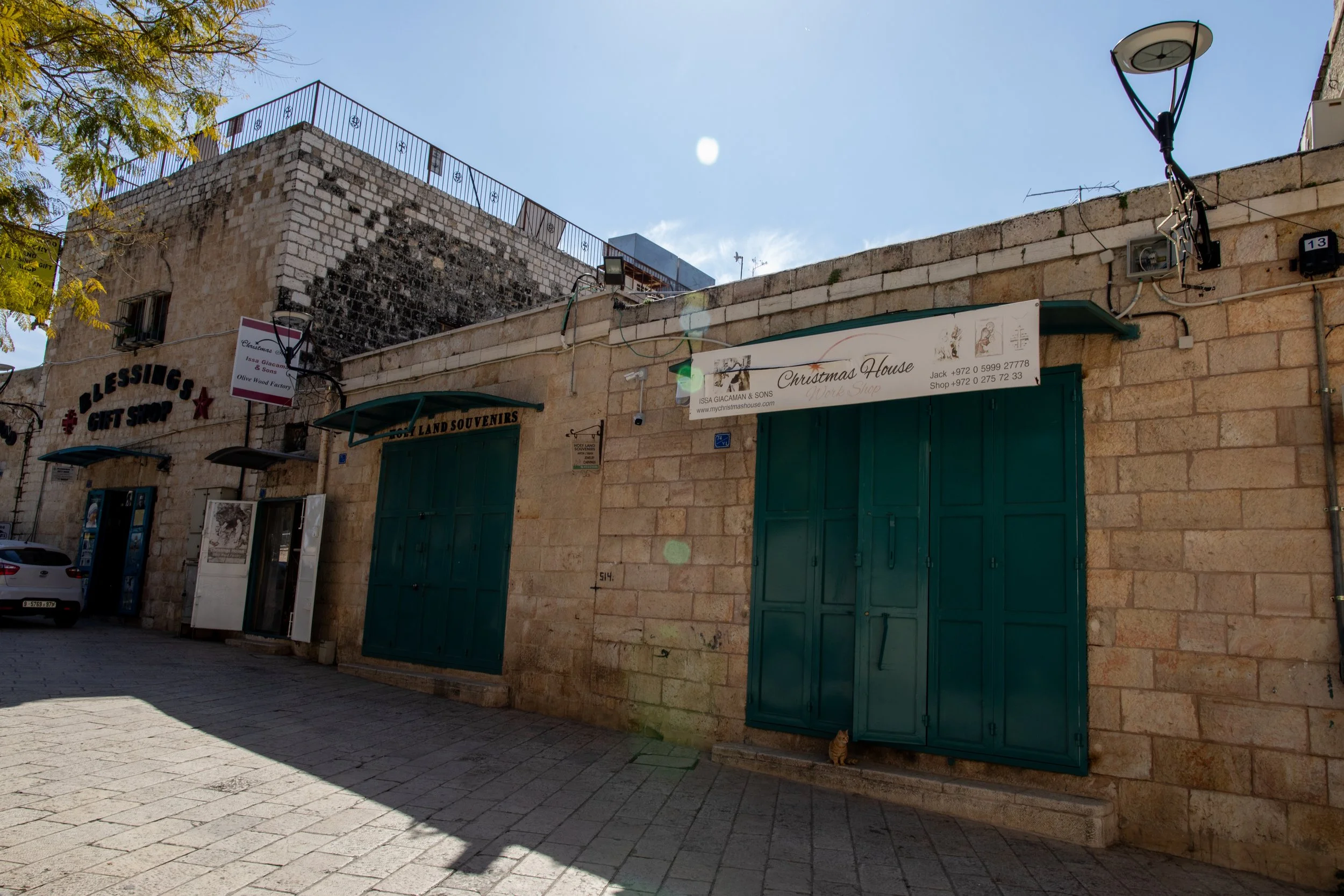
The outside of the My Christmas House workshop and storefront located on Milk Grotto Street in Bethlehem.
Jack Giacaman sitting at his desk in the souvenir shop section of his store. In addition to the financial stress stemming from the Israel-Hamas war, Giacaman said there's a constant fear of being evicted. "A lot of Israeli ministers say they want to kick out Palestinians," he said. "We don't feel secure because Israel can kick us out and shut down our businesses."
Jack Giacaman using a sander inside his workshop to shape a wooden spoon.
M. Giacaman (preferred name) carrying a crate of figurines through the back end of the My Christmas House workshop.
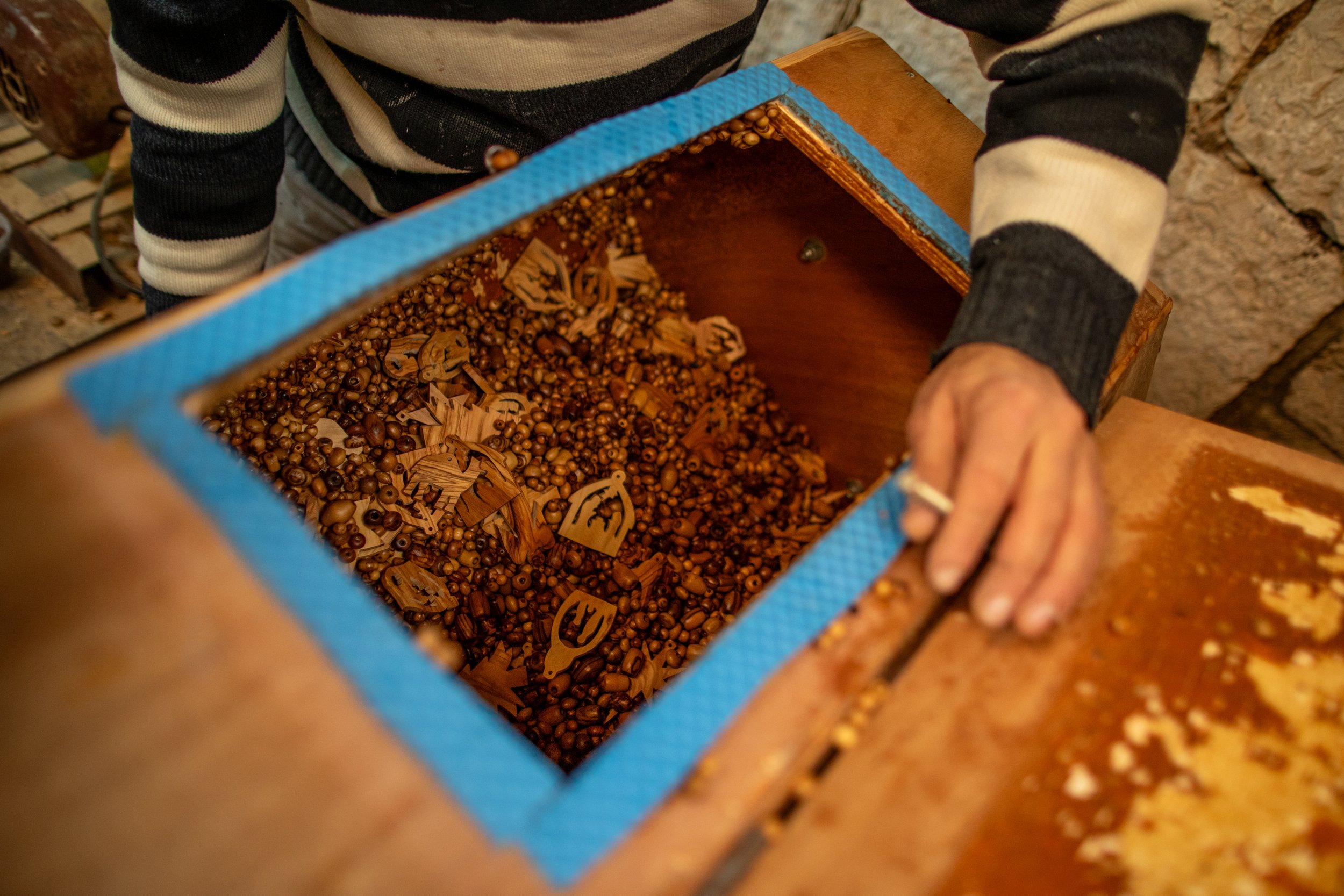
M. Giacaman collecting olive wood beads and carvings from a tumbler used to dry the wood-stained souvenirs.
A. Giacaman inspecting animal figurines to be sold in the My Christmas House souvenir shop. Jack Giacaman said that, following the beginning of the Israel-Hamas war, one of the hardest things for him and other Palestinian Christians has been Israel's restriction on Palestinians attempting to enter Jerusalem. He said, "As a Christian Palestinian living here for hundreds of years, this is the first time we couldn't reach Jerusalem. They treat us like terrorists."
Wadi Rum is one of the most popular tourist destinations in Jordan, rivaled only by the ancient city of Petra. It is a government-protected nature reserve home to Bedouin tribes who have inhabited the wadi and desert for hundreds of years.
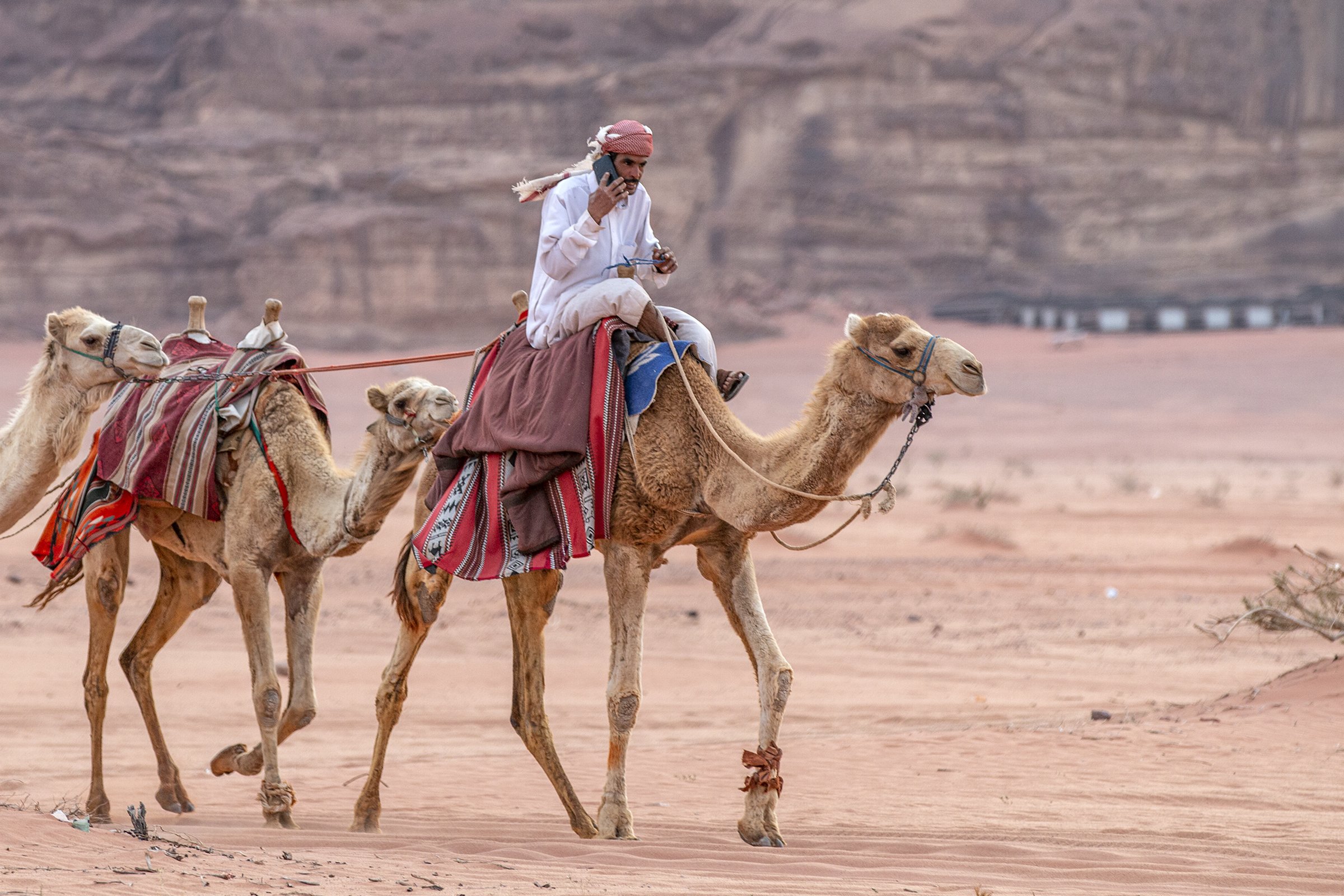
And while the Bedouins living in Wadi Rum have passed down their traditions and culture for generations, they have also kept up with modern times and use smartphones, social media and cars like anywhere else in the world.
Many Bedouin tribes operate camping sites marketed toward tourists and offer camel rides, jeep tours and traditional Bedouin meals. Tourism serves as a major source of income for Bedouin tribes, but it also brings its own set of problems. Off-road vehicles, litter and loss of wildlife from illegal hunting have damaged Wadi Rum's ecosystem.
To mitigate these negative effects and others, access to Wadi Rum has been restricted and monetized by the Jordanian government. To enter the desert, one must coordinate a trip with a Bedouin tribe, and unlicensed vehicles are not allowed in the desert. Arranging a trip can easily be done online; however, so Wadi Rum is still very accessible to those hoping to visit despite the enforced restrictions.
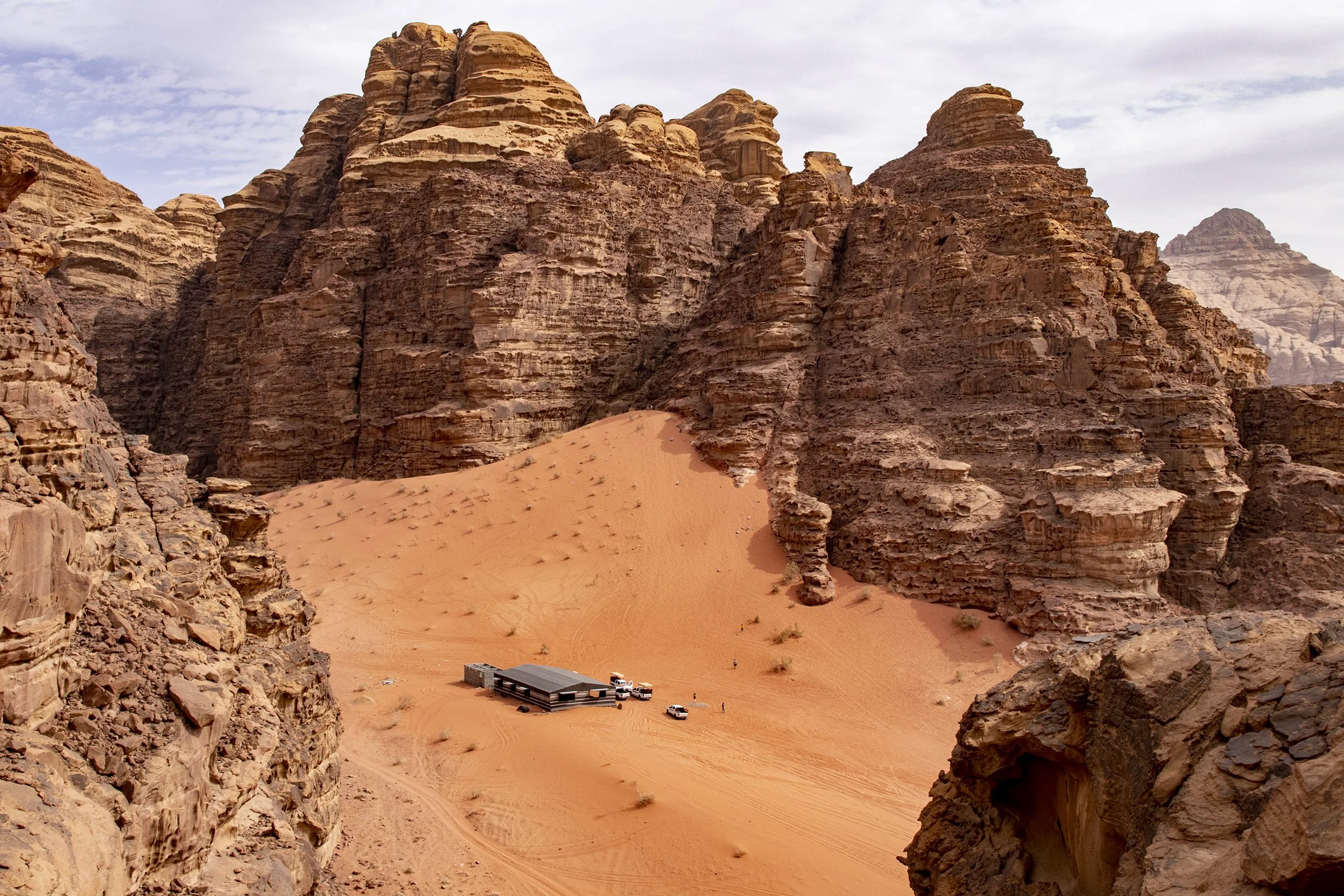
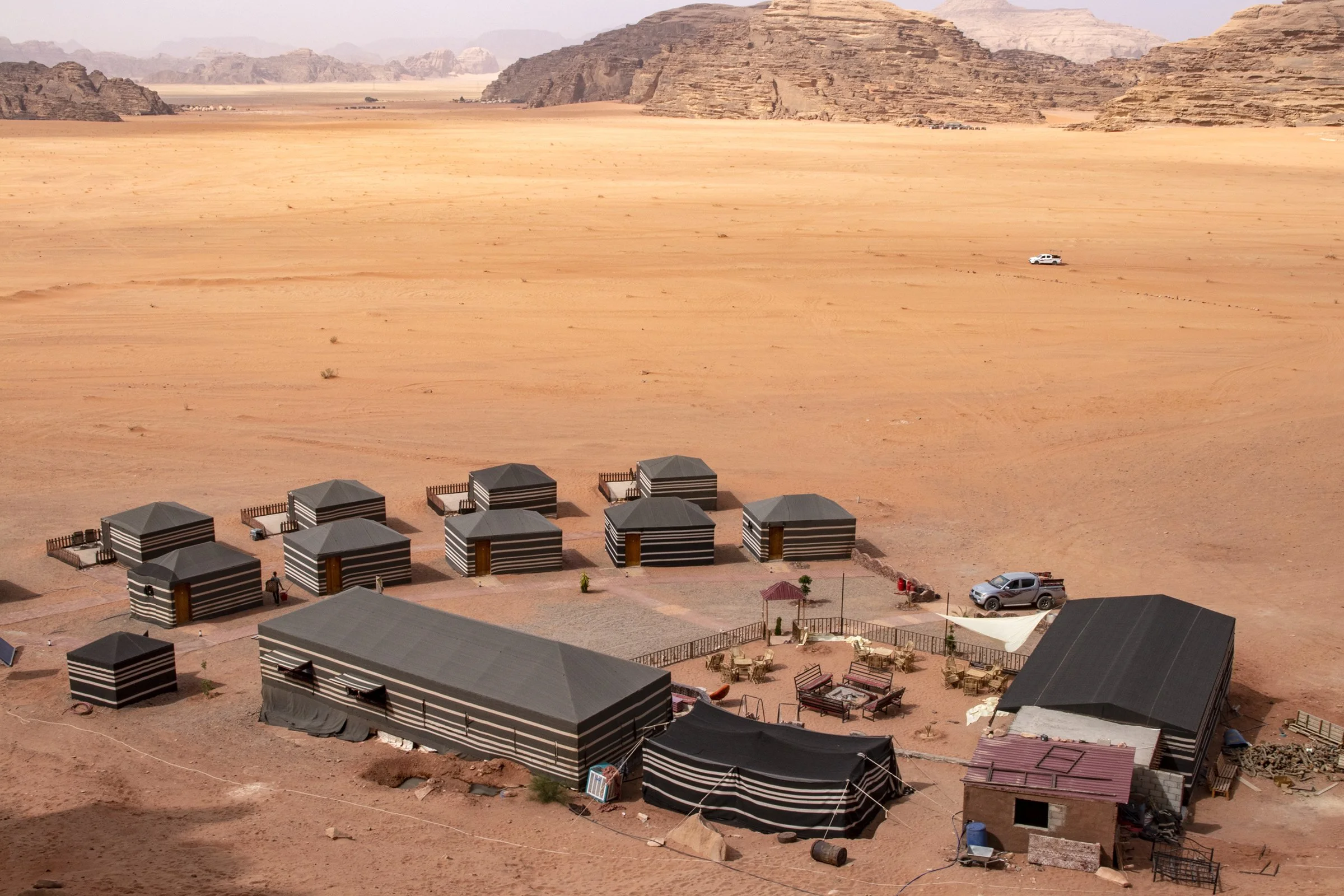
A camping site located between mountains in Wadi Rum. Wadi Rum's otherworldly beauty and scenery have routinely led it to be the filming location of major Hollywood films. This includes films such as "Star Wars" and "Dune."
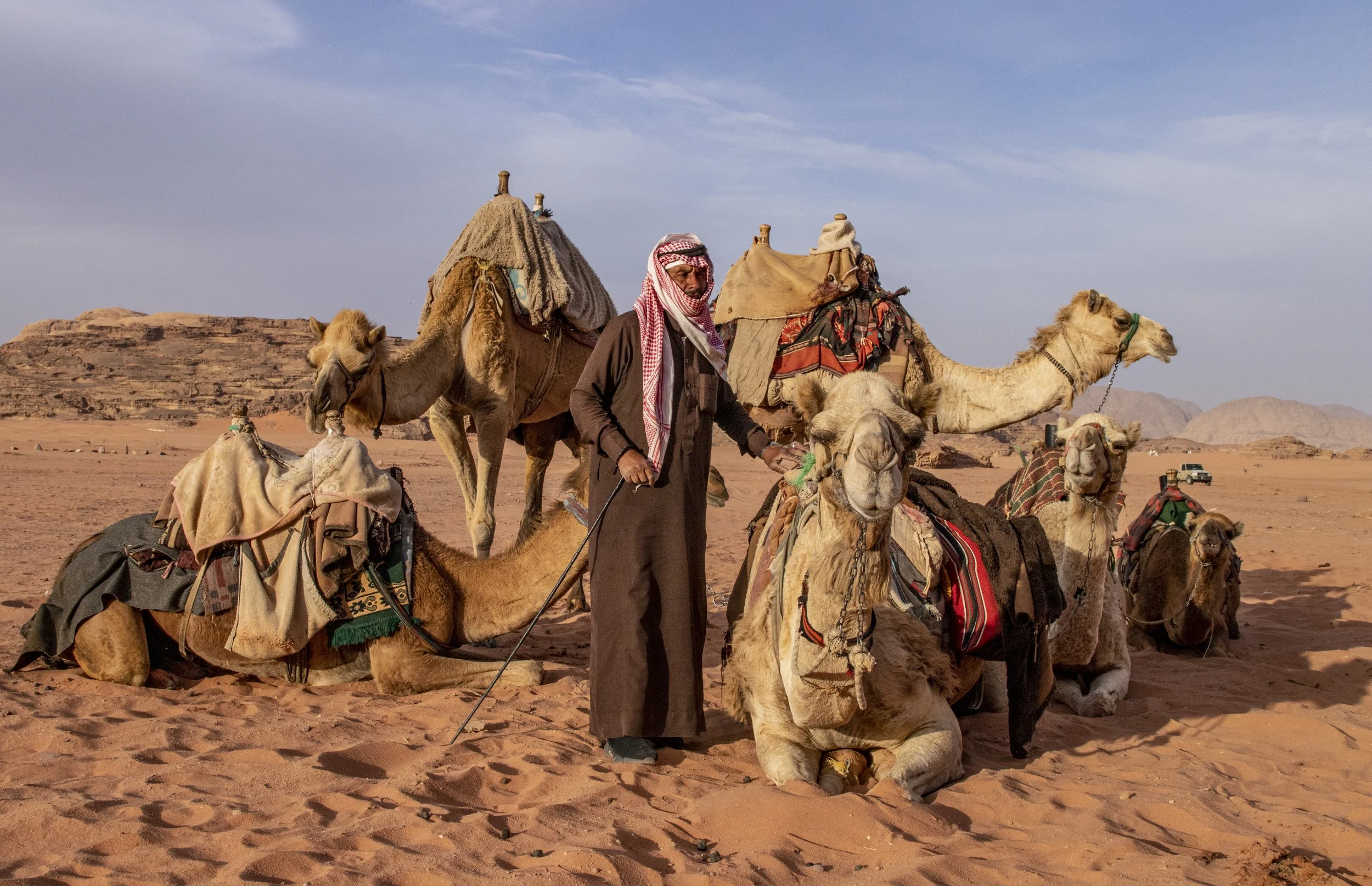
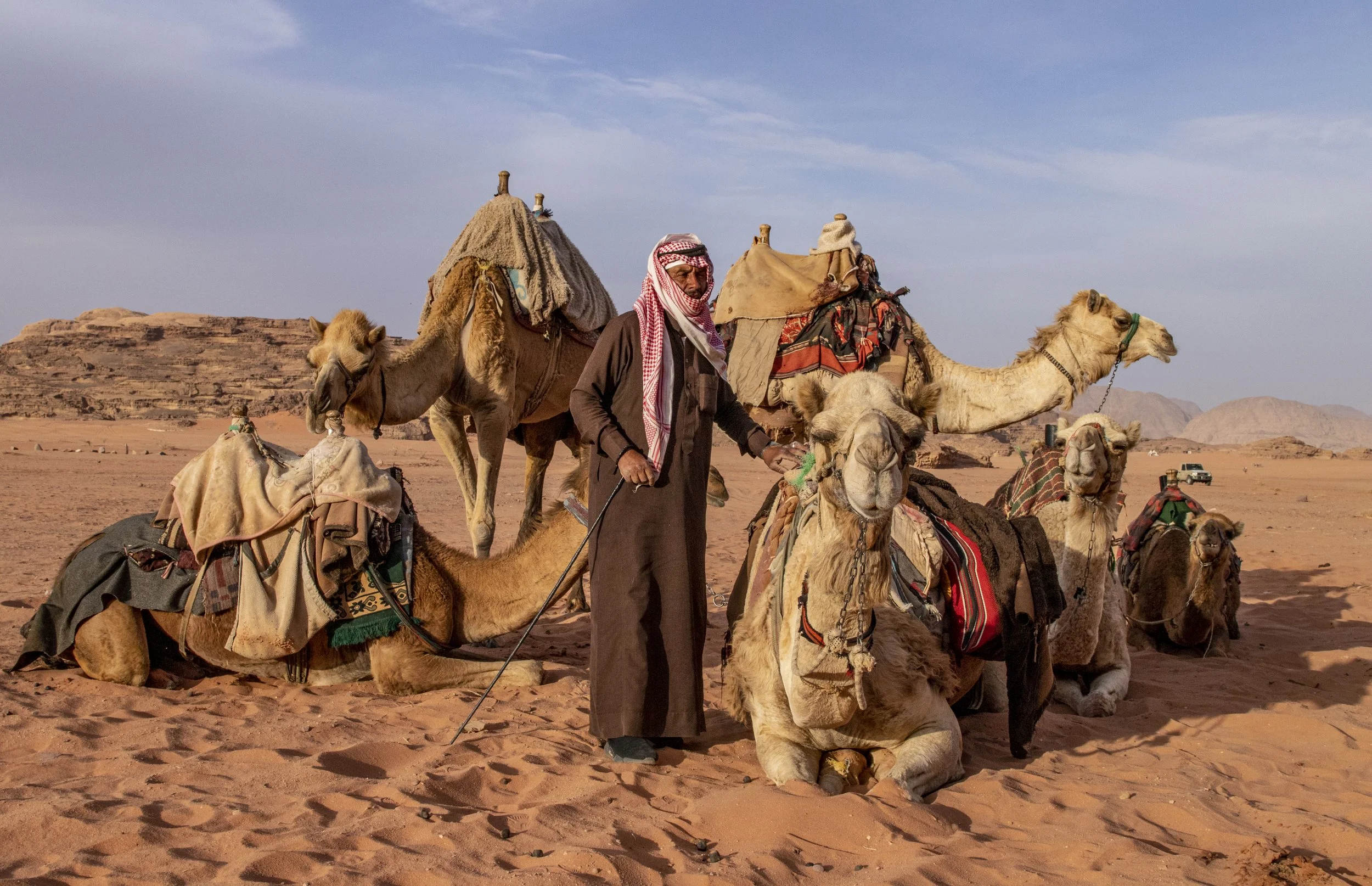
Bedouin tribesman Nayef waiting to lead tourists on a camel ride through the Wadi Rum desert in Jordan.
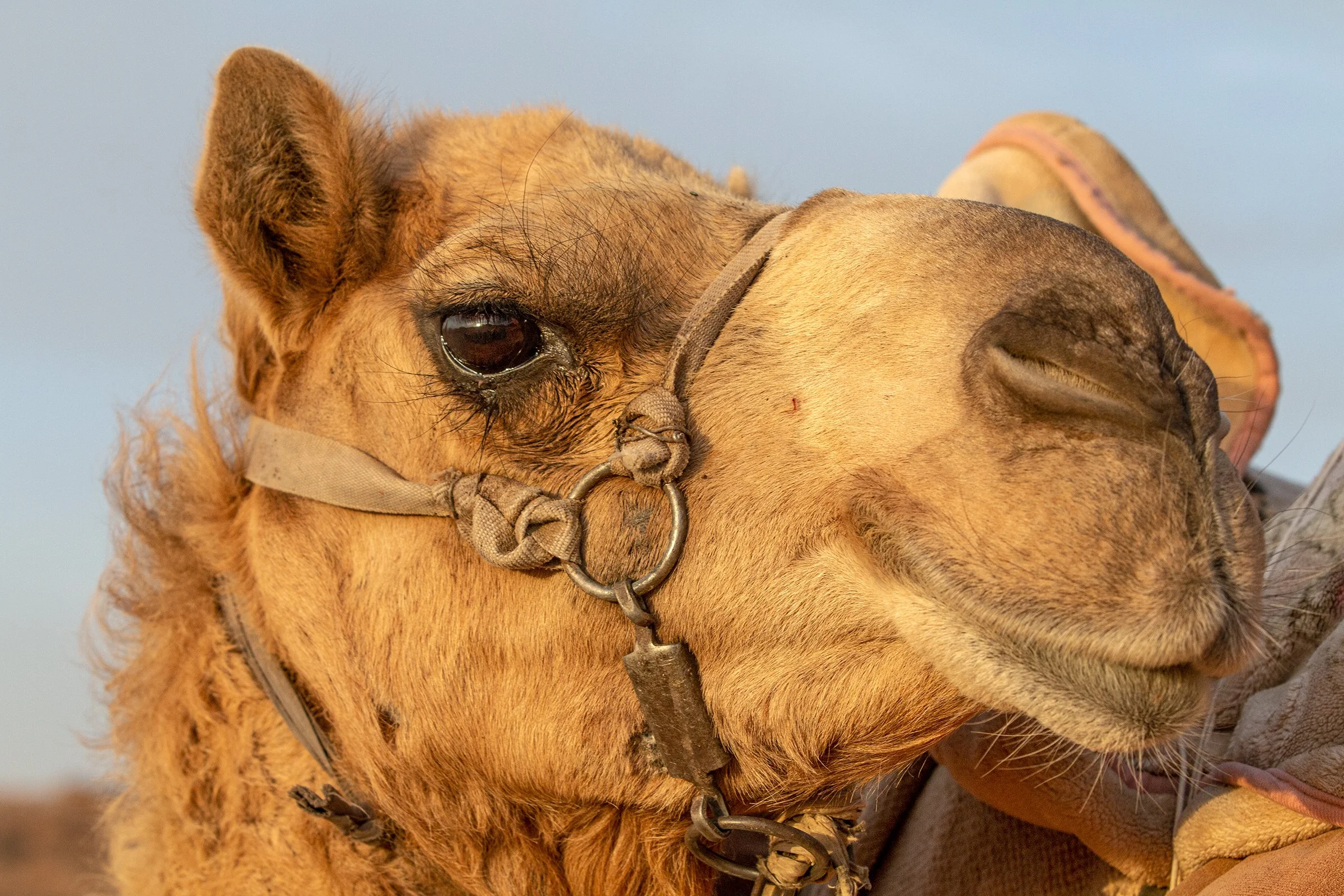
A resting camel in Jordan's Wadi Rum desert.
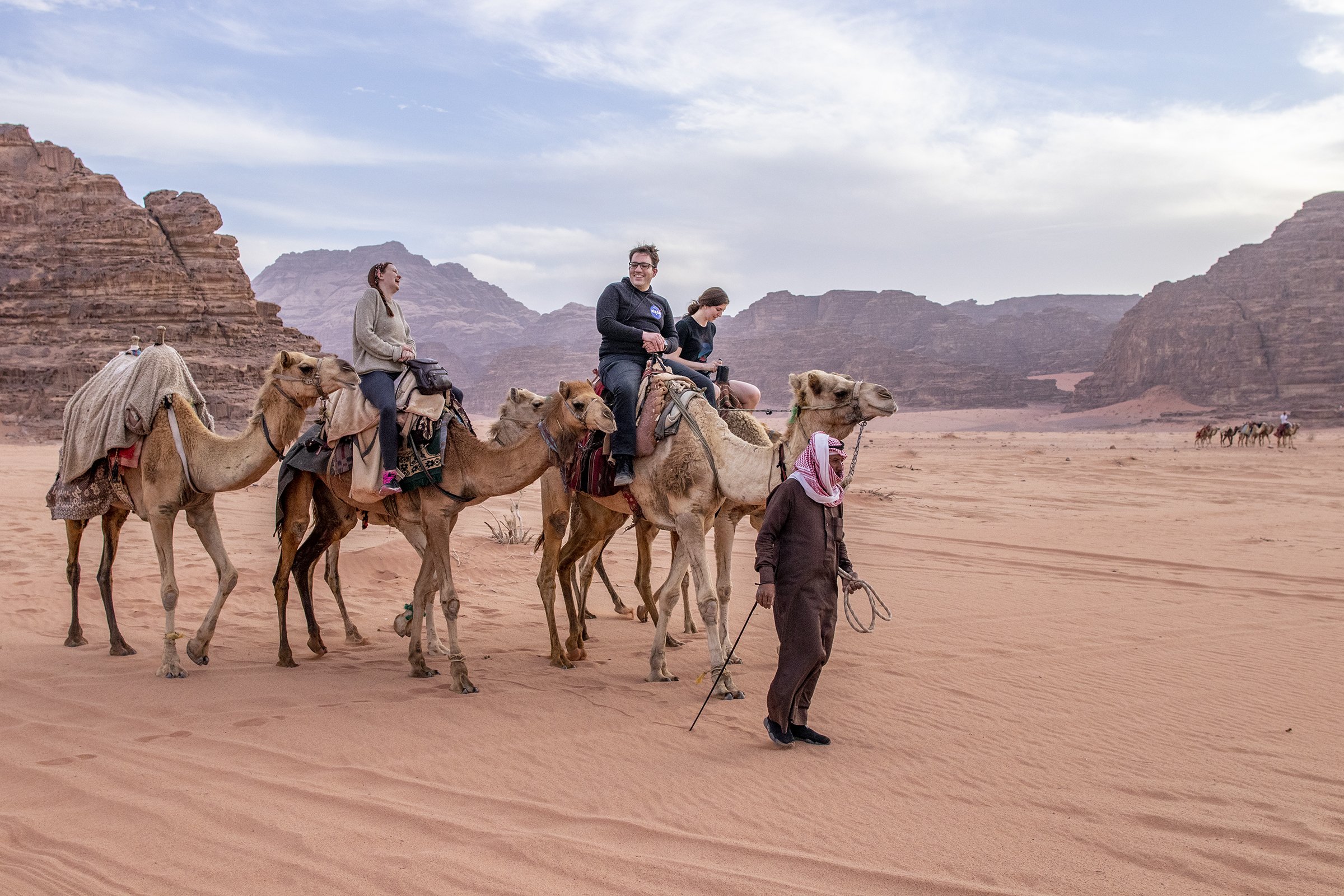
Bedouin tribesman Nayef leading a group on a camel ride through Wadi Rum.
A camping site based inside the Wadi Rum protected area. Camping sites vary in amenities and price, but most are equipped with running water, electricity and in some cases Wi-Fi.
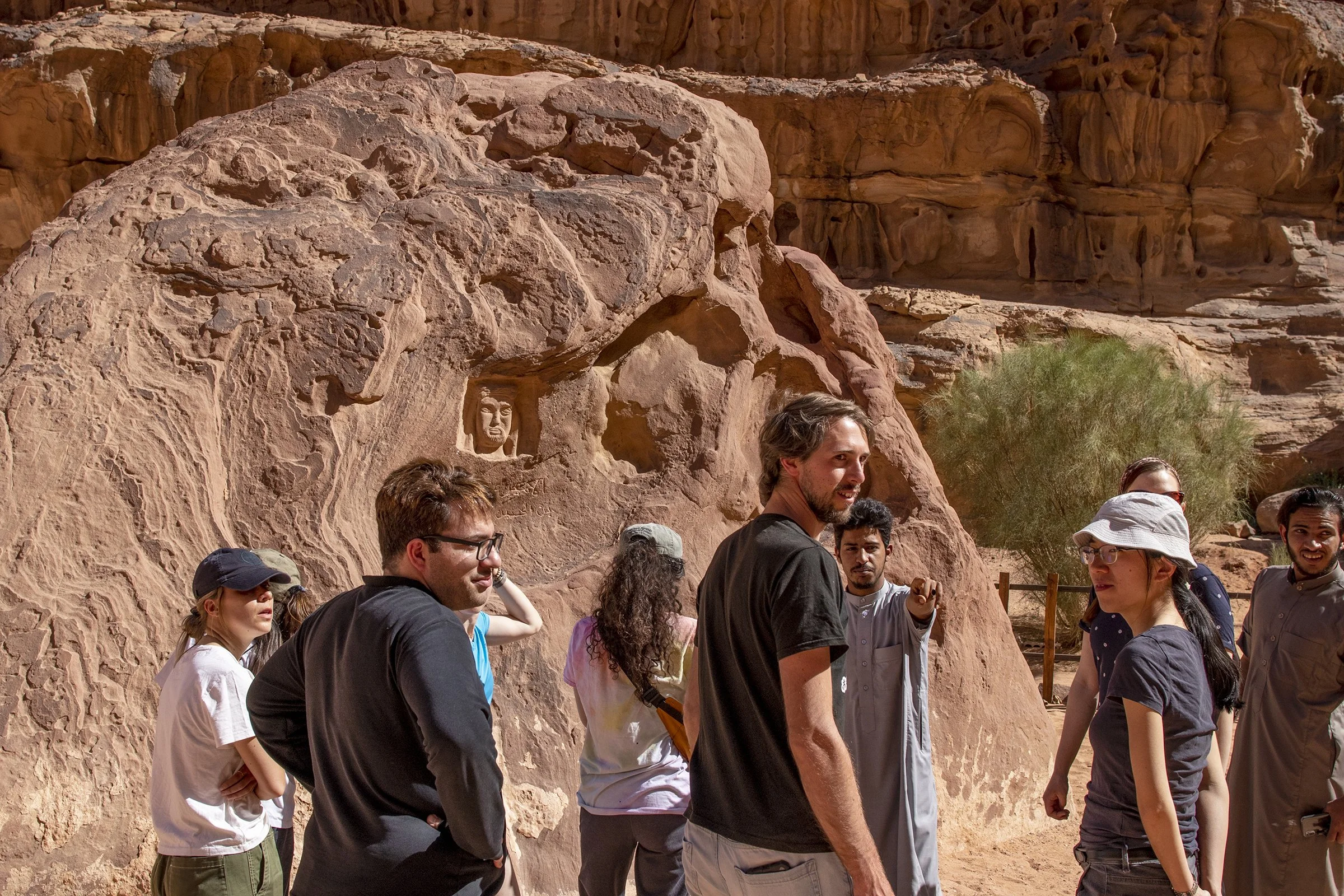
A Bedouin guide points a tourist group to a historical stone carving after explaining the history of another carving.
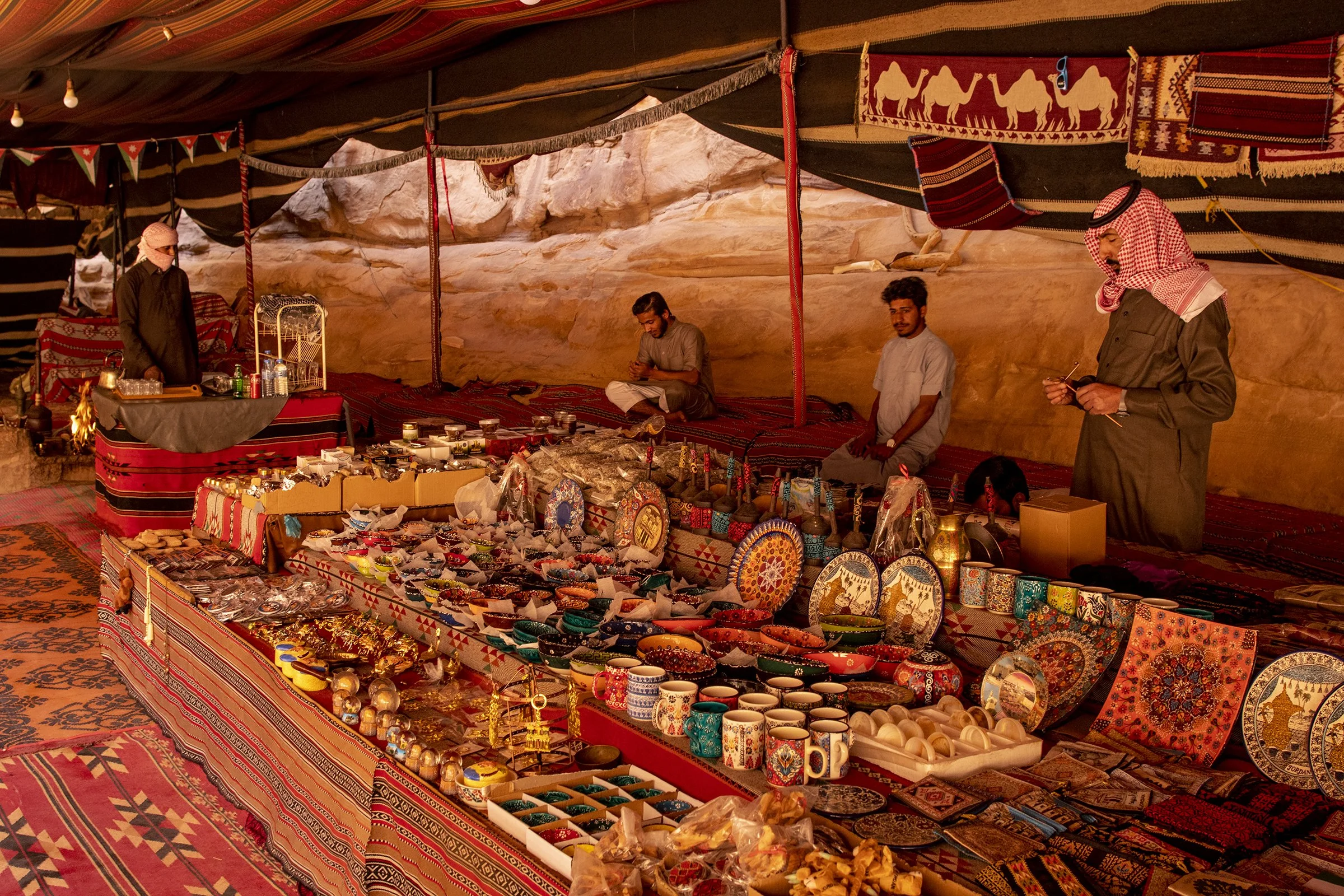
Bedouin tribesmen running a tent and resting site where souvenirs are sold to tourists in Wadi Rum.
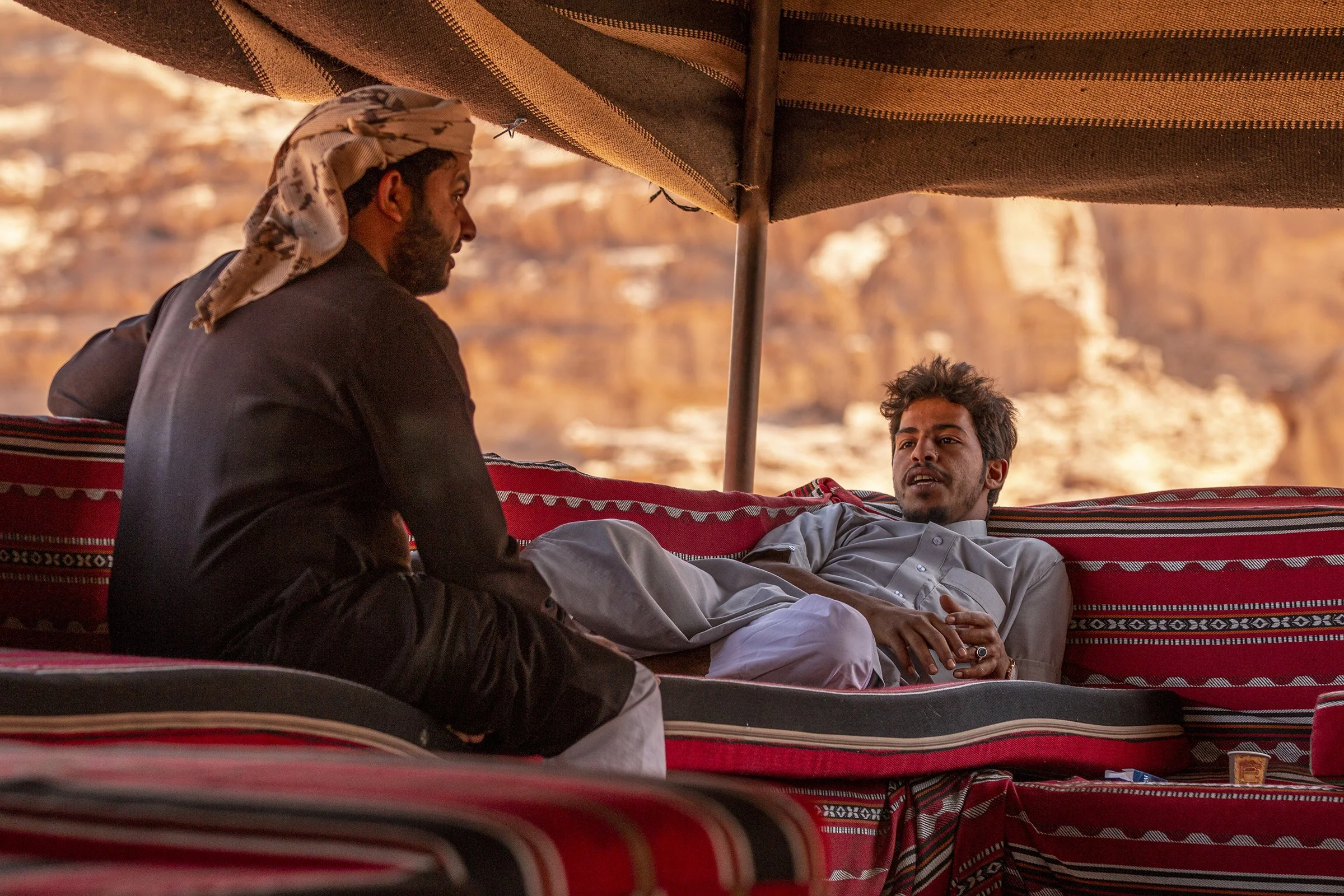
24-year-old Bedouin tribesman Mahmoad Zawayedah, right, resting inside a tent after leading a jeep tour through Wadi Rum. Zawayedah said he has lived in Wadi Rum his entire life.
A Bedouin tribesman rides a camel through Wadi Rum while making a call on his smartphone.
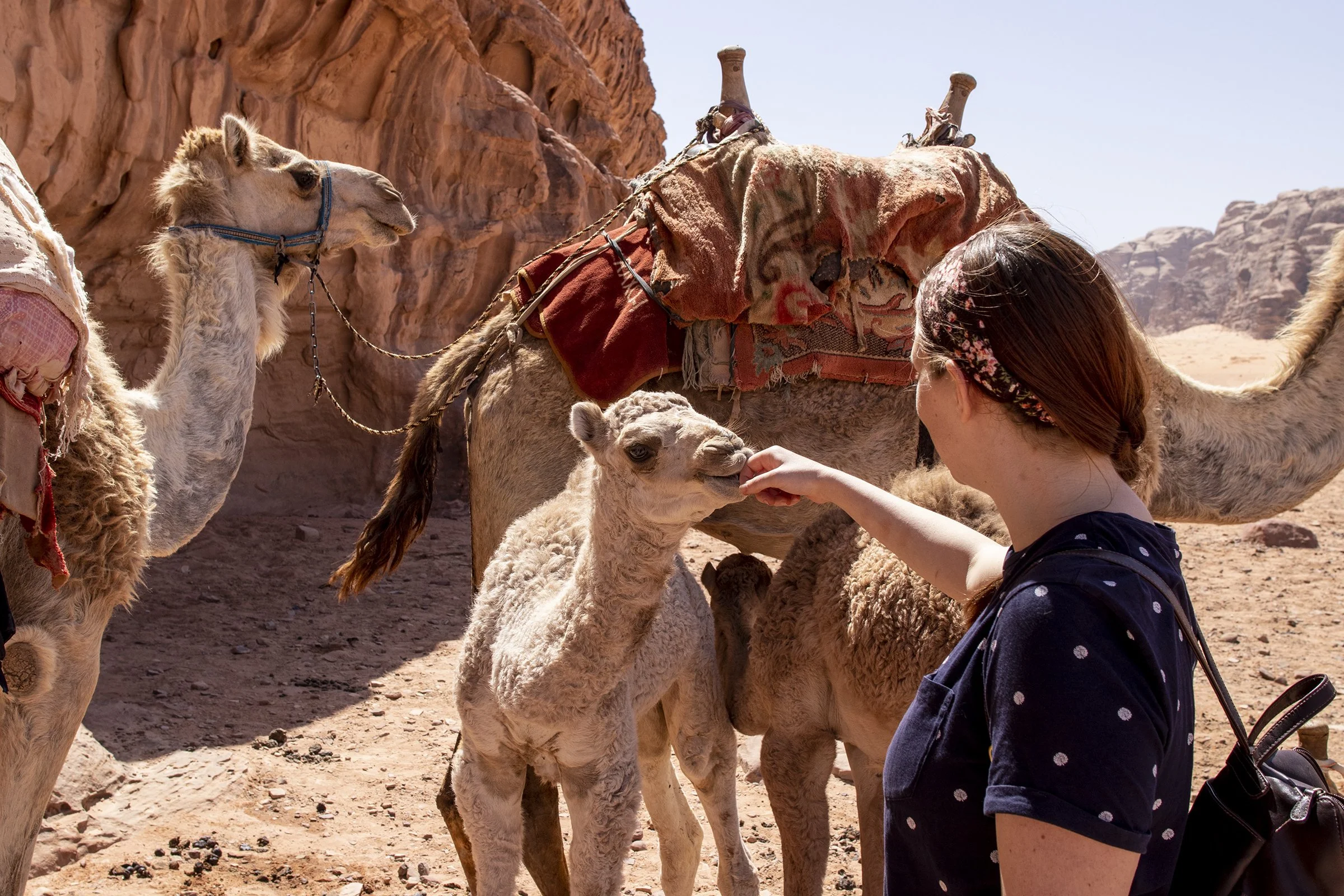
A baby camel nibbles at the hand of a woman at a resting site in Wadi Rum.
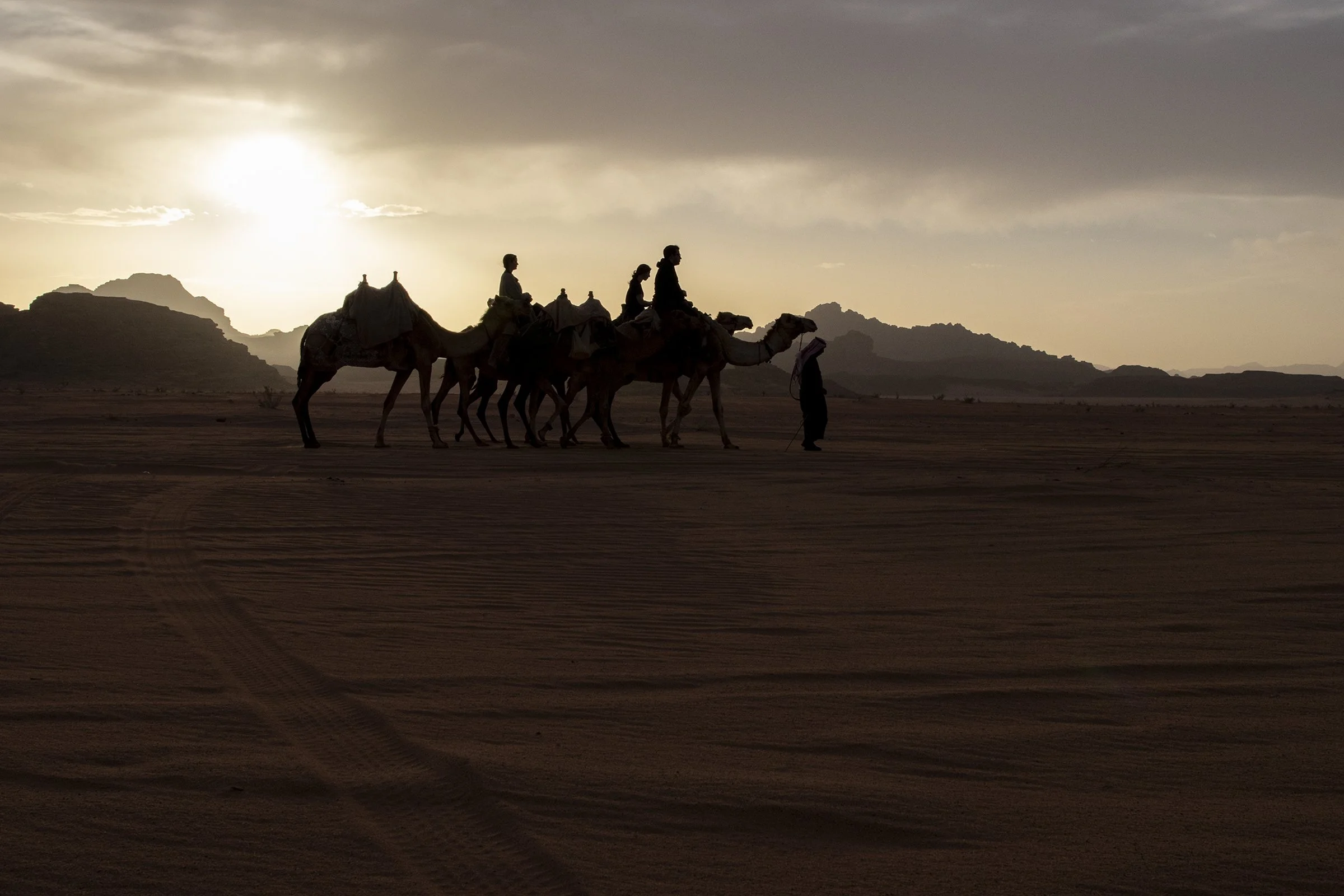
A tourist group riding camels lead by Bedouin tribesman Nayef at sunset in Wadi Rum.